St. Vitus Cathedral
Prague, Czech Republic
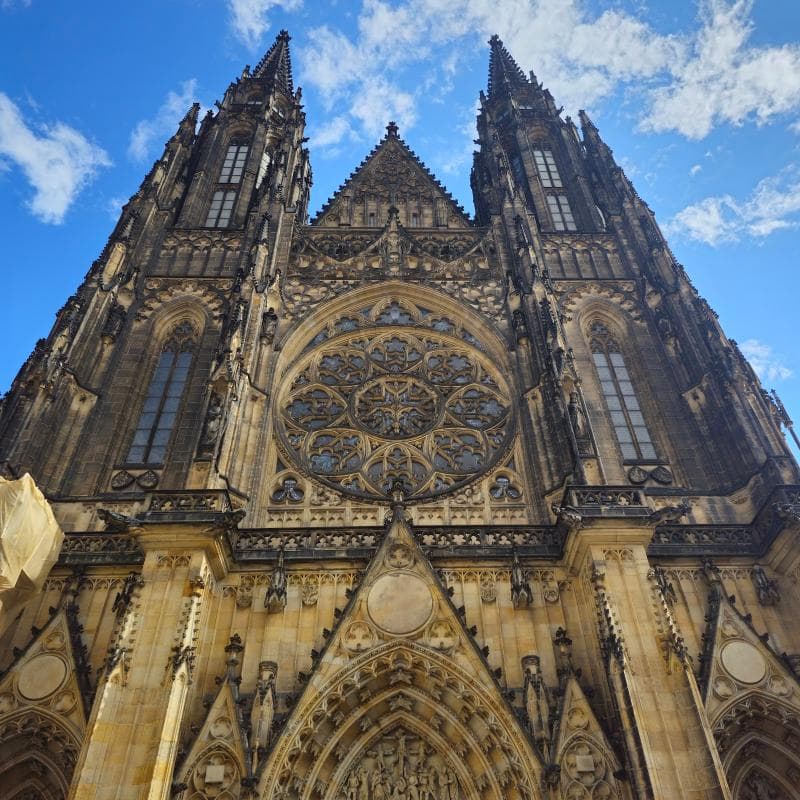
Discover St. Vitus Cathedral in Prague, Czech Republic, a Gothic masterpiece within Prague Castle. Explore its history, stunning architecture, royal tombs, and vibrant stained glass.
Overview
St. Vitus Cathedral, formally known as the Metropolitan Cathedral of Saints Vitus, Wenceslaus and Adalbert, stands as the paramount religious edifice within the Czech Republic and the dominant feature of the Prague Castle complex. This magnificent Gothic masterpiece is not merely a church but a spiritual symbol deeply interwoven with the Czech state's identity. Its towering spires and intricate facade are instantly recognizable, defining Prague's iconic skyline. Begun in the mid-14th century, its construction spanned nearly 600 years, making it a living testament to centuries of architectural evolution and cultural endurance.
History & Cultural Background
The history of St. Vitus Cathedral reaches back to the 10th century, with its origins as a Romanesque rotunda founded by Prince Wenceslas around 925. This humble beginning evolved into a larger Romanesque basilica after 1060. The cornerstone for the current Gothic cathedral was laid in 1344 by Charles IV, then King of Bohemia and future Holy Roman Emperor. His vision for the cathedral was grand: a coronation church, a family crypt, a treasury for precious relics, and a revered pilgrimage site dedicated to the patron saint Wenceslas.
The initial designs, influenced by French Gothic traditions, were overseen by Matthias of Arras, followed by the highly influential Peter Parler, who introduced a distinctive Late Gothic style that would significantly impact Central European architecture. Construction, however, was a protracted affair, punctuated by historical events such as the Hussite Wars in the 15th century, which brought work to a standstill for centuries. It was not until 1929 that the cathedral was finally completed, fulfilling Charles IV's centuries-old dream.
Throughout its long history, St. Vitus Cathedral served as the setting for coronations, weddings, and funerals of Bohemian kings and emperors. It is the final resting place for numerous patron saints, sovereigns, noblemen, and archbishops, including several Bohemian monarchs and Holy Roman Emperors, whose tombs lie within its sacred walls.
What Makes It Special
The cathedral is a quintessential example of Gothic architecture, characterized by its soaring pointed arches, intricate ribbed vaults, and impressive flying buttresses. Peter Parler's innovative net vaults, in particular, were highly influential, shaping the Late Gothic style across Central Europe. Inside, the St. Wenceslas Chapel stands out as a cult center, adorned with magnificent frescoes and semi-precious stones, guarding the tomb of Saint Wenceslas himself.
Adjacent to this chapel is the heavily guarded Crown Chamber, which houses the Bohemian Coronation Jewels, secured by seven locks, each requiring a key held by a different official. The ceremonial Golden Portal, featuring a stunning mosaic of the Last Judgment, serves as a grand entrance. Visitors can ascend the Great South Tower, which rises over 90 meters, to witness the massive Zikmund bell, the largest in Czechia, and enjoy panoramic views of Prague after climbing its 287 steps.
The cathedral's vibrant stained-glass windows are another highlight, including remarkable Art Nouveau pieces designed by Alfons Mucha, and the beautiful Cyril and Methodius window, alongside the Rose Window. Beneath the main altar, the Royal Mausoleum and Royal Crypt serve as the solemn resting places for generations of Bohemian royalty. The Prague Cathedral Treasury further enriches the cathedral's significance, boasting over 400 pieces, including the historic sword of St. Wenceslas.
Stories, Fun Facts & Local Details
Beyond its grand architecture, St. Vitus Cathedral holds many fascinating details. Legend has it that Matthias of Arras and Peter Parler, the two principal architects, are interred within the Chapel of St. Mary Magdalene. Look closely, and you might spot the 'Devil's Stone' near one of the entrances, a grotesque figure that locals believe wards off evil spirits. Similarly, numerous hidden gargoyles, intended both as decorative elements and functional rain spouts, are tucked away in less visible corners.
Alfons Mucha's renowned stained-glass windows are not just beautiful; they subtly weave in symbolism and references to Czech history and folklore, often missed by the casual observer. The sheer scale of the cathedral is impressive, with a length of 124 meters, a width of 60 meters, and its main tower reaching over 90 meters into the sky. The long construction period means the cathedral incorporates a blend of architectural styles, though Gothic dominates, showcasing the continuous evolution of design through the centuries.
Visitor Perspective
Visiting St. Vitus Cathedral offers an immersive journey through history and art. Located prominently within the Prague Castle complex, it's easily accessible by public transport, with trams 22 and 23 stopping conveniently nearby at 'Pražský hrad.' To fully experience its grandeur, a ticket is required, as the cathedral forms part of the Prague Castle's Main Visitor Route. A separate ticket allows visitors to climb the Great South Tower for unparalleled city views.
For a more tranquil experience, planning your visit for early morning or late afternoon, especially on weekdays, is recommended to avoid the busiest crowds. While a free section was once available, it is currently closed due to construction, meaning a ticket is now essential to appreciate the architectural and historical wonders within. Audio guides are often available, providing deeper insights into the cathedral's rich narrative and detailed artistry.
Coordinates: 14.420692, 50.087437
View on Google Maps💬 How Travelers Describe This Place
Based on community votes
Interesting
996Must See
658Unique
585Photogenic
143Beautiful
69
Traveler Stories
Discover memorable experiences shared by travelers who have visited this place.
No traveler stories yet.
Be the first traveler to share what made this place memorable.
Things to see at St. Vitus Cathedral



Tour
By
Spot
Discover amazing places around the world. Your journey starts here.
Explore
© 2026 TourBySpot. All rights reserved.