St. Wenceslas Chapel
Prague, Czech Republic
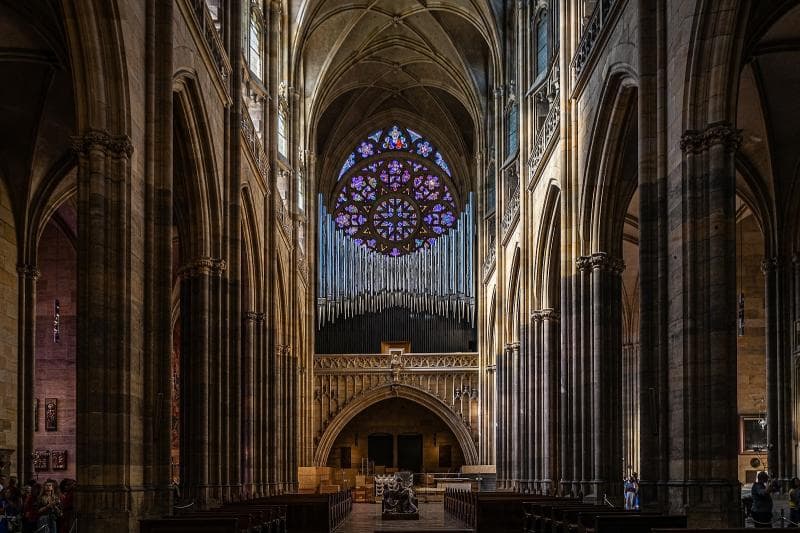
Explore the resplendent St. Wenceslas Chapel inside St. Vitus Cathedral, Prague, Czech Republic. Discover its history, dazzling gem-adorned walls, and its role as the resting place of the Czech patron saint and guardian of the Crown Jewels.
Overview
Deep within the majestic St. Vitus Cathedral in Prague Castle lies the St. Wenceslas Chapel, a true masterpiece of Bohemian Gothic art and a site of profound historical and spiritual significance. Dedicated to St. Wenceslas, the revered patron saint of the Czech lands, this chapel is often considered the heart of the cathedral. Its distinctive architecture and lavish decoration set it apart, emphasizing its singular role as a focal point within the larger sacred space. While not fully accessible for entry, visitors can admire its splendor and absorb its rich history from the entrance, an experience that offers a unique glimpse into Czech heritage and faith.
History & Cultural Background
The history of the St. Wenceslas Chapel is deeply intertwined with the legacy of St. Wenceslas himself, a 10th-century Bohemian prince from the Premyslid dynasty who was assassinated by his own brother. His moral life and martyrdom transformed him into a symbol of Christianity and the Czech nation. The chapel stands on the very spot where a Romanesque rotunda once housed St. Wenceslas's original tomb.
Construction of the current Gothic chapel began in the 14th century under the patronage of Emperor Charles IV, a key figure in Czech history. Charles IV, who held St. Wenceslas in high esteem, enlisted his favorite architect, Petr Parler, to design this splendid chapel above the saint's grave. The chapel was conceived not just as a burial place but as a sacred space reflecting the vision of 'New Jerusalem' from St. John's Gospel. It quickly became the spiritual core of the nascent Gothic cathedral and played a crucial role in the kingdom's rituals, with all coronations of Bohemian kings commencing here as they prayed before the saint.
What Makes It Special
What truly sets the St. Wenceslas Chapel apart is its extraordinary and opulent decoration, which has remained largely unchanged for centuries. The lower sections of its walls are encrusted with more than 1,300 Bohemian semi-precious stones, including amethyst, jasper, agate, and lapis, with the joints between them covered in gold. This dazzling array of gems symbolizes both earthly virtue and divine eternity, reflecting medieval beliefs about color and truth.
Above this jeweled dado, ornate Gothic frescoes narrate scenes from St. Wenceslas's life and various biblical stories. These valuable paintings include a depiction of Christ's crucifixion above the altar, where Charles IV himself is immortalized. In the center of the chapel lies the beautifully decorated tomb of St. Wenceslas, housing the saint's holy relics. A lesser-known but significant feature is a small, locked door in the southwest corner of the chapel. This door leads to the Crown Chamber, the highly guarded vault where the priceless Bohemian Crown Jewels, the insignia of Czech kings, are kept.
Stories, Fun Facts & Local Details
The chapel is steeped in legend and cultural significance. One of the frescoes notably depicts a story from St. Wenceslas's legend where, late for an imperial assembly, he arrived accompanied by angels and a shining golden crucifix, prompting the emperor to offer him his own seat. It's said that night masses were historically held in the chapel during times of national peril for the Czech nation, underscoring its role as a spiritual protector. Even today, masses are still held there, albeit only on St. Wenceslas's Day (September 28th).
The Bohemian Crown Jewels, hidden behind that discreet door, are secured by seven locks, with each key held by a different high-ranking official, symbolizing the collective guardianship of the nation's heritage. This elaborate security measure highlights the immense value and importance of these regalia. The chapel's design, inspired by the 'New Jerusalem,' adds another layer of mystical significance, intended to protect and preserve the world.
Visitor Perspective
While direct entry into the St. Wenceslas Chapel is not permitted, visitors to St. Vitus Cathedral can experience its grandeur by observing it from the entrance. Standing at the threshold, one can gaze upon the incredible detail of the gem-encrusted walls and the vibrant Gothic frescoes. The atmosphere shifts upon approaching the chapel, with the light transforming and a palpable sense of history filling the air. It’s an opportunity to feel the reverence and understand why this space is considered the 'beating heart' of the cathedral. Taking time to appreciate the intricate artistry and the stories etched into its very fabric offers a profound connection to Czech history and spirituality.
Coordinates: 14.420692125267662, 50.08743720228142
View on Google Maps💬 How Travelers Describe This Place
Based on community votes
Unique
872Beautiful
846Interesting
684Photogenic
363Must See
87
Traveler Stories
Discover memorable experiences shared by travelers who have visited this place.
No traveler stories yet.
Be the first traveler to share what made this place memorable.

Tour
By
Spot
Discover amazing places around the world. Your journey starts here.
Explore
© 2026 TourBySpot. All rights reserved.