Nave
Prague, Czech Republic
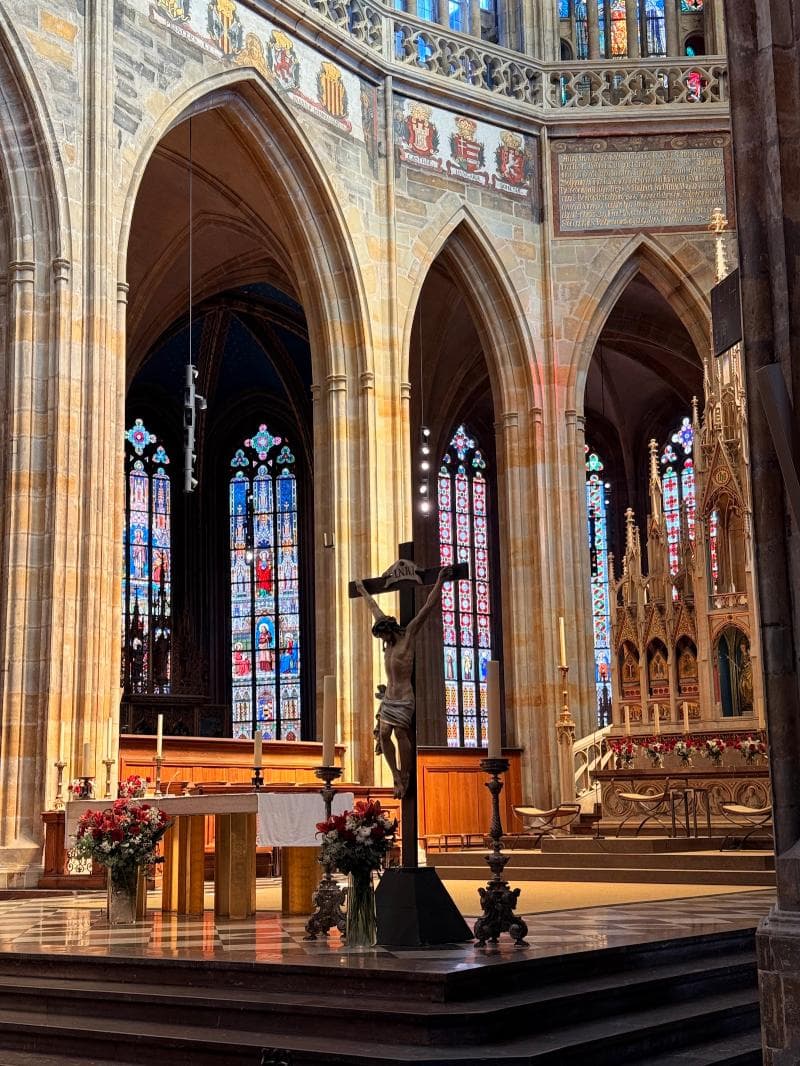
Explore the magnificent Nave of St. Vitus Cathedral in Prague, Czech Republic. Discover its Gothic architecture, rich history, and stunning stained glass.
Overview
The Nave of St. Vitus Cathedral in Prague, Czech Republic, stands as a monumental testament to Gothic architecture and a profound symbol of Czech national and spiritual identity. As the largest and most significant church in the country, the cathedral's nave immediately impresses visitors with its soaring verticality and intricate design. Spanning an impressive 124 meters in length and 33 meters in width, the central aisle, or nave, is the heart of this magnificent structure.
Walking down the nave, one is humbled by the grandeur of its scale and the masterful interplay of light and shadow filtering through its stained-glass windows. This space has historically served not only as a place of worship but also as the coronation site for Bohemian kings and queens, and the final resting place for numerous patron saints, sovereigns, noblemen, and archbishops.
History & Cultural Background
The history of St. Vitus Cathedral is a rich tapestry woven over centuries, beginning long before the current Gothic edifice. The site itself has been a place of worship since the 10th century, starting with a Romanesque rotunda founded by Prince Wenceslas around 925 AD. This rotunda was later replaced by a larger Romanesque basilica with three naves and two steeples.
The construction of the present-day Gothic cathedral began in 1344 under the patronage of Charles IV, who envisioned it as a grand coronation church, a family crypt, a treasury for precious relics, and a pilgrimage site for St. Wenceslas. The initial design was laid out by the French architect Matthias of Arras, known for his geometric precision and French Gothic style. Following his death, the visionary Peter Parler took over in 1356, introducing innovative elements such as the distinctive net vaulting, which would profoundly influence Late Gothic architecture across Central Europe.
However, the cathedral's construction faced numerous interruptions, notably during the Hussite Wars in the 15th century, leaving it incomplete for hundreds of years. It was not until the late 19th and early 20th centuries that a concerted effort led to its final completion in 1929, nearly 600 years after its foundation stone was laid.
What Makes It Special
The Nave of St. Vitus Cathedral is particularly distinguished by its architectural ingenuity and artistic splendor. Peter Parler's revolutionary net vaulting, a crisscrossing rib pattern across the ceiling, was a unique 14th-century design that creates a breathtaking sense of height and lightness.
The play of light within the nave is significantly enhanced by its exquisite stained-glass windows. Above the main entrance, the impressive Rose Window, installed in 1927, vividly depicts scenes from the Biblical story of creation. Along the north side, visitors can admire the iconic stained glass designed by the celebrated Art Nouveau artist Alfons Mucha, which portrays the lives of Saints Cyril and Methodius alongside St. Wenceslas and St. Ludmila, noted for its vibrant colors and sharp lines. In the south transept, Max Švabinský's 'Last Judgement' window is another striking feature.
The entrance through the western facade features massive bronze doors adorned with detailed reliefs, narrating the cathedral's history and the legends of St. Wenceslas and St. Adalbert. While not directly in the nave, the opulent Chapel of St. Wenceslas, located adjacent to the nave, is a focal point, housing the tomb of the patron saint and decorated with over 1,300 semi-precious stones and 14th-century paintings depicting the Passion of Christ. Beyond this chapel lie the Bohemian Coronation Jewels, and nearby, the Royal Mausoleum and Crypt contain the remains of many Bohemian kings and Holy Roman Emperors.
Stories, Fun Facts & Local Details
- The Enduring Legacy of St. Wenceslas: The initial rotunda on this site was dedicated to St. Vitus due to Prince Wenceslas acquiring a relic, the arm of St. Vitus. It's thought that Wenceslas chose St. Vitus partly because his name (Svatý Vít) resonated with the Slavic solar deity Svantevit, aiding Christian conversion. St. Wenceslas himself, famous from the Christmas carol 'Good King Wenceslas,' is Bohemia's patron saint and his memory is central to the cathedral's spiritual significance.
- St. Vitus, a Diverse Patron: Interestingly, St. Vitus is known as the patron saint of actors, entertainers, and dancers. He is also invoked for protection against lightning, dog bites, and even oversleeping.
- A Millennium in the Making: The construction of St. Vitus Cathedral truly spanned generations, with its final completion in 1929 marking nearly a thousand years since the first rotunda and almost 600 years for the Gothic structure itself.
- Art Nouveau Masterpiece: The inclusion of Alfons Mucha's distinctive Art Nouveau stained glass in the north part of the nave is a fascinating detail, showcasing a blend of centuries-old Gothic tradition with early 20th-century artistic innovation.
Visitor Perspective
Upon entering the Nave of St. Vitus Cathedral, visitors are encouraged to pause, take a seat, and truly absorb the immense scale, the intricate details, the vibrant colors, and the palpable sense of history. The sheer size can be overwhelming, but allowing time for reflection reveals the profound artistry and spiritual depth of the space. The cathedral, located within the sprawling Prague Castle complex, requires a circuit ticket for full access, which typically includes other significant castle buildings. While in the past a small part of the cathedral was freely accessible, this area is currently closed due to ongoing construction work. To experience the nave and its surrounding chapels with fewer crowds, visiting during the early morning or late afternoon hours is highly recommended. As you explore, remember you are walking through centuries of history, a place where art, faith, and power have converged to create an enduring masterpiece.
Coordinates: 14.420692125267662, 50.08743720228142
View on Google Maps💬 How Travelers Describe This Place
Based on community votes
Interesting
872Unique
846Photogenic
684Must See
121Beautiful
87
Traveler Stories
Discover memorable experiences shared by travelers who have visited this place.
No traveler stories yet.
Be the first traveler to share what made this place memorable.

Tour
By
Spot
Discover amazing places around the world. Your journey starts here.
Explore
© 2026 TourBySpot. All rights reserved.