Rose Window
Prague, Czech Republic
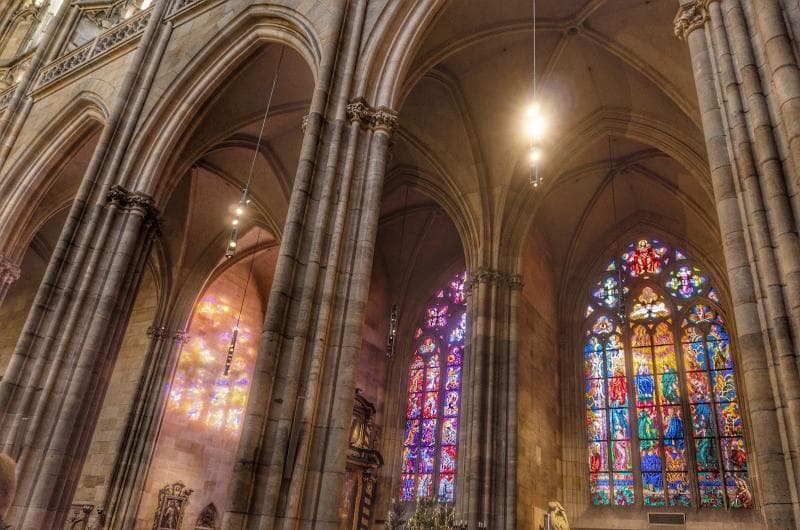
Discover the stunning Rose Window of St. Vitus Cathedral in Prague, Czech Republic. This masterpiece depicts the biblical Creation story in vibrant stained glass.
Overview
The Rose Window of St. Vitus Cathedral in Prague, Czech Republic, is a breathtaking masterpiece of stained glass art, captivating visitors with its vibrant colors and intricate narrative. Situated prominently on the cathedral's western facade, it serves as a radiant focal point upon entering this grand Gothic structure, which is itself nestled within the historic Prague Castle complex. The window, approximately 7 meters in diameter, depicts the biblical story of the Creation of the World, offering a profound visual sermon in light and glass. Crafted by the Czech artist František Kysela, this monumental work was completed between 1925 and 1927 and was a significant part of the cathedral's final consecration in 1929, bringing centuries of construction to a spectacular close. Comprising an astonishing 27,000 pieces of colored glass, it is a testament to both artistic vision and painstaking craftsmanship.
History & Cultural Background
St. Vitus Cathedral, a symbol of Czech statehood and faith, boasts a construction history spanning nearly six centuries. Initiated in 1344 under the patronage of Charles IV, its early architects, Matthias of Arras and Peter Parler, laid the foundations of this Gothic marvel. However, progress was often halted, leaving the cathedral unfinished for extended periods. The western facade, where the Rose Window now resides, was a later addition, developed during the 19th and 20th centuries as part of a Neo-Gothic completion effort. The stone tracery for the Rose Window had been conceived by Peter Parler's workshop in the 14th century, but it waited over 500 years for its glass to be installed. František Kysela's design for the Rose Window masterfully blended traditional medieval symbolism with the flowing lines and rich palettes characteristic of Art Nouveau, a prominent artistic movement of his era. This fusion allowed for a contemporary artistic interpretation within a historically profound architectural setting, culminating in a harmonious and culturally significant artwork.
What Makes It Special
What truly sets the St. Vitus Rose Window apart is its profound narrative and stunning visual impact. Unlike many rose windows that feature abstract designs or specific saints, Kysela's work visually interprets the first nine chapters of the Book of Genesis—the Creation story. Detailed inscriptions within the stained glass articulate this theme, with an outer circle describing 'in the beginning, God created the earth and the earth was empty. And deserted, darkness lay above the world, and the divine spirit floated above the world,' while an inner circle speaks of 'initially there was a word. The creation of angels.' Each petal of the enormous window symbolically represents a day of the week, depicting sequential parts of the creation. The central medallion is said to portray God the Creator, presiding over his universe. The sheer scale, combining 27,000 individual glass pieces, and the meticulous craftsmanship ensure that when sunlight pierces through, the cathedral's interior is bathed in an ethereal dance of rubies, sapphires, and gold, transforming the space into a vibrant canvas of divine light.
Stories, Fun Facts & Local Details
The Rose Window's journey to completion holds a compelling story. It was one of the final elements to be installed, culminating the cathedral's construction almost 600 years after its foundation stone was laid. This grand unveiling coincided with the cathedral's final consecration in 1929, a moment of immense national pride. While the Rose Window is Kysela's distinctive creation on the western facade, St. Vitus Cathedral is also home to other remarkable stained-glass windows, including those designed by the renowned Art Nouveau artist Alphonse Mucha. His celebrated work in the New Archbishop's Chapel, for instance, depicts St. Wenceslas and scenes from the lives of Slavic saints, showcasing the diverse artistic contributions to the cathedral over centuries. A fascinating detail reveals that during World War II, the Rose Window's panels were carefully dismantled and safeguarded in rural monasteries to prevent their destruction or confiscation by the Nazis. Remarkably, the glass returned intact after the war, a 'rare miracle of survival,' with its original panes and Bohemian sand-and-mineral hues preserved.
Visitor Perspective
Experiencing the Rose Window is an essential part of any visit to St. Vitus Cathedral. For the most dramatic effect, travelers are often advised to visit in the late afternoon when the setting sun illuminates the western facade, causing the glass to erupt in a spectacular cascade of colors that flood the entire nave. Standing just inside the main doors and gazing upwards, visitors can witness the window hovering 'like a living mandala,' its colors seemingly breathing and shifting with the light. Alternatively, a morning visit offers a different perspective, with cooler tones of light revealing the intricate sculptural tracery more clearly. The window is not merely a decorative element; it is an immersive theological experience, making the 'light visible' and consecrating the space with its cosmic bloom. Its placement ensures it anchors the cathedral's overall geometry, and on clear days, its reflected hues can even be seen faintly spilling onto other buildings within the Prague Castle complex, coloring the entire city with its ancient story.
Coordinates: 14.40056, 50.09083
View on Google Maps💬 How Travelers Describe This Place
Based on community votes
Photogenic
996Must See
953Beautiful
658Interesting
585Unique
69
Traveler Stories
Discover memorable experiences shared by travelers who have visited this place.
No traveler stories yet.
Be the first traveler to share what made this place memorable.

Tour
By
Spot
Discover amazing places around the world. Your journey starts here.
Explore
© 2026 TourBySpot. All rights reserved.