Potemkin Stairs
Odessa, Ukraine
Discover the iconic Potemkin Stairs in Odesa, Ukraine. Explore its history, famous optical illusion, and cinematic legacy from 'Battleship Potemkin'.
Overview
The Potemkin Stairs, officially known as the Prymorski Stairs, are an iconic landmark nestled in the heart of Odesa, Ukraine. Rising majestically from the Black Sea port, this monumental stairway serves as a grand formal entrance to the city, connecting the bustling harbor with the elegant Primorsky Boulevard above. It is not merely a set of steps but a powerful symbol of Odesa's history, culture, and architectural ingenuity. Consisting of 192 steps and stretching 142 meters in length, the stairs are renowned for their remarkable optical illusion, making them appear endless from below and uniformly wide from above.
History & Cultural Background
The origins of the Potemkin Stairs date back to the early 19th century when Odesa, perched on a high steppe plateau, urgently needed direct access to its growing port below. Before their construction, only winding paths and crude wooden stairs offered a connection. The decision to build a 'monstrous staircase' was made in 1837, commissioned by Prince Mikhail Semyonovich Vorontsov, the regional governor-general, as a gift to his wife and to garner local elite support. Designed by Italian architect Francesco Boffo, with contributions from St. Petersburg architects Avraam Melnikov and Pot'e, the stairs were constructed between 1837 and 1841. Originally, the staircase comprised 200 steps, crafted from greenish-grey sandstone imported from the Austrian port of Trieste. However, an 1866 construction of Primorsky Street and a 1933 renovation, which replaced the sandstone with rose-grey granite and covered landings with asphalt, reduced the number to the current 192 steps, distributed across ten landings.
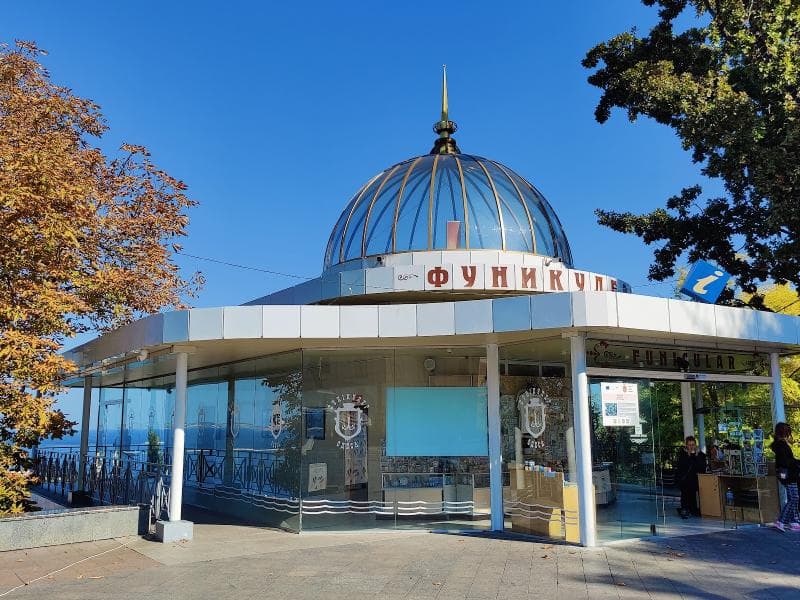
Over its lifetime, the stairs have borne several names, including the Boulevard Steps, the Giant Staircase, and the Richelieu Steps. It was in 1955, during the Soviet era, that they were officially renamed the Potemkin Stairs to commemorate the 50th anniversary of the mutiny on the battleship Potemkin. Following Ukraine's independence in 1991, the historical name 'Prymorski Stairs' was reinstated, though they are still widely known by their Soviet-era moniker due to their cinematic fame. A funicular railway, built in 1906 and modernized in 2005, runs alongside the stairs, providing an alternative for those preferring not to climb.
What Makes It Special
The true genius of the Potemkin Stairs lies in their architectural design and the optical illusion they create. The stairs are significantly wider at the base (21.7 meters) than at the top (12.5 meters), and they extend for 142 meters, rising 27 meters in height. This clever tapering ensures that when viewed from the top, only the landings are visible, creating the impression of a uniform, flowing descent. Conversely, when observed from the bottom, only the steps are visible, making the staircase appear much longer and more imposing than it truly is, seemingly stretching endlessly towards the sky. This intentional perspective manipulation was a remarkable feat of 19th-century engineering and design, solidifying its place as an architectural masterpiece and a 'monumental Classicist structure.'
Stories, Fun Facts & Local Details
The Potemkin Stairs gained worldwide renown thanks to Sergei Eisenstein's 1925 silent film, 'Battleship Potemkin.' The movie features a dramatic, albeit fictionalized, scene depicting a massacre of civilians by Tsarist soldiers on the steps, including the iconic image of a baby carriage careening down the staircase. This powerful sequence, a masterclass in montage editing, became one of cinema's most famous and influential moments, inspiring countless homages in other films. The film's impact was so profound that it led to the stairs' renaming during the Soviet era.
Beyond cinematic fame, the stairs are steeped in local lore. Legends whisper of underground passages leading to the Vorontsov Palace or hidden treasures of smugglers beneath its arches. Odesa's residents often infuse their unique humor into traditions surrounding the stairs, such as annual marathons where athletes race to the top. The legendary Odesa athlete Sergey Utochkin even made his mark by descending the stairs on cars, motorcycles, and bicycles. In 2015, the European Film Academy honored the Potemkin Stairs with the title 'The Treasure of European Cinema Culture,' acknowledging their immense cultural significance. After being closed for security reasons since the beginning of the full-scale war in Ukraine, the Potemkin Stairs, along with other key city sites, have gradually reopened to the public in 2024, inviting visitors once more to experience this historic landmark.
Visitor Perspective
Experiencing the Potemkin Stairs offers more than just a physical climb; it's a journey through Odesa's soul. For the active traveler, walking all 192 steps provides a unique perspective – witnessing the clever optical illusion firsthand as you ascend or descend. At the summit, you're greeted by the Monument to Duke de Richelieu, Odesa's first governor, and sweeping panoramic views of the Marine Terminal and the vast Gulf of Odesa. The surrounding Primorsky Boulevard is a vibrant area, perfect for a stroll, with historic buildings, statues, and cafes. For a more relaxed ascent or descent, the modern funicular offers a convenient and scenic ride alongside the steps. Whether you choose to walk or ride, the Potemkin Stairs serve as an ideal starting point for exploring the rich history and vibrant culture of this captivating Black Sea city.
Coordinates: 30.74333, 46.48917
View on Google Maps💬 How Travelers Describe This Place
Based on community votes
Unique
680Interesting
588Photogenic
566Beautiful
432Must See
316
Traveler Stories
Discover memorable experiences shared by travelers who have visited this place.
No traveler stories yet.
Be the first traveler to share what made this place memorable.
Things to see at Potemkin Stairs



Tour
By
Spot
Discover amazing places around the world. Your journey starts here.
Explore
© 2026 TourBySpot. All rights reserved.