Funicular Station
Odessa, Ukraine
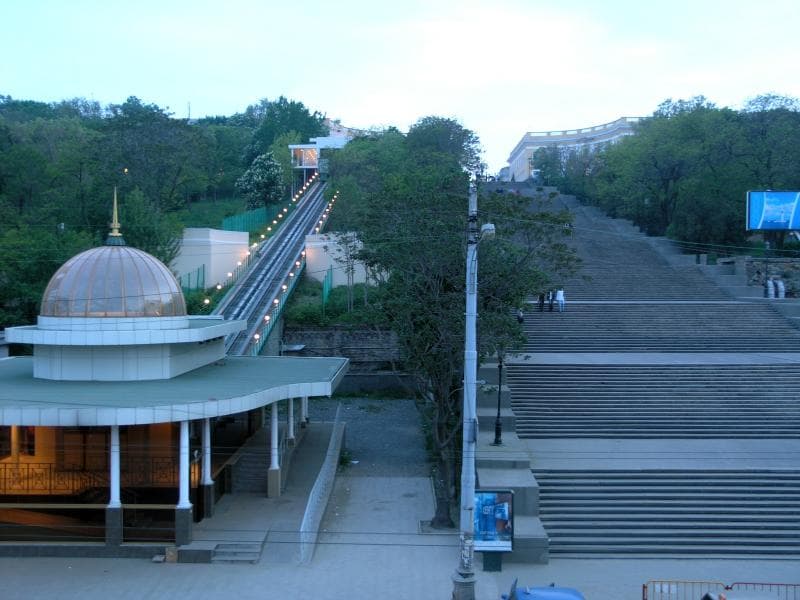
Discover the Funicular Station at Potemkin Stairs in Odessa, Ukraine. Learn its history, from 1902 to its modern inclined elevator form, offering scenic views.
Overview
Nestled alongside Odessa's world-renowned Potemkin Stairs, the Funicular Station offers a unique and practical way to navigate the city's dramatic incline, connecting Primorsky Boulevard at the top with Primorskaya Street and the bustling Port of Odessa below. While officially known today as an inclined elevator system, it continues to be affectionately referred to as the funicular by locals and visitors alike. This vital link provides an effortless journey up or down, offering a respite from the 192 steps of its famous neighbor and a chance to admire the architectural grandeur of the Potemkin Stairs from a different perspective.
The current system, which resumed operation in 2005, features two independent cabins that transport passengers efficiently along the steep slope. It serves not only as a tourist attraction but also as an indispensable part of daily life for Odessans, facilitating movement between the upper city and the port area.
History & Cultural Background
The story of the funicular in Odessa is one of innovation, change, and resilience. The original funicular, known then as a 'Lift Electric Machine,' was first constructed in 1902. Designed by engineer M. Pyatnytsky, this pioneering system was the first of its kind in Ukraine. It featured two elegant carriages, imported from Paris, each capable of carrying up to 35 passengers. These cars operated on a single track with a passing loop, with one car descending to help pull the other upwards, reflecting a clever early 20th-century engineering solution.
For several decades, the funicular served as a beloved and efficient mode of transport. However, its era came to an end in 1970 when city authorities opted to replace it with a more modern escalator system. This escalator, while initially progressive, eventually succumbed to the ravages of time and lack of maintenance after the collapse of the USSR, ultimately closing its doors in 1997. Recognizing the importance of this historical connection between the city and its port, a decision was made to restore the funicular. After years of planning and construction, a new inclined elevator system, closely mimicking the original funicular's purpose, was inaugurated in September 2005.
What Makes It Special
What truly sets the Funicular Station apart is its symbiotic relationship with the Potemkin Stairs. While the stairs are an iconic architectural masterpiece, known for their unique optical illusion where only the steps are visible from below and only the landings from above, the funicular offers a complementary experience. It allows visitors to appreciate the scale and design of the stairs without the physical exertion, making the landmark accessible to everyone.
The ride itself provides panoramic views of the port and the Black Sea, framed by the historic urban landscape of Odessa. It represents a continuous thread of ingenious engineering solutions applied to overcome the city's topography, adapting through different eras to maintain this crucial link between the seafront and the boulevard above. The modern system, although technically an inclined lift, captures the spirit of its predecessor, ensuring that this historical passage remains vibrant.
Stories, Fun Facts & Local Details
The original funicular held a special charm. It was built with carriages sourced from Paris, and its cables were manufactured locally at an Odessa rope factory, a testament to international collaboration and local industry. Interestingly, the descent in the original funicular was cheaper than the ascent (2 kopecks vs. 3 kopecks), perhaps reflecting the mechanics where the descending car aided the ascent of the other.
The transition from a true funicular to an escalator, and then to the current inclined elevator, tells a broader story of Odessa's urban development and its efforts to preserve its heritage while embracing modern solutions. Many older Odessans fondly recall the charm of the original funicular. While the modern cabins are smaller, holding about 12 people compared to the original 35, the sentiment attached to this unique form of transport remains strong.
Visitor Perspective
For visitors, the funicular offers a convenient and pleasant journey lasting approximately 3.5 minutes for its 130-meter length. It's an ideal choice for those who wish to conserve energy, have mobility challenges, or are simply curious to experience this historical mode of transport. The ride provides a moment of calm, allowing passengers to take in the views of the sea port, the harbor, and the endless expanses of the Gulf of Odessa.
Operating daily during daylight hours (weather permitting), the funicular is an accessible and affordable way to transition between the two levels of the city. While it's recommended to check the current schedule on-site, it typically offers extended hours. Experiencing the funicular is more than just a ride; it's an opportunity to connect with the city's past, observe daily life, and appreciate the creative engineering that has shaped Odessa's unique landscape for over a century.
Coordinates: 30.74219, 46.48839
View on Google Maps💬 How Travelers Describe This Place
Based on community votes
Beautiful
954Unique
514Photogenic
316Interesting
196Must See
66
Traveler Stories
Discover memorable experiences shared by travelers who have visited this place.
No traveler stories yet.
Be the first traveler to share what made this place memorable.

Tour
By
Spot
Discover amazing places around the world. Your journey starts here.
Explore
© 2026 TourBySpot. All rights reserved.