Stair Terraces
Odessa, Ukraine
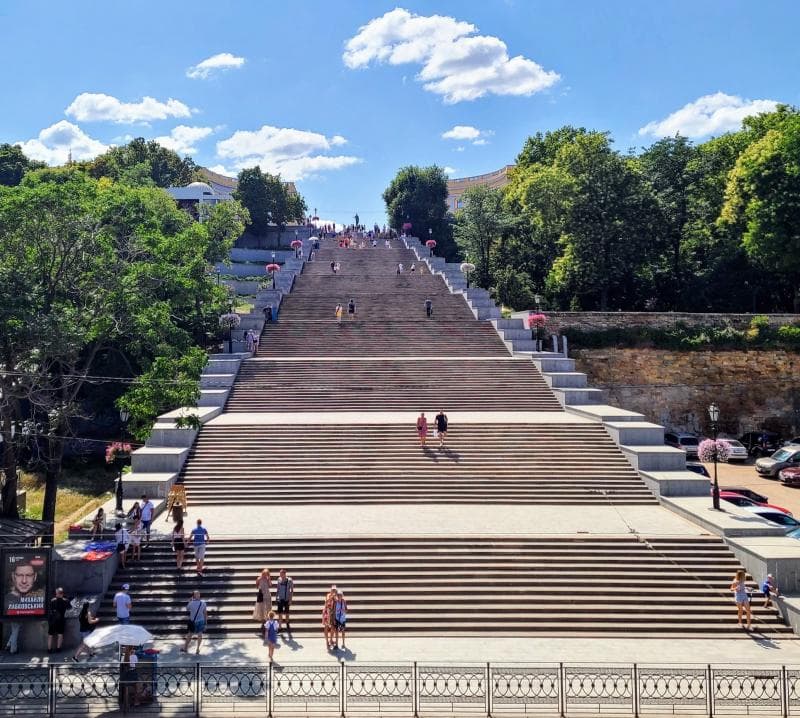
Explore the unique Stair Terraces of Potemkin Stairs in Odessa, Ukraine. Discover the history, optical illusion, and cinematic fame of this iconic landmark.
Overview
Nestled in the vibrant heart of Odessa, Ukraine, the Potemkin Stairs stand as an iconic architectural marvel, famously connecting the city's elevated historic center with its bustling Black Sea port. While colloquially referred to as the Potemkin Stairs, their official designation is the Prymorski Stairs, a name that echoes their prime location overlooking the sea. Within this grand edifice, the concept of 'Stair Terraces' emerges from the ingenious design featuring distinct landings that break the monumental ascent into visually engaging segments. These terraces are not merely functional breaks but integral components of the stairs' renowned optical illusion, transforming a climb into a journey through perspective and history. With 192 steps divided into ten flights by these strategic landings, the Potemkin Stairs offer breathtaking panoramic views of the Gulf of Odessa, serving as a formal gateway to the city from the sea.
Completed in 1841, this magnificent structure is more than just a staircase; it is a symbol of Odessa's rich heritage and a testament to 19th-century engineering and aesthetic prowess. For visitors, traversing these stairs—whether climbing the continuous cascade of steps visible from below or descending past the seemingly endless landings from above—is an immersive experience. A funicular operates alongside, offering a convenient alternative for those who wish to conserve their energy while still soaking in the splendid scenery.
History & Cultural Background
The genesis of the Potemkin Stairs dates back to the early 19th century when Odessa, perched on a high plateau, desperately needed a direct and grand connection to its burgeoning harbor. Before this grand construction, access to the port was limited to winding paths and rudimentary wooden stairs. The decision to build a 'monstrous staircase' was made in 1837, commissioned by Prince Mikhail Semyonovich Vorontsov, the regional governor-general, as a gift to his wife and to solidify support among the local elite.
Designed by Swiss architect Francesco Boffo, alongside St. Petersburg architects Avraam Melnikov and Pot'e, with construction supervised by English engineer John Upton, the stairs were initially built with 200 steps and ten landings. The original material was greenish-grey sandstone sourced from Trieste. Over the years, particularly during a 1933 renovation, eight of the lower steps were lost due to port expansion and street construction, bringing the count to the current 192 steps. The original sandstone was also replaced with durable rose-grey granite, and the landings were covered with asphalt.
Initially known by various names such as the Boulevard Steps, Giant Staircase, or Richelieu Steps, the stairs gained international fame and their enduring popular name, Potemkin Stairs, after their dramatic depiction in Sergei Eisenstein's 1925 silent film, 'Battleship Potemkin.' While the film's iconic massacre scene was a fictionalized account, it indelibly linked the staircase to revolutionary fervor and cinematic history. In 1955, during the Soviet era, the name was formally changed to honor the 50th anniversary of the mutiny. Although its historic name, Prymorski Stairs, was reinstated after Ukrainian independence, the cinematic legacy ensures its common reference as the Potemkin Stairs.
What Makes It Special
What truly sets the Potemkin Stairs apart, particularly its terraced design, is the masterful optical illusion it creates. From the bottom, looking up, the stairs appear as an unbroken cascade, an endless ascent stretching towards the sky. This is because the strategically placed landings are hidden from view. Conversely, when viewed from the top, only the spacious, uniform landings are visible, making the descent seem shorter and less steep than it truly is.
This architectural trickery is achieved by the varying widths of the staircase: the top step measures 12.5 meters (41 feet) wide, while the lowest step expands to 21.7 meters (71 feet) wide. This tapering design, combined with the intervals created by the terraces, plays wonderfully with human perception, making the 142-meter (466-foot) length feel different depending on your vantage point. It's an engineering marvel that continues to captivate and mystify visitors, offering a unique visual experience every time.
Stories, Fun Facts & Local Details
Beyond its grand appearance, the Potemkin Stairs are steeped in local lore and cinematic legend. The most famous story, of course, is its immortalization in Eisenstein's 'Battleship Potemkin,' particularly the emotionally charged baby carriage scene which, though fictional, cemented the stairs' place in global culture. This cinematic association makes many visitors feel as if they are stepping onto a movie set.
Locally, the stairs have inspired a unique tradition: an annual marathon where participants race up the 192 steps, with impressive records like 22.8 seconds. Legends also whisper of hidden underground passages beneath the stairs, rumored to lead to Vorontsov Palace or conceal smugglers' treasures, including those of the legendary bandit Mishka Yaponchik. At the very top, visitors are greeted by the monument to Duke de Richelieu, Odessa's first mayor, a significant figure in the city's early prosperity and growth.
Visitor Perspective
For any curious traveler, the Potemkin Stairs offer a multifaceted experience. The ascent or descent provides not only a physical challenge but also a journey through history and art. Standing at the top, beside the Duke de Richelieu monument, you are treated to an expansive vista of the port and the Black Sea, a view that underscores the stairs' role as a grand maritime entrance. The strategically placed terraces offer natural resting points and opportunities to pause and appreciate the changing perspectives and the intricate design that makes the stairs seem to shift before your eyes.
Many choose to walk the entire length, savoring the architectural genius and the cultural weight of each step. For those who prefer a less strenuous option, the funicular provides a charming and swift ride, mirroring the stairs' path. Whether you are a film buff, a history enthusiast, or simply a curious wanderer, exploring the terraced landscape of the Potemkin Stairs is an essential Odessa experience. It's a place where grand design meets cinematic drama, offering an unforgettable impression of this historic Ukrainian city.
Coordinates: 30.74333, 46.48917
View on Google Maps💬 How Travelers Describe This Place
Based on community votes
Beautiful
931Photogenic
670Interesting
655Must See
491Unique
266
Traveler Stories
Discover memorable experiences shared by travelers who have visited this place.
No traveler stories yet.
Be the first traveler to share what made this place memorable.

Tour
By
Spot
Discover amazing places around the world. Your journey starts here.
Explore
© 2026 TourBySpot. All rights reserved.