Palace Of The Shirvanshahs
Baku, Azerbaijan
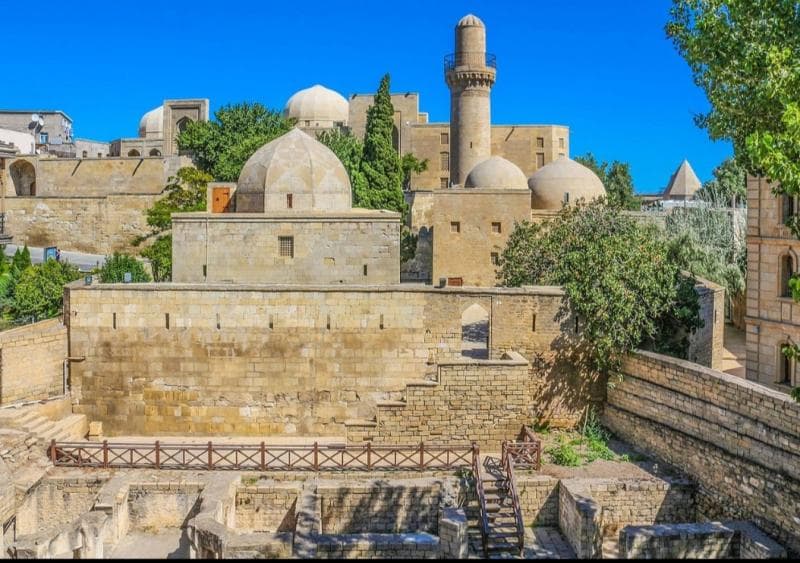
Explore the 15th-century Palace of the Shirvanshahs in Baku, Azerbaijan. A UNESCO World Heritage site, revealing centuries of history and unique architecture.
Overview
Nestled within the ancient walls of Icherisheher, Baku's Old City, stands the majestic Palace of the Shirvanshahs. This 15th-century architectural marvel, described by UNESCO as 'one of the pearls of Azerbaijan's architecture', offers a profound glimpse into the country's rich medieval past. More than just a palace, it is a grand ensemble of historical monuments, forming a UNESCO World Heritage site alongside the iconic Maiden Tower. The complex includes the main palace building, the Divanhane, royal burial vaults, a mosque with a minaret, the mausoleum of Seyid Yahya Bakuvi, the Eastern Portal (known as Murad's Gate), a reservoir, and the remnants of a historic bathhouse. Strategically situated on one of the highest points in the Old City, it served as the ultimate seat of power for the Shirvanshah rulers.
History & Cultural Background
The history of the Shirvanshahs, rulers of the region of Shirvan, spans centuries, with their state lasting from 861 AD. The original capital was Shamakhi, but following a devastating earthquake in the 12th century, the capital was officially moved to Baku. It was during the 15th century, approximately between 1411 and 1460, that the Palace of the Shirvanshahs complex began to take its impressive form. Construction was primarily initiated by Shirvanshah Ibrahim I and continued under his successor, Shirvanshah Khalilullah I, and his son Faruk. This period marked a significant cultural and economic revival for Shirvan.
Over its long history, the palace endured numerous conflicts and invasions, sustaining damage during the fierce Safavid-Ottoman wars and later from a Russian bombardment in 1723. Despite these challenges, its resilience allowed it to survive as a testament to Azerbaijani heritage. Following the 1917 revolution, efforts began to restore and preserve the complex. In 1964, it was officially designated a museum-reserve, and a significant milestone arrived in 2000 when, along with the Maiden Tower and the Walled City of Baku, it was inscribed on the UNESCO World Heritage List.
What Makes It Special
The Palace of the Shirvanshahs stands out for its unique blend of architectural grandeur and historical depth. It embodies the distinctive Shirvan-Absheron architectural school, characterized by a harmonious unity of scale, rhythm, and proportionality across its various structures, despite being built at different times. Crafted from local honey-colored limestone, the artistry lies in its intricate stonework, elegant proportions, and the captivating play of shadows throughout the courtyards.
This complex is not a single building but a collection of distinct monuments thoughtfully arranged on three different levels. Key components include the two-story main palace, the enigmatic octagonal Divanhane – debated by historians as either a ceremonial reception hall, a courtroom, or a place of worship – with its intricately carved portal, and the Shirvanshahs' family tomb, which features remarkable inscriptions. The ensemble also boasts a mosque with its slender minaret, the mausoleum of Seyid Yahya Bakuvi, the Eastern Portal (Murad Gate) added much later during Ottoman rule, and the atmospheric ruins of a bathhouse and cistern.
Stories, Fun Facts & Local Details
Legend has it that the palace complex was built upon a site once considered sacred, possibly the tomb of a Sufi saint, and some of its ancient wells were even believed to possess healing properties. The main palace building, with its irregular rectangular shape, originally housed 52 rooms; the lower floor, with 27 rooms, was designated for servants and storage, while the upper floor, with 25 rooms and wider windows, was reserved for the shah and his family.
An interesting anecdote surrounds Shirvanshah Farrukh Yasar, who, despite having a tomb prepared, was reportedly not buried there after being killed and burned in battle against Safavid troops in 1500-1501. The Eastern Portal, or Murad Gate, holds a unique inscription revealing the name of its architect, 'Great master Amirshah Valiankuhi', a detail that hints at the skilled artisans of the era. Inside the Shirvanshahs' family tomb, built by Khalilullah I for his mother and his 6-7 year old son in 1435-1436, a medallion above the entrance arch cryptically repeats the name 'Ali' 24 times, visible only with a mirror, showcasing a blend of architectural artistry and spiritual symbolism. Furthermore, during archaeological work, remnants of the submerged Bayil Fortress, known as Bayil Stones, with their unique inscriptions, were discovered and now adorn parts of the middle courtyard. Visitors today can experience medieval life through digital technology and animated miniatures displayed within the palace rooms, offering a dynamic glimpse into its storied past.
Visitor Perspective
Exploring the Palace of the Shirvanshahs is an immersive journey through time. Conveniently located in the heart of Baku's Old City, it is easily accessible by public transport; the Icherisheher metro station is just a short walk away, and several bus routes also serve the area. Most visitors find that allocating one to three hours allows ample time to wander through the complex and appreciate its intricate details.
The palace is best explored on foot, allowing you to discover its various courtyards and buildings at your own pace. While information plaques provide context, considering a guided tour or conducting some research beforehand can enrich your understanding of its profound history and cultural significance. From certain vantage points within the palace grounds, you can capture unique photographs that juxtapose the ancient architecture with Baku's modern skyline, including the distinctive Flame Towers. Bear in mind that direct parking is not available; visitors typically use paid parking facilities located outside the Old City walls.
Coordinates: 49.83343, 40.36605
View on Google Maps💬 How Travelers Describe This Place
Based on community votes
Unique
685Photogenic
472Beautiful
446Interesting
399Must See
33
Traveler Stories
Discover memorable experiences shared by travelers who have visited this place.
No traveler stories yet.
Be the first traveler to share what made this place memorable.
Things to see at Palace Of The Shirvanshahs



Tour
By
Spot
Discover amazing places around the world. Your journey starts here.
Explore
© 2026 TourBySpot. All rights reserved.