Courtyards
Baku, Azerbaijan
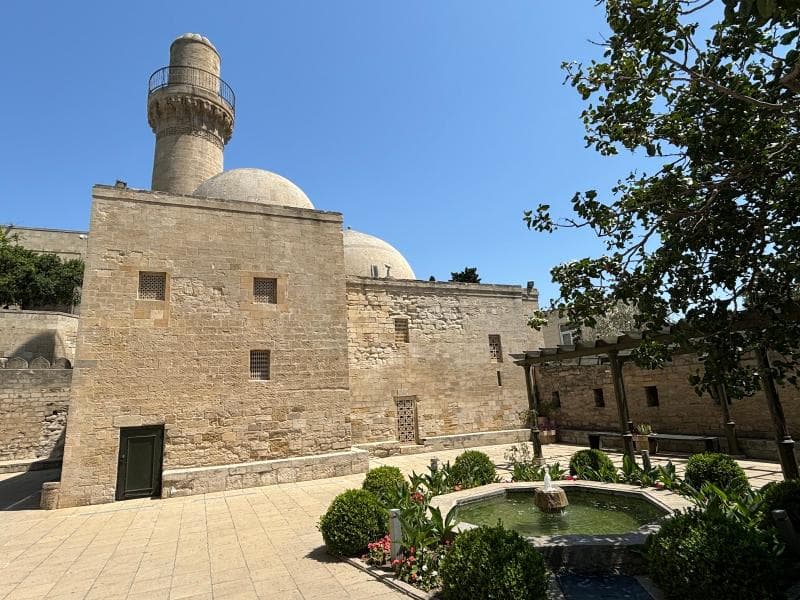
Explore the historic courtyards of the Palace of the Shirvanshahs in Baku, Azerbaijan. Discover its 15th-century royal history and unique architecture.
Overview
Nestled within the ancient walls of Baku's Old City, the Palace of the Shirvanshahs stands as a remarkable testament to Azerbaijan's rich history and architectural prowess. More than just a single structure, this 15th-century complex is an intricate ensemble of buildings, each with its own story, thoughtfully arranged across three distinct courtyards. This UNESCO World Heritage site offers visitors a profound journey into the heart of the Shirvanshah dynasty, whose legacy shaped this land for centuries.
The palace complex, described by UNESCO as 'one of the pearls of Azerbaijan's architecture', was originally built after the Shirvanshah capital relocated from Shemakha to Baku. Its strategic location on the highest point of the Old City provides not only a sense of historical significance but also offers captivating views of Baku and the Caspian Sea.
History & Cultural Background
The construction of the Palace of the Shirvanshahs began in the early 15th century under Shirvanshah Ibrahim I, following a devastating earthquake that prompted the relocation of the capital to Baku. The complex evolved over decades, with various structures added by successive Shirvanshah rulers, most notably Khalilullah I. This period marked a flourishing era for the Shirvanshah dynasty, who ruled this region for nearly 700 years, establishing a vibrant cultural and political center.
The palace's architecture reflects the distinctive Shirvan-Absheron school, characterized by its use of local limestone, intricate stone carvings, and a harmonious blend of Persian, Ottoman, and local Azerbaijani influences. The design of the courtyards, spread across three different levels due to the uneven terrain, showcases a deliberate and organic growth over time, yet maintains a striking artistic unity. Many historians believe the complex was built around the sacred tomb of Seyid Yahya Bakuvi, a revered Sufi saint and court scholar.
What Makes It Special
The courtyards of the Palace of the Shirvanshahs are not merely open spaces; they are integral components of the complex's narrative, each housing key structures that tell a part of the dynasty's life. The upper courtyard, for instance, features the main residential building of the palace, where the Shirvanshahs and their close circle resided, featuring wide windows that once offered views of their domain. The thoughtful arrangement ensures that despite being built over a long period, the entire ensemble exudes a striking completeness.
The middle courtyard is particularly notable for the Divanhane, an elegant octagonal pavilion, whose exact purpose remains a subject of historical debate—perhaps a courtroom, a council chamber, or even a mausoleum. This courtyard also holds the Dervish Mausoleum, believed to be the resting place of Seyid Yahya Bakuvi. A unique feature here are the stone slabs inscribed with ancient texts and images, remnants of the submerged Bayil Fortress, which once defended Baku's harbor.
The lowest courtyard is home to the Shirvanshahs' burial vault, the Royal Mosque with its minaret, and the Palace Bath. These elements highlight the intertwining of spiritual life, governance, and daily routines within the royal compound. The Palace Bath, like many in the Old City, was built partly underground to maintain a stable temperature, a clever design adaptation to the local climate.
Stories, Fun Facts & Local Details
Imagine the sounds that once filled these courtyards: the murmur of courtly discussions in the Divanhane, the call to prayer from the mosque's minaret, or perhaps the splashing of water in the royal bathhouse. The palace's story is one of resilience; it endured periods of foreign occupation, damage from bombardments, and subsequent restorations, each leaving its mark on the stones. One fascinating detail is the discovery of a 2.1-meter tall skeleton near the tomb in the lower courtyard, sparking local legends.
The construction materials themselves tell a story—the entire complex was built from local Badamdar limestone, chosen for its durability and aesthetic qualities. Look closely at the intricate carvings and geometric patterns, which are not just decorative but often carry symbolic meanings, reflecting the sophisticated artistic traditions of the era. The courtyards, though seemingly functional, were designed to reflect the Shirvanshahs' power and devotion, creating an atmosphere of quiet grandeur.
Visitor Perspective
As you wander through the courtyards of the Palace of the Shirvanshahs today, you are stepping onto ground walked by kings, scholars, and Sufi mystics. The serene ambiance offers a stark contrast to the bustling city just outside its walls. Take your time to appreciate the distinct character of each courtyard, noticing how they seamlessly connect different aspects of royal life, from governance to prayer and relaxation.
Visitors often describe the experience as stepping back in time, allowing for a deeper understanding of Azerbaijan's dynastic past and rich cultural heritage. The carefully preserved structures within these courtyards, from the residential quarters to the religious sites, collectively paint a vivid picture of a powerful medieval state. It is a place for quiet contemplation, a connection to a bygone era, and a journey through the architectural 'pearls' of Baku.
Coordinates: 49.833443, 40.366149
View on Google Maps💬 How Travelers Describe This Place
Based on community votes
Interesting
953Beautiful
695Photogenic
658Must See
396Unique
22
Traveler Stories
Discover memorable experiences shared by travelers who have visited this place.
No traveler stories yet.
Be the first traveler to share what made this place memorable.

Tour
By
Spot
Discover amazing places around the world. Your journey starts here.
Explore
© 2026 TourBySpot. All rights reserved.