Gazi Husrev-beg Mosque
Sarajevo, Bosnia and Herzegovina
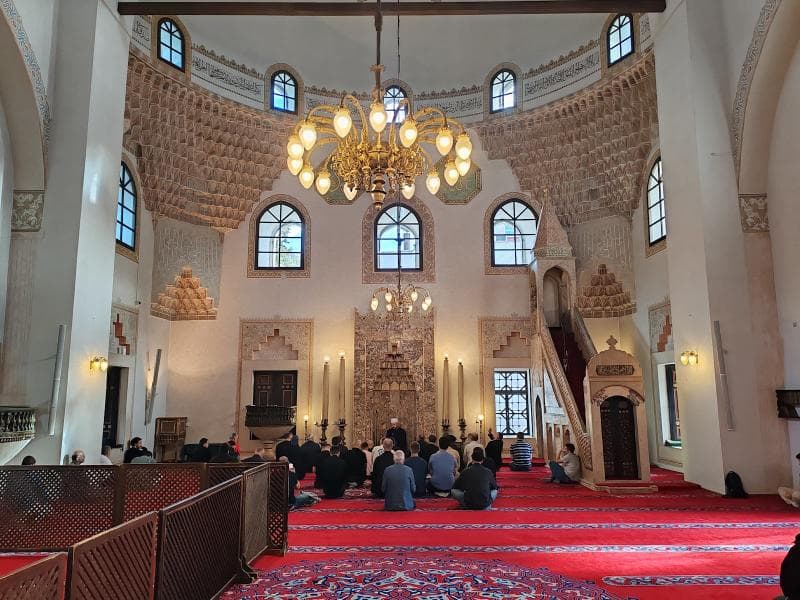
Explore the Gazi Husrev-beg Mosque in Sarajevo, Bosnia and Herzegovina. Discover its rich Ottoman history, stunning architecture, and cultural significance.
Overview
Nestled in the bustling heart of Baščaršija, Sarajevo's historic old bazaar, stands the Gazi Husrev-beg Mosque, a magnificent testament to Ottoman architecture and a living symbol of Bosnia and Herzegovina's rich cultural heritage. Locally known as Begova Džamija, or 'Bey's Mosque,' it is the largest historical mosque in the country and a central pillar of Islamic life in the region.
Its prominent position and grand design make it an unmissable landmark, drawing both worshippers and curious travelers who seek to understand the profound history and spiritual essence woven into Sarajevo's urban fabric.
History & Cultural Background
The Gazi Husrev-beg Mosque was commissioned by its namesake, Gazi Husrev-beg, the Ottoman governor (sandžak-beg) of Bosnia, who ruled multiple times between 1521 and 1541. Construction of this monumental edifice began in 1530 and was completed by 1532.
Gazi Husrev-beg was a visionary leader, profoundly committed to the development of Sarajevo. He established a 'vakuf' – an Islamic charitable endowment – which funded not only the mosque but also an extensive complex of supporting institutions. This complex included a madrasa (Islamic school), a library, a bezistan (vaulted marketplace), a hammam (public bath), and public fountains, forming the very core of Ottoman Sarajevo. This system of waqf ensured that revenue from these establishments perpetually supported the mosque and its associated services, a model of sustainable community development that continues to this day.
The mosque's primary architect is widely believed to be Acem Esir Ali, also known as Alaüddin, a Persian architect from Tabriz who served as the chief Ottoman court architect under Sultan Suleiman the Magnificent. Some scholars even theorize that the renowned Mimar Sinan, then a young apprentice, may have contributed to its design due to stylistic similarities with his later works. Over its nearly five centuries of existence, the mosque has witnessed numerous historical upheavals, including significant damage during the Bosnian War in the 1990s. However, through dedicated restoration efforts, it has been meticulously returned to its original splendor, serving as a testament to resilience and continuity.
What Makes It Special
The Gazi Husrev-beg Mosque stands out for its classical Ottoman architectural style. Its exterior, constructed from cut stone, features a grand central dome, approximately 13 meters in diameter and 26 meters high, surrounded by smaller domes, and a slender 47-meter minaret. The main entrance is adorned with exquisitely stylized arabesques, intricate ornamentation, gilding, and marble, with a carved stone tablet above bearing verses in Arabic.
Inside, the prayer hall is spacious and airy, dominated by the central dome. The interior walls are covered with beautiful calligraphy and floral arabesques, restored after wartime damage. The mihrab, indicating the direction of Mecca, is made of red marble, while the minbar (pulpit) features delicate latticework, believed to be original to the 16th century.
In the mosque's courtyard, an octagonal 'shadirvan' (ablution fountain) from the 1530s provides water for ritual washing before prayers, adding to the spiritual ambiance. The mosque's unique historical significance is further highlighted by its claim to be the first mosque in the world to receive electric lighting, installed in 1898, even before many mosques in Istanbul, Cairo, or Damascus.
Stories, Fun Facts & Local Details
One of the most remarkable stories associated with the Gazi Husrev-beg Mosque is its pioneering adoption of electricity. In 1898, Sarajevo, under Austro-Hungarian rule, equipped the mosque with electric lights, making it a beacon of modernity in the Islamic world. The original lamp fittings, modified for modern bulbs, are still in place inside.
The mosque's resilience is another compelling aspect of its narrative. During the brutal Siege of Sarajevo (1992-1995), it was hit by over a hundred mortar and artillery shells. Its restoration post-war was not merely about repairing a building but about rebuilding hope and identity in a shattered city.
The Gazi Husrev-beg Mosque is a truly active center of faith. The 'adhan' (call to prayer) is still delivered directly from its minaret five times a day by a muezzin, rather than played from a recording, a practice that sets it apart from many contemporary mosques. Furthermore, a full recitation of the Qur'an, known as a 'hatma,' is completed within its walls every single day. Many believe that Gazi Husrev-beg's prayers when establishing the waqf continue to protect the mosque. An inscription above its main entrance reads 'Enter in peace and safety,' embodying the welcoming spirit of Islamic architecture. Its proximity to other houses of worship – Catholic and Orthodox cathedrals and a Jewish synagogue – earns Sarajevo the affectionate nickname 'European Jerusalem,' with the mosque standing as a proud symbol of this multi-ethnic harmony.
Visitor Perspective
The Gazi Husrev-beg Mosque is conveniently located in Baščaršija, Sarajevo's old bazaar, just a short walk from the iconic Sebilj fountain. It is open to visitors outside of daily prayer times, which are posted at the entrance.
Respectful attire is essential for all visitors. Women are requested to cover their hair (scarves are often available at the entrance), and shoulders and knees should be covered for both men and women. Shoes must be removed before entering the prayer hall. Visitors are encouraged to observe the tranquil atmosphere, keeping voices low, and refraining from photographing worshippers during prayer.
Allow approximately 20-30 minutes to explore the interior and another 10-15 minutes for the courtyard and the adjacent tombs of Gazi Husrev-beg and his successor, Murad-beg. The mosque's complex also includes the Gazi Husrev-beg Library, the oldest public library in Bosnia and Herzegovina, housing thousands of Ottoman manuscripts, offering a deeper dive into the region's intellectual history.
Coordinates: 18.431, 43.8595
View on Google Maps💬 How Travelers Describe This Place
Based on community votes
Photogenic
712Interesting
542Unique
516Beautiful
326Must See
171
Traveler Stories
Discover memorable experiences shared by travelers who have visited this place.
No traveler stories yet.
Be the first traveler to share what made this place memorable.
Things to see at Gazi Husrev-beg Mosque



Tour
By
Spot
Discover amazing places around the world. Your journey starts here.
Explore
© 2026 TourBySpot. All rights reserved.