Main Prayer Hall
Sarajevo, Bosnia and Herzegovina
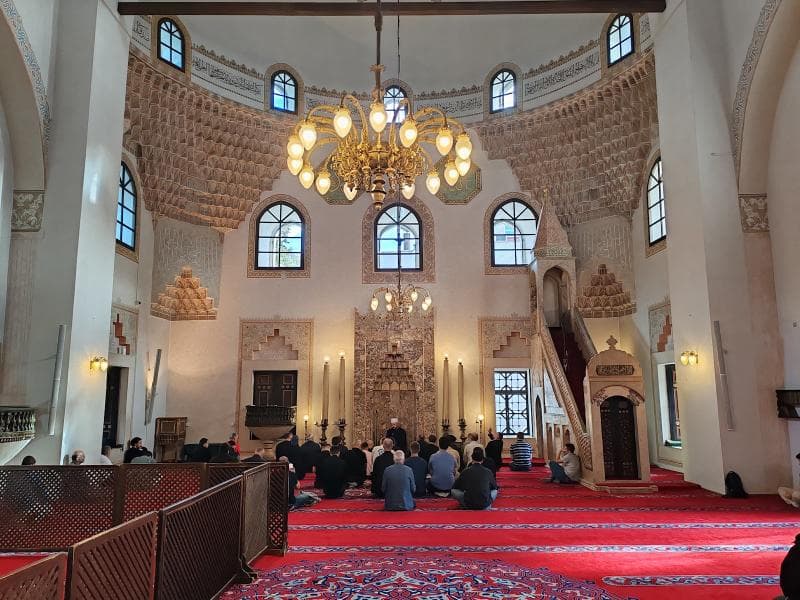
Explore the Main Prayer Hall of Gazi Husrev-beg Mosque in Sarajevo, Bosnia and Herzegovina. Discover its rich history, stunning Ottoman architecture, and cultural significance.
Overview
Stepping into the Main Prayer Hall of the Gazi Husrev-beg Mosque in Sarajevo is to enter a space imbued with centuries of devotion, architectural mastery, and enduring resilience. Located in the vibrant Baščaršija neighborhood, this hall serves as the spiritual heart of the largest historical mosque in Bosnia and Herzegovina. Its grand proportions and serene atmosphere offer visitors a profound glimpse into Ottoman Islamic art and culture, a legacy carefully preserved and meticulously restored throughout its long history.
As the central congregational mosque for Muslims in Bosnia and Herzegovina, the Main Prayer Hall is not merely a historical monument but a living, active place of worship. It welcomes worshippers and curious travelers alike, providing a unique opportunity to witness the continuous flow of faith and community life that has defined Sarajevo for nearly 500 years.
History & Cultural Background
The Gazi Husrev-beg Mosque, and by extension its Main Prayer Hall, was built between 1530 and 1532, commissioned by Gazi Husrev-beg, the Ottoman governor of Bosnia. This visionary leader established a charitable foundation, known as a 'waqf', which included not just the mosque but also a madrasa (Islamic school), a library, a hammam (bathhouse), and a marketplace, all crucial to the development of Ottoman Sarajevo. The mosque's construction marked a pivotal moment in the city's growth, becoming the central object of this extensive endowment.
The architect behind this masterpiece is believed to be Acem Ali Tabrizi 'Alaüddin', a Persian-born chief Ottoman court architect. Some scholars suggest that the renowned Mimar Sinan, his apprentice, may have also been involved in its early stages. Over the centuries, the mosque has witnessed numerous events, including a significant fire in 1879, followed by an interior refurbishment in 1886. Tragically, it suffered considerable damage during the Siege of Sarajevo in the 1990s. However, with international aid, it was meticulously restored, and its interior was fully redesigned in 2001/2002 by Bosnian calligrapher Hazim Numanagić, ensuring its spiritual and architectural grandeur endured.
What Makes It Special
The Main Prayer Hall's distinctiveness lies in its classical Ottoman architectural style, characterized by a dominant central dome that rises an impressive 26 meters high with a diameter of 13 meters. This central space is expanded by a semi-dome extending towards the qibla (direction of Mecca) and flanked by two smaller domed spaces, creating an open, yet harmonious interior.
Within the hall, several key architectural elements serve both functional and aesthetic purposes. The 'mihrab', a beautifully decorated prayer niche indicating the direction of Mecca, features intricate muqarnas ornamentation. Adjacent to it stands the 'minbar', a finely crafted marble pulpit used by the imam for sermons, known for its delicate latticework. A two-story 'mahfil' or gallery, supported by marble pillars, provides space for the muezzin and other congregants. The walls and domes are adorned with exquisite calligraphy and floral arabesques, a testament to the skill of Bosnian artisans and the rich tradition of Islamic art.
Stories, Fun Facts & Local Details
One fascinating aspect of the Gazi Husrev-beg Mosque is its pioneering role in technological advancement: it was the first mosque in the world to receive electricity and electric illumination in 1898, during the Austro-Hungarian period. The original lamp fittings, modified for modern bulbs, are still in place, a subtle nod to its innovative past.
A deeply rooted cultural practice that continues to this day is the live delivery of the 'adhan', or call to prayer, directly from the minaret. Unlike many modern mosques that use recordings, here the human voice echoes through the Baščaršija, connecting the present with centuries of tradition. The mosque also plays a central role during the holy month of Ramadan, with heightened activity and spiritual gatherings, especially at night. Furthermore, an inscription above the main entrance reads, 'Enter in peace and safety,' reflecting a welcoming and inclusive spirit that permeates the sacred space.
Visitor Perspective
For those wishing to experience the Main Prayer Hall, it is important to remember that it is an active place of worship. Visitors are welcomed outside of the five daily prayer times, which are announced at the entrance. Modest dress is required: women should cover their hair and shoulders, and men should wear long pants. Scarves are typically available at the entrance for women who may need one. Removing shoes before entering the prayer hall is a sign of respect.
Inside the hall, a sense of tranquility prevails. The light, calm interior provides a space for quiet contemplation, even for non-worshippers. Photography without flash is generally permitted during visiting hours, but it is crucial to avoid photographing individuals engaged in prayer. Allowing approximately 20-30 minutes to absorb the intricate details, the grandeur of the dome, and the overall peaceful ambiance is recommended. This sacred space offers a profound connection to Sarajevo's history, culture, and spiritual identity.
Coordinates: 18.429028, 43.85917
View on Google Maps💬 How Travelers Describe This Place
Based on community votes
Beautiful
712Unique
628Interesting
609Must See
542Photogenic
349
Traveler Stories
Discover memorable experiences shared by travelers who have visited this place.
No traveler stories yet.
Be the first traveler to share what made this place memorable.

Tour
By
Spot
Discover amazing places around the world. Your journey starts here.
Explore
© 2026 TourBySpot. All rights reserved.