Fort Lovrijenac
Dubrovnik, Croatia
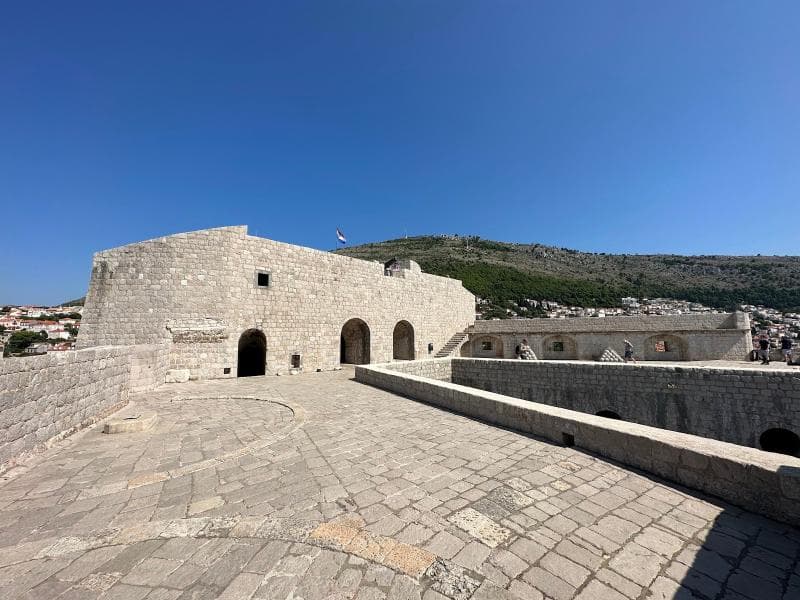
Discover Fort Lovrijenac in Dubrovnik, Croatia: a historic fortress known as 'Dubrovnik's Gibraltar' with a rich past and stunning views.
Overview
Perched dramatically on a 37-meter-high rock, Fort Lovrijenac, often referred to as 'Dubrovnik's Gibraltar' or St. Lawrence Fortress, stands as a formidable symbol of defiance and independence for the city of Dubrovnik, Croatia. This impressive fortress guards the western sea approach to the Old Town, offering breathtaking panoramic views of the Adriatic Sea and the ancient city walls. Its strategic location made it crucial for the defense of Dubrovnik (then the Republic of Ragusa) against maritime and land attacks, particularly from the Venetian fleet.
Today, Fort Lovrijenac is not only a significant historical monument but also a vibrant cultural venue. It attracts countless visitors annually, eager to explore its storied past and experience its unique atmosphere.
History & Cultural Background
The origins of Fort Lovrijenac are steeped in both historical accounts and local legend. While some historical records first mention the fort in 1301 when a commander was appointed, chronologists suggest its construction dates back much earlier, possibly between 1018 and 1038. A captivating legend tells of how the people of Dubrovnik, upon learning of a Venetian plan to build a fort on the same strategic rock to control the city, rapidly constructed Lovrijenac in a mere three months. When the Venetian ships arrived with building materials, they were met with an already erected fortress, forcing them to retreat.
Throughout the centuries, Lovrijenac underwent several upgrades and repairs, notably in the 15th and 16th centuries, and following the devastating earthquake of 1667. Its primary purpose was to protect Dubrovnik's freedom. This unwavering commitment is famously inscribed above its entrance: 'NON BENE PRO TOTO LIBERTAS VENDITUR AURO,' which translates to 'Freedom is not to be sold for all the treasures (or all the gold) in the world.' After the fall of the Republic of Ragusa, the fort served various functions, including as a barracks and a prison during the Austrian occupation and even in World War II.
What Makes It Special
Fort Lovrijenac's unique architecture is a testament to ingenious defensive engineering. Its triangular shape conforms to the contour of the rock, featuring three stepped terraces. The most striking aspect of its design is the varying wall thickness: the outer walls facing the sea are up to 12 meters thick, built to withstand powerful attacks, while the inner walls facing the city are a mere 60 centimeters thick. This deliberate design ensured that if the fort were ever captured, the city's cannons could easily breach the inner walls, preventing the enemy from using the fortress against Dubrovnik.
Beyond its military prowess, Lovrijenac has become a prominent cultural landmark. It is renowned as a primary venue for the Dubrovnik Summer Festival, hosting theatrical performances, most notably Shakespeare's 'Hamlet,' which gains an unparalleled ambiance amidst the fort's ancient stones. Furthermore, its dramatic setting has made it a popular filming location, famously recognized by fans worldwide as the 'Red Keep' in the television series 'Game of Thrones'.
Stories, Fun Facts & Local Details
The legend of the fort's rapid construction in three months underscores the resourcefulness and determination of Dubrovnik's citizens in preserving their independence against the powerful Venetians. Another intriguing detail involves 'Gušter,' or 'The Lizard,' a massive four-meter-long cannon, marvelously carved and decorated, positioned atop the fort. Despite its formidable presence, legend has it that 'The Lizard' never fired a single shot in battle, its mere existence being a deterrent. This symbolic cannon later met an unfortunate fate, reportedly falling into the sea during an attempted transport by the Austrian Empire and never recovered.
The fort's nickname, 'Dubrovnik's Gibraltar,' highlights its imposing elevation and strategic command over the sea, much like the famous strait. These stories and facts add layers of emotional depth to the impressive stone structure, allowing visitors to connect with the past on a more personal level.
Visitor Perspective
Reaching Fort Lovrijenac involves a climb of over 200 steps from Pile Gate, but the effort is richly rewarded with spectacular views of Dubrovnik's Old Town, the Adriatic Sea, and Kolorina Bay. The path winds through picturesque pine trees, offering glimpses of the stunning coastal landscape. The fort is open daily, and entry is often included with a City Walls ticket, making it a valuable addition to exploring Dubrovnik's fortifications. Visitors can explore its three levels, inner courtyard with arches, and various ramparts. During the Dubrovnik Summer Festival, access might be limited due to performances, so it's advisable to check schedules in advance if planning a visit during that period.
Coordinates: 18.104412, 42.640731
View on Google Maps💬 How Travelers Describe This Place
Based on community votes
Beautiful
981Photogenic
946Must See
795Interesting
439Unique
66
Traveler Stories
Discover memorable experiences shared by travelers who have visited this place.
No traveler stories yet.
Be the first traveler to share what made this place memorable.
Things to see at Fort Lovrijenac



Tour
By
Spot
Discover amazing places around the world. Your journey starts here.
Explore
© 2026 TourBySpot. All rights reserved.