Sea Walls
Dubrovnik, Croatia
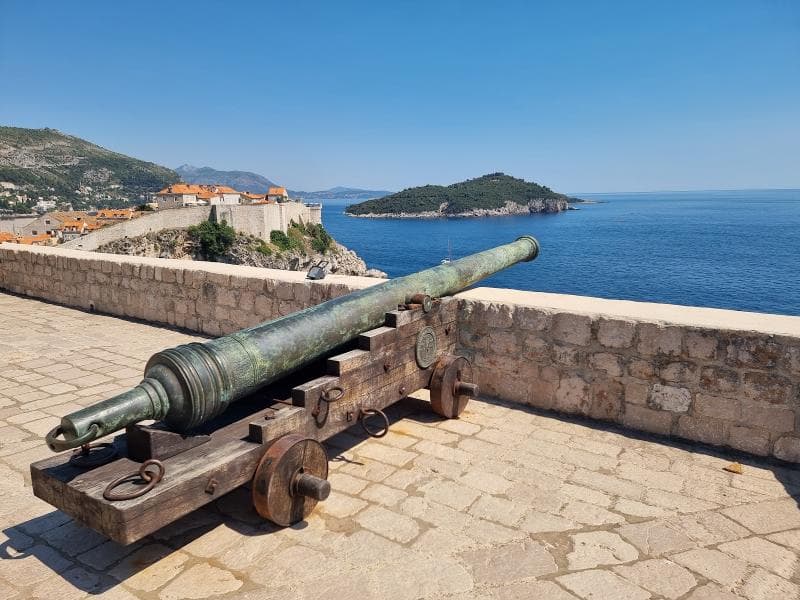
Explore the historic sea walls of Fort Lovrijenac in Dubrovnik, Croatia, and uncover tales of defense, freedom, and strategic architectural brilliance.
Overview
Perched dramatically atop a 37-meter-high rock, Fort Lovrijenac stands as a formidable sentinel overlooking the sparkling Adriatic Sea and Kolorina Bay in Dubrovnik, Croatia. Often dubbed 'Dubrovnik's Gibraltar,' this independent fortress, strategically located just outside the western city walls, has been a critical defensive structure for centuries. While not a distinct 'sub-spot' named 'Sea Walls,' the fort's seaward-facing fortifications are its defining feature, embodying an ingenious architectural and strategic brilliance that guarded the Republic of Ragusa from maritime threats. Visitors today can explore its three terraced levels, winding staircases, and historic battlements, immersing themselves in a rich tapestry of history and breathtaking panoramic views.
History & Cultural Background
The origins of Fort Lovrijenac are steeped in a captivating legend that speaks volumes about Dubrovnik's unwavering spirit of independence. Historical records first mention the fort around 1301, when a commander was appointed. However, a popular legend suggests its construction began much earlier, in the 11th century, in a remarkably swift three-month period. This rapid build was a direct response to a covert Venetian plot to establish their own fortress on the same strategic rock, intending to conquer the city. The citizens of Dubrovnik, learning of this plan, mobilized quickly to erect Lovrijenac first, effectively thwarting the Venetian invasion before it could even begin.
Throughout its history, Fort Lovrijenac underwent continuous reconstruction and upgrades. Significant alterations were made during the 15th and 16th centuries, with notable repairs to the parapets by municipal builder I. K. Zanchi of Pesaro. The fort also suffered damage during the devastating earthquake of 1667, but was subsequently restored to its former glory in the 17th century. For centuries, it served as the primary defense for Dubrovnik's western flank, protecting against both land and sea assaults, and housing a garrison of 25 men along with a fort commander.
What Makes It Special
The 'Sea Walls' of Fort Lovrijenac are arguably its most exceptional feature, renowned for their unparalleled defensive engineering. Unlike typical fortifications, the fort's architecture was designed with a unique paradox in mind. The exterior walls, those facing the open Adriatic Sea and potential enemy attack, boast an astonishing thickness of up to 12 meters. This immense robustness was engineered to withstand the most ferocious naval bombardments and ensure the city's protection from seaward invasions. In stark contrast, the walls of the fort that face inland, towards the city of Dubrovnik, are remarkably thin, measuring only about 60 centimeters. This strategic weakness was a deliberate failsafe: should the fort's commander ever contemplate a coup or betray the Republic, Dubrovnik's own artillery could easily breach Lovrijenac, preventing it from being used against its own people. This architectural duality vividly illustrates the Republic of Ragusa's profound commitment to its liberty, even at the cost of internal vulnerability.
Beyond their defensive ingenuity, the sea walls contribute to the fort's triangular shape, following the natural contour of the rock upon which it is built. They rise majestically from the sea, creating an imposing and dramatic silhouette that has captivated visitors for centuries.
Stories, Fun Facts & Local Details
- The Inscription of Freedom: Above the main entrance to Fort Lovrijenac, an enduring inscription declares, 'NON BENE PRO TOTO LIBERTAS VENDITUR AURO,' which translates to 'Freedom is not to be sold for all the treasures (or all the gold) in the world.' This powerful motto encapsulates the spirit of the Republic of Ragusa and its fiercely guarded independence.
- The Lost Lizard Cannon: The fort once bristled with ten large cannons. The most famous was 'Gušter' (the 'Lizard'), a beautifully crafted cannon made by Ivan Rabljanin in 1537. Legend has it that during the Austrian occupation in the 19th century, while attempting to remove the cannons, the rope holding the Lizard snapped, sending the cannon plummeting into the Adriatic Sea, where it remains lost to this day.
- A Stage for Shakespeare: In modern times, the historic setting of Fort Lovrijenac has been transformed into a renowned open-air stage for the Dubrovnik Summer Festival. Its dramatic terraces and atmospheric surroundings provide a spectacular backdrop, particularly for performances of Shakespeare's 'Hamlet,' which has become a symbol of the festival.
- King's Landing: Fans of the popular television series 'Game of Thrones' will recognize Fort Lovrijenac as the formidable Red Keep, the primary royal residence in King's Landing. Numerous iconic scenes were filmed within its walls, adding a layer of contemporary allure to its ancient stones.
Visitor Perspective
Visiting Fort Lovrijenac offers an unforgettable experience, combining historical exploration with unparalleled scenic beauty. The approach to the fort from Pile Gate involves a short walk along the coastal path, offering striking views of the fort rising from the sea before you begin the climb up the stone staircase. Once inside, visitors can explore the three terraced levels, each offering different vantage points. The journey through its arched courtyards and along its robust battlements allows for a tangible connection to Dubrovnik's past.
The reward for the climb is the panoramic view from the top. From here, you can gaze upon the terracotta rooftops of Dubrovnik's Old Town, the shimmering expanse of the Adriatic, and the formidable city walls. It provides a unique perspective on the entire fortified city and its strategic position. A typical visit takes between 45 to 90 minutes, allowing ample time to appreciate the architecture, read the informative displays, and soak in the breathtaking surroundings. Entry to Fort Lovrijenac is often included with a ticket for the Dubrovnik City Walls, making it a convenient and highly recommended addition to exploring Dubrovnik's rich heritage.
Coordinates: 18.1051, 42.6409
View on Google Maps💬 How Travelers Describe This Place
Based on community votes
Must See
954Beautiful
514Photogenic
432Interesting
316Unique
196
Traveler Stories
Discover memorable experiences shared by travelers who have visited this place.
No traveler stories yet.
Be the first traveler to share what made this place memorable.

Tour
By
Spot
Discover amazing places around the world. Your journey starts here.
Explore
© 2026 TourBySpot. All rights reserved.