Defensive Chambers
Dubrovnik, Croatia
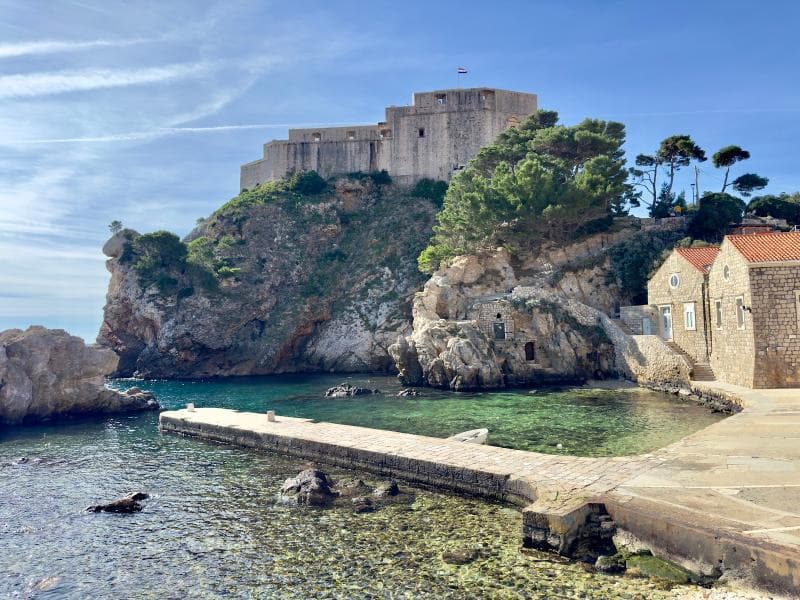
Explore the historic Defensive Chambers of Fort Lovrijenac in Dubrovnik, Croatia. Discover its strategic architecture, rich history, and stunning views.
Overview
Perched dramatically on a 37-meter-high rock just outside the western walls of Dubrovnik, Croatia, Fort Lovrijenac stands as a formidable guardian of the city, often hailed as 'Dubrovnik's Gibraltar'. This triangular fortress has played a pivotal role in the defense of Dubrovnik, controlling both land and sea approaches and overseeing the historically significant Kolorina Bay, the city's oldest port. Far more than just a military stronghold, Lovrijenac embodies the spirit of freedom and resilience that defined the historic Republic of Ragusa.
A visit to Fort Lovrijenac offers breathtaking panoramic views of Dubrovnik's Old Town, the shimmering Adriatic Sea, and the surrounding coastline, making it an essential experience for any curious traveler. Its strategic design, featuring multiple levels and robust defensive chambers, tells a compelling story of ingenuity and determination against powerful adversaries.
History & Cultural Background
The origins of Fort Lovrijenac are steeped in a legend that highlights Dubrovnik's cunning and fierce independence. While formal records first mention the fort in 1301 when a commander was appointed, historians suggest its construction began much earlier, likely between 1018 and 1038. The most popular tale recounts that in the 11th century, the Venetians planned to build a fortress on this very rock to assert control over Dubrovnik. However, the quick-thinking citizens of Dubrovnik learned of this plot and, in an astonishing feat, constructed their own substantial fort in just three months, effectively thwarting the Venetian ambitions. When Venetian ships arrived with building materials, they were met with an already established stronghold and had no choice but to retreat.
Over centuries, Lovrijenac was continuously fortified and upgraded, particularly during the 15th and 16th centuries, adapting to evolving warfare technologies. Despite suffering damage during the devastating earthquake of 1667, the fortress was diligently repaired, preserving its crucial role in Dubrovnik's defense system. It remained a military installation through various periods, even serving as barracks during Austrian occupation and a prison during World War II, before transitioning into a significant cultural landmark by the mid-20th century.
What Makes It Special
The true genius of Fort Lovrijenac lies in its architectural design, particularly its 'defensive chambers' – the various internal spaces and strategic structural elements that formed its protective core. The fort's triangular shape conforms perfectly to the natural contours of the rock, optimizing its defensive posture. One of its most distinctive features is the varying thickness of its walls: the outer walls facing the potential enemy on the sea are an imposing 12 meters thick, built to withstand heavy bombardment. In stark contrast, the walls facing the city of Dubrovnik are remarkably thin, measuring only about 60 centimeters.
This asymmetrical design was a deliberate and brilliant safeguard. It ensured that if a fort commander were to betray the Republic or if the fortress fell into enemy hands, Dubrovnik's own artillery could easily breach the thinner inner walls and regain control. Within these protective walls, the fort boasts three distinct terraces with powerful parapets, each serving a specific defensive purpose and providing elevated positions for observation and combat. A large inner courtyard, bounded by numerous arches, would have facilitated troop movements and logistical support during sieges. These integrated elements, from the varying wall thicknesses to the multi-level terraces, collectively formed the sophisticated defensive chambers of Fort Lovrijenac, making it a masterpiece of medieval military architecture.
Stories, Fun Facts & Local Details
Beyond its military might, Fort Lovrijenac is rich with stories. Above its main entrance, travelers will find the powerful inscription, 'Non Bene Pro Toto Libertas Venditur Auro,' meaning 'Freedom is not to be sold for all the gold in the world'. This motto perfectly encapsulates Dubrovnik's unwavering commitment to its independence, a principle the fort was built to uphold. Another fascinating detail is the tale of 'Gušter' (the Lizard), one of the ten large cannons crafted by Ivan Rabljanin in 1537, positioned on the fort's rooftop. Despite its formidable presence, legend has it that the 'Lizard' was never actually fired in battle.
To prevent any commander from turning rogue, the Republic enforced a strict rule: the commander of Lovrijenac was elected monthly from the nobility and was forbidden to leave the fort during his term. In more recent times, the fort has gained international fame as a filming location, most notably portraying the Red Keep in the popular series Game of Thrones. It also serves as a spectacular open-air stage for the Dubrovnik Summer Festival, where Shakespeare's Hamlet is frequently performed, adding a dramatic cultural layer to its ancient stones.
Visitor Perspective
Today, Fort Lovrijenac invites visitors to step back in time and explore its historic grounds. The ascent to the fort, while involving over 200 stairs, is well worth the effort, revealing increasingly stunning vistas with each step. Once inside, you can wander through its various levels, including the inner courtyard and the three terraces, imagining the soldiers who once guarded these very battlements.
The views from the fort are unparalleled, offering a unique perspective of the iconic city walls, the bustling Old Town, and the vast expanse of the Adriatic. It's an ideal spot for photography, especially during sunset, when the ancient stones are bathed in a warm, golden light. Entry to Fort Lovrijenac is often included with a ticket for the Dubrovnik City Walls, making it a convenient and historically rich addition to any Dubrovnik itinerary. Allow at least 30 to 60 minutes to fully explore the fort and soak in its atmosphere and magnificent surroundings.
Coordinates: 18.104412, 42.640773
View on Google Maps💬 How Travelers Describe This Place
Based on community votes
Beautiful
680Photogenic
653Unique
588Interesting
566Must See
432
Traveler Stories
Discover memorable experiences shared by travelers who have visited this place.
No traveler stories yet.
Be the first traveler to share what made this place memorable.

Tour
By
Spot
Discover amazing places around the world. Your journey starts here.
Explore
© 2026 TourBySpot. All rights reserved.