Castello Sforzesco
Milan, Italy
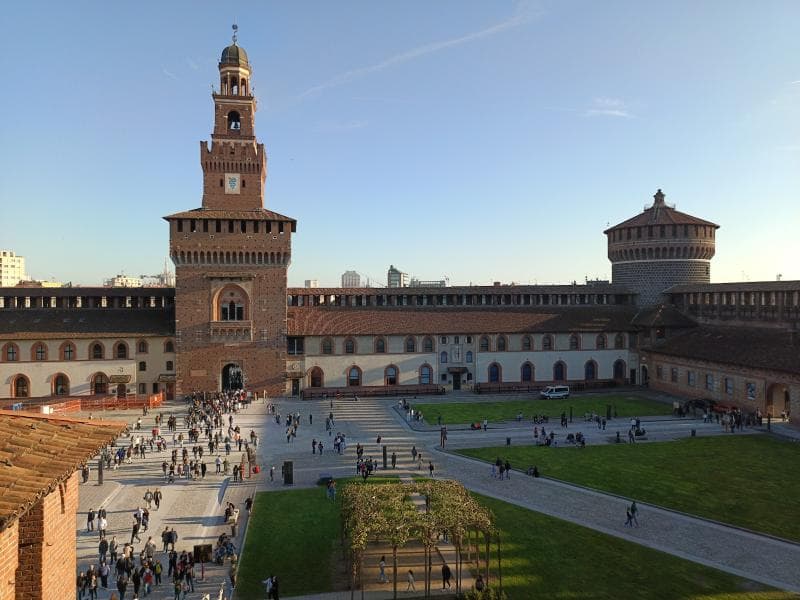
Explore Castello Sforzesco in Milan, Italy, a historic fortress housing Michelangelo's Rondanini Pietà, Leonardo's Sala delle Asse, and diverse museums.
Overview
Nestled in the vibrant heart of Milan, Italy, Castello Sforzesco stands as a monumental testament to centuries of history, art, and power. Once a formidable fortress and later a lavish ducal residence, this imposing red-brick structure now serves as one of Italy's most significant cultural complexes. It's a landmark that beautifully encapsulates the layered narrative of Milan, inviting curious travelers to step back in time and explore its rich past and diverse collections. Situated strategically, the castle grounds seamlessly lead into the expansive Parco Sempione, offering a serene escape amidst the bustling city.
History & Cultural Background
The origins of Castello Sforzesco trace back to the mid-14th century, when Galeazzo II Visconti, then Lord of Milan, ordered the construction of a defensive fortress known as Castello di Porta Giova between 1358 and 1370. This initial structure, with its 180-meter-long walls and corner towers, was expanded by his successors. However, after the fall of the Visconti family and the establishment of the Golden Ambrosian Republic, the Milanese, seeing it as a symbol of tyranny, largely razed the original fortress in 1447.
Just three years later, in 1450, the celebrated condottiero Francesco Sforza, who married Bianca Maria Visconti, seized power and began to reconstruct the castle, transforming it into his princely residence and a symbol of the Sforza dynasty. Under his son, Ludovico Sforza, famously known as 'il Moro,' the castle reached its Renaissance zenith. Ludovico commissioned eminent artists and architects of the era, including Leonardo da Vinci and Donato Bramante, to embellish the castle, turning it into a magnificent ducal palace adorned with frescoes and elegant courtyards. The iconic central tower, the Torre del Filarete, was originally designed by Filarete in 1452, though it was later rebuilt in the early 20th century after an accidental gunpowder explosion in 1521.
Over subsequent centuries, the castle endured periods of foreign domination, serving as a military barracks under Spanish and Austrian rule, and even faced demolition orders from Napoleon in the early 1800s. During the Spanish era, it became one of Europe's largest citadels, effectively a small city housing between 1,000 and 3,000 people. In the late 19th century, the castle underwent an extensive restoration led by architect Luca Beltrami, aiming to restore its Renaissance grandeur and preventing its complete destruction. Severely damaged during World War II, it was later lovingly rebuilt and repurposed to house Milan's civic museums, solidifying its role as a vibrant cultural center.
What Makes It Special
What truly sets Castello Sforzesco apart is its remarkable evolution and its current incarnation as a vast repository of art and history. Its quadrangular layout, punctuated by robust towers like the Torre del Filarete and the two prominent round towers facing the city, reflects its dual identity as both a formidable defensive structure and an elegant ducal court.
Today, the castle is home to several of Milan's municipal museums, offering an unparalleled cultural journey. Visitors can explore the Museum of Ancient Art, which proudly displays Michelangelo's poignant final masterpiece, the Rondanini Pietà. The Pinacoteca del Castello Sforzesco houses an extensive collection of over 1,500 works, spanning from the 13th to the 18th centuries, including pieces by Italian masters like Andrea Mantegna and Canaletto. Other notable collections include the Museum of Musical Instruments, featuring a diverse array from around the world, the Egyptian Museum with its ancient artifacts, and the Archaeological Museum detailing Lombardy's past. The Applied Arts Collection and the Antique Furniture and Wooden Sculpture Museum further enrich the visitor experience, showcasing exquisite craftsmanship through the ages.
Stories, Fun Facts & Local Details
The castle is imbued with fascinating stories and details that bring its history to life. One of the most captivating connections is to Leonardo da Vinci, who worked here under Ludovico il Moro. He contributed not only as an artist, famously decorating the 'Sala delle Asse' (Room of the Wooden Boards) with an intricate fresco of intertwining trees, but also as a military engineer, designing defensive elements. A fun detail surrounding the Sala delle Asse is Leonardo's choice of the mulberry tree for his frescoes. This wasn't merely an artistic decision; the mulberry was crucial for silkworm rearing, a significant economic driver for the Sforza Duchy. Furthermore, Ludovico Sforza's nickname, 'il Moro,' literally translates to 'the mulberry,' potentially adding a layer of personal symbolism to the artwork, as the mulberry also symbolized prudence.
Another intriguing tale involves the Torre del Filarete, which dramatically collapsed in 1521 due to a gunpowder explosion, serving as an ammunition depot at the time. Its subsequent rebuilding in the early 20th century recreated the original splendor. Legend also whispers of a secret tunnel starting from the castle's basement, stretching beneath the city to the Church of Santa Maria delle Grazie. For a period, the powerful Visconti family's mythical 'biscione' coat of arms, depicting a snake swallowing a human, could be seen on the castle, a tribute to the first dynasty that built a fortress on this site.
Visitor Perspective
For any traveler to Milan, Castello Sforzesco offers a compelling journey through Italian history and art. The castle's courtyards and grounds are freely accessible daily, allowing visitors to wander through its imposing architecture and enjoy the transition into Parco Sempione. To delve deeper into its treasures, a single ticket grants access to all the castle's museums, typically requiring about two to three hours for a comprehensive visit. Key highlights for museum-goers include the deeply moving Rondanini Pietà by Michelangelo and the chance to witness Leonardo da Vinci's masterful Sala delle Asse.
Located conveniently, the castle is easily reachable by metro, with stops like Cairoli Castello and Cadorna nearby, and is a pleasant walk from other central Milan attractions like the Duomo. The site is committed to accessibility, offering ramps, elevators, and dedicated pathways for visitors with mobility needs. Whether you're captivated by Renaissance art, medieval fortifications, or simply seeking a historical respite within a modern metropolis, Castello Sforzesco provides an enriching and memorable experience.
Coordinates: 9.17861, 45.47
View on Google Maps💬 How Travelers Describe This Place
Based on community votes
Interesting
494Must See
242Photogenic
193Unique
125Beautiful
82
Traveler Stories
Discover memorable experiences shared by travelers who have visited this place.
No traveler stories yet.
Be the first traveler to share what made this place memorable.
Things to see at Castello Sforzesco



Tour
By
Spot
Discover amazing places around the world. Your journey starts here.
Explore
© 2026 TourBySpot. All rights reserved.