Sempione Park access
Milan, Italy
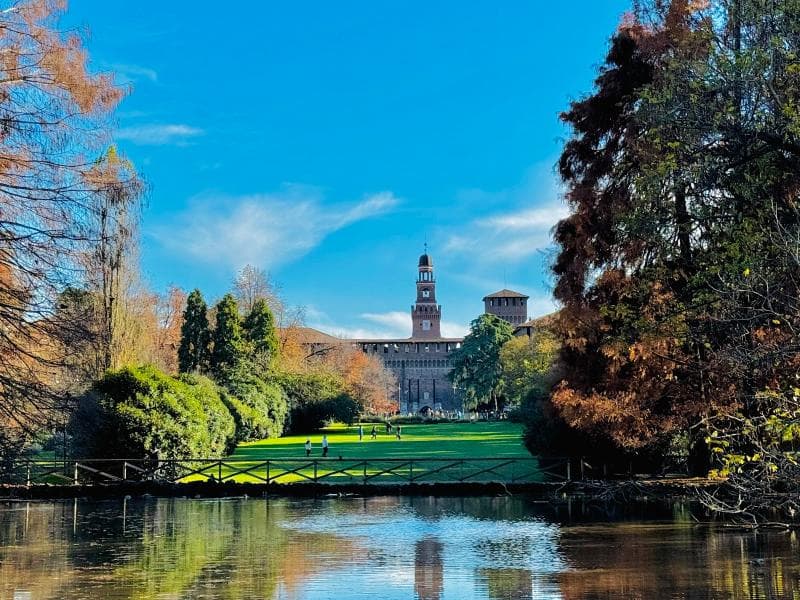
Explore Sempione Park, Milan, Italy, a vast green oasis connecting Castello Sforzesco to the Arch of Peace with rich history and iconic landmarks.
Overview
Stepping out from the imposing walls of Castello Sforzesco, a grand historical fortress in the heart of Milan, Italy, one is immediately greeted by the sprawling green expanse of Sempione Park. This vital urban oasis, known in Italian as Parco Sempione, serves as a natural extension of the castle's historical narrative and a beloved retreat for both Milanese residents and curious travelers alike. Covering an area of approximately 38.6 hectares (95 acres), the park is strategically positioned between the magnificent Castello Sforzesco to the east and the monumental Arco della Pace (Arch of Peace) to the west, creating a continuous vista of history and nature. It is a place where centuries of history meet contemporary urban life, offering a tranquil escape from the city's bustling rhythm.
Sempione Park is more than just a green space; it's a vibrant public arena where picturesque pathways wind through open lawns, tranquil ponds shimmer, and the hum of city traffic gives way to the soft rustle of leaves. Its access from Castello Sforzesco is seamless, with visitors often transitioning directly from exploring ducal courtyards and museum collections to strolling through tree-lined avenues. This harmonious blend of cultural heritage and natural beauty makes it an indispensable part of the Milanese experience.
History & Cultural Background
The history of Sempione Park is deeply intertwined with Milan's evolution, dating back centuries before its formal establishment as a public park. Originally, the area was part of the Visconti ducal park, a vast hunting ground known as 'Barcho', first created in 1392 by Gian Galeazzo Visconti. The Sforza family, who later ruled Milan, further enlarged and fenced this area, transforming it into a massive hunting reserve spanning over 3 million square meters, populated with exotic animals.
With the fall of the Sforzas and subsequent Spanish domination, the park was largely abandoned, and portions were even used for agriculture and military exercises near the Sforza Castle until 1861. The castle itself became a barracks, leading to its degradation. During the Napoleonic era in the early 1800s, ambitious plans emerged to transform the land behind the castle into a grand parade ground, part of Napoleon's 'Foro Buonaparte' project, which also envisioned the Arco della Pace. Although Napoleon's downfall in 1815 left many of these plans unrealized, the Arch of Peace and the Arena Civica stand as his legacy.
The current Sempione Park was designed between 1890 and 1893 by architect Emilio Alemagna, adopting the romantic English landscape garden style, characterized by winding paths, open grassy areas, and tall trees. This transformation was part of a broader movement to restore the Castello Sforzesco and provide Milan with a much-needed public green space.
What Makes It Special
Sempione Park's special allure lies in its unique fusion of natural beauty with significant architectural and cultural landmarks. Its design creates an elegant corridor directly connecting the grandeur of Castello Sforzesco with the neoclassical majesty of the Arco della Pace, offering a visual journey through Milanese history.
Within its boundaries, the park hosts several other notable attractions. The Triennale di Milano, a museum dedicated to Italian art and design, is situated on its edge. The Civic Aquarium of Milan, housed in a charming Art Nouveau building, is the third-oldest aquarium in Europe. For breathtaking panoramic views of the city skyline, visitors can ascend the Torre Branca, a 108-meter-tall observation tower. The park's English-style layout, with its picturesque bridges, tranquil ponds, and diverse flora including holly, magnolias, and red oaks, provides a serene contrast to the urban bustle.
Stories, Fun Facts & Local Details
The park is a repository of local stories and intriguing details. During the latter months of World War II, when famine gripped Milan, a remarkable decision was made to sow Sempione Park with potatoes, and sunflowers lined its sides, transforming its recreational purpose into a vital food source for the city's inhabitants. The park also houses various artworks, including the 'Teatro Continuo' by Alberto Burri, restored for Expo 2015, and the 'Accumulazione Musicale e Seduta' (amphitheater) by Arman.
Local legend also speaks of the 'Black Lady' ghost, said to appear on foggy evenings, accompanied by the scent of violets, adding a touch of mystery to the park's atmosphere. For locals, Sempione Park is truly Milan's 'green lung', a place for everything from leisurely strolls and picnics to jogging and cycling. It also hosts various events and exhibitions, particularly at the Arena Civica, a neoclassical amphitheater that still hosts sporting events and concerts.
Visitor Perspective
For visitors exploring Milan, the Sempione Park access from Castello Sforzesco offers a seamless transition from historical grandeur to natural tranquility. After delving into the rich history and art collections within the castle, stepping into the expansive park feels like entering a different world. The pathway leading away from the castle's rear offers immediate immersion into tree-lined avenues and open spaces, inviting a change of pace.
Many choose to wander aimlessly, enjoying the peaceful atmosphere, while others seek out specific attractions. You might see families enjoying picnics, couples strolling hand-in-hand across the Mermaid Bridge, or runners making their way along the dirt paths. The park provides numerous vantage points to admire the castle from a new perspective or to gaze towards the Arco della Pace in the distance. Plan at least two to three hours to fully enjoy the park's offerings, or even a whole day if you intend to explore its museums and landmarks. Whether seeking relaxation, cultural enrichment, or a glimpse into Milanese daily life, Sempione Park offers a refreshing and memorable experience right in the city's heart.
Coordinates: 9.17722, 45.47227
View on Google Maps💬 How Travelers Describe This Place
Based on community votes
Beautiful
670Must See
655Interesting
594Unique
166Photogenic
83
Traveler Stories
Discover memorable experiences shared by travelers who have visited this place.
No traveler stories yet.
Be the first traveler to share what made this place memorable.

Tour
By
Spot
Discover amazing places around the world. Your journey starts here.
Explore
© 2026 TourBySpot. All rights reserved.