Michelangelo’s Rondanini Pietà
Milan, Italy
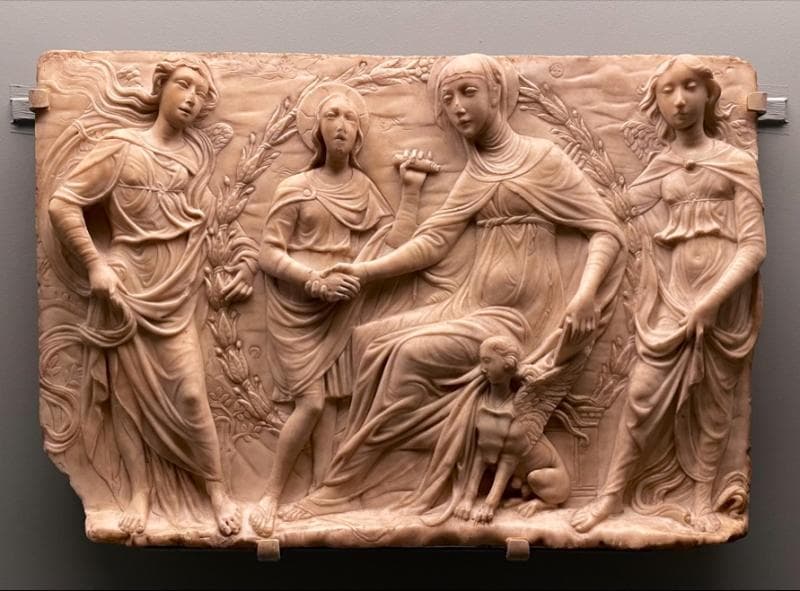
Discover Michelangelo’s Rondanini Pietà, his final, unfinished masterpiece, housed in Castello Sforzesco, Milan, Italy. A profound and moving work of art.
Overview
Deep within the historic walls of Castello Sforzesco in Milan, Italy, lies a profoundly moving masterpiece: Michelangelo’s Rondanini Pietà. This sculpture, the artist’s final work, offers a unique glimpse into the spiritual and artistic journey of one of the Renaissance’s greatest geniuses. Unlike his earlier, more polished works, the Rondanini Pietà stands as a testament to the raw emotion and profound contemplation of Michelangelo’s last years, left purposefully unfinished or perpetually in a state of becoming.
Housed in a specially dedicated museum within the castle’s former Spanish Hospital, the sculpture draws visitors into a silent dialogue with the artist’s soul. It portrays the Virgin Mary supporting the emaciated body of Christ in an intertwined, vertical pose, emphasizing their deep emotional and physical unity.
History & Cultural Background
Michelangelo Buonarroti began work on the Rondanini Pietà around 1552, continuing to chisel and redefine it until just six days before his death in 1564, at the age of 88. This was a period when the master was increasingly preoccupied with his own mortality and spiritual reflection. The Pietà theme, depicting the Virgin Mary mourning over the dead body of Christ, was one Michelangelo revisited throughout his career, beginning with his famous Vatican Pietà sculpted over 60 years earlier.
Originally, this late Pietà was likely intended for his own tomb, a personal project without a formal commission. Over the years, Michelangelo significantly reworked the marble block, altering the composition from an earlier version, even discarding and re-carving parts of the figures. After Michelangelo’s death, the sculpture had a somewhat obscure history, eventually residing for centuries in the Palazzo Rondanini in Rome, from which it derives its name. In 1952, the City of Milan acquired the sculpture. Since 2015, it has been proudly displayed in its own dedicated museum within the former Spanish Hospital of Castello Sforzesco.
What Makes It Special
The Rondanini Pietà is celebrated for its radical departure from Michelangelo’s earlier, more idealized works. Its unfinished state is not merely an absence of completion but rather a powerful artistic choice that speaks volumes about the artist’s evolving style and spiritual focus. The elongated, almost spectral figures of Mary and Christ appear fused into a single columnar form, conveying a profound sense of suffering, love, and spiritual essence rather than anatomical perfection. This raw, expressionistic quality led sculptor Henry Moore to call it 'the most moving sculpture ever created by an artist.'
The visible marks of Michelangelo’s chisel, the contrasting rough and refined surfaces, and the traces of earlier versions within the marble block invite contemplation on the creative process itself. Scholars often view this work as a bridge between Renaissance classicism and later artistic movements, even an early form of 'modern art' due to its minimalism and emotional intensity.
Stories, Fun Facts & Local Details
The name 'Rondanini' comes from the Roman palace where the sculpture was kept for nearly two centuries, the Palazzo Rondanini. Its journey to Milan and its current prominent display in Castello Sforzesco is a story of its recognition from a once-overlooked work to a national treasure. Michelangelo famously worked on the sculpture right up until his final days, a testament to his unwavering dedication to his art and faith. He was still carving it just six days before his death.
The dedicated museum space within the Spanish Hospital of Castello Sforzesco was thoughtfully chosen. This 16th-century infirmary, a place associated with suffering and solace, provides a fitting, almost sacred, environment for Michelangelo’s final expression of human grief and divine love. The installation itself is designed to enhance the viewing experience, with an anti-seismic dais protecting the masterpiece and lighting carefully arranged to eliminate shadows, allowing the sculpture’s form to speak clearly.
Visitor Perspective
Visiting Michelangelo’s Rondanini Pietà offers an incredibly intimate and reflective experience. Located within the vast Castello Sforzesco, reaching the dedicated museum space feels like a pilgrimage. Visitors are encouraged to walk slowly around the sculpture, observing it from multiple angles to fully appreciate its evolving forms and emotional depth. The side and rear views reveal nuances not immediately apparent from the front, showcasing Michelangelo's continuous reworking of the marble.
Entry to the Museo della Pietà Rondanini is included with a general ticket to the Castello Sforzesco museums, making it an integral part of exploring this historic Milanese landmark. To best experience the Pietà, consider visiting during quieter times, such as the first hour after opening or late afternoon on weekdays, allowing for a more personal and contemplative encounter with Michelangelo's ultimate artistic statement.
Coordinates: 9.17861, 45.47
View on Google Maps💬 How Travelers Describe This Place
Based on community votes
Unique
683Interesting
642Photogenic
300Must See
251Beautiful
88
Traveler Stories
Discover memorable experiences shared by travelers who have visited this place.
No traveler stories yet.
Be the first traveler to share what made this place memorable.

Tour
By
Spot
Discover amazing places around the world. Your journey starts here.
Explore
© 2026 TourBySpot. All rights reserved.