Amalienborg Palace
Copenhagen, Denmark
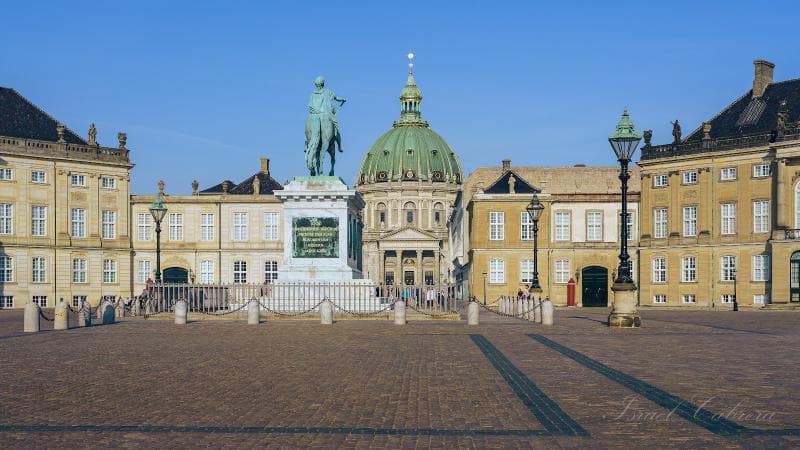
Explore Amalienborg Palace, the official winter residence of the Danish royal family in Copenhagen. Witness the Changing of the Guard and discover royal history.
Overview
Amalienborg Palace, nestled in the heart of Copenhagen, Denmark, stands as the official residence of the Danish royal family. This magnificent Rococo complex is composed of four identical palace buildings, gracefully arranged around an octagonal courtyard known as Amalienborg Slotsplads. It serves not only as the monarch's winter residence but also as a vibrant symbol of one of the world's oldest monarchies. Visitors flock here daily to witness the ceremonial Changing of the Royal Guard, a tradition that brings the palace square to life. At the center of the square, an imposing equestrian statue of King Frederik V, the palace's founder, commands attention, reflecting the grandeur of the complex.
History & Cultural Background
The story of Amalienborg begins in the mid-18th century within the Frederiksstaden district, an area initiated by King Frederik V to commemorate the 300th anniversary of the Oldenburg family's ascent to the Danish throne. Court architect Nicolai Eigtved was commissioned to design not only the district but also the four grand palaces that now form Amalienborg. These palaces, built between 1750 and 1760, were originally intended as residences for four prominent noble families.
However, fate intervened dramatically on February 26-27, 1794, when Christiansborg Palace, the then-royal residence, was destroyed by fire. The royal family found themselves in need of a new home and promptly acquired the Amalienborg palaces, moving in as a temporary measure that became permanent. This unplanned relocation transformed Amalienborg into the enduring seat of the Danish monarchy. The palaces were subsequently named after the monarchs who resided in them, such as Christian VII's Palace, Christian VIII's Palace, Frederik VIII's Palace, and Christian IX's Palace.
What Makes It Special
Amalienborg's distinctiveness lies in its harmonious architectural design. The four nearly identical Rococo palaces, Moltke's (Christian VII's), Levetzau's (Christian VIII's), Brockdorff's (Frederik VIII's), and Schack's (Christian IX's), encircle the octagonal square, creating a visually striking and cohesive urban space. The equestrian statue of King Frederik V, sculpted by French artist Jacques Saly, is a masterpiece and a central focal point, linking the palaces and symbolizing the monarch's central role.
Beyond its architectural beauty, Amalienborg is special because it remains a living royal residence. King Frederik X and Queen Mary reside in Frederik VIII's Palace, and the presence of the monarch is indicated by a hoisted flag. This means that visitors are not just observing a historical monument, but a functioning home of royalty. The daily Changing of the Guard ceremony, performed by the Royal Life Guard, is another significant feature, showcasing a proud military tradition that dates back centuries.
Stories, Fun Facts & Local Details
The impressive equestrian statue of King Frederik V in the palace square took 20 years to complete and reportedly cost more than the entire Amalienborg complex itself, a testament to its artistic and symbolic value.
The Royal Life Guard, responsible for protecting the palace and the royal family, marches daily at noon from Rosenborg Castle through the streets of Copenhagen to Amalienborg. If the monarch is in residence, a full marching band accompanies the ceremony, making it a particularly grand spectacle.
Interestingly, the palaces were never initially conceived as royal residences but as homes for noble families. The royal move in 1794 was a direct consequence of a devastating fire at Christiansborg Palace.
Amalienborg was once home to Christian IX and Queen Louise, who were famously known as 'the in-laws of Europe.' Four of their children ascended to thrones across Europe, becoming monarchs in England, Greece, Russia, and Denmark.
Adjacent to the palace, the beautiful Amaliehaven (Amalie Garden) was a gift to Copenhagen's citizens from the A.P. Møller and Chastine McKinney Møller Foundation, established in 1983.
Visitor Perspective
Experiencing Amalienborg Palace offers a unique glimpse into Danish royal life. Most visitors make their way to the octagonal palace square to witness the Changing of the Royal Guard, a free and captivating spectacle that occurs daily at noon. It is advisable to arrive a little early to secure a good viewing spot.
Beyond the outdoor ceremony, parts of Amalienborg are open to the public. The Amalienborg Museum, located in Christian VIII's Palace, provides fascinating insights into the history of the Danish monarchy. Here, you can explore private royal interiors, historical artifacts, and exhibitions that span 150 years of royal history, offering a journey through time and a personal look at the lives of past kings and queens.
While Christian VII's Palace is primarily used for official functions and guests, it occasionally offers guided tours during summer months, providing a rare opportunity to see its magnificent reception rooms. The courtyard itself is accessible 24/7, allowing visitors to appreciate the palace's exterior beauty at any time.
Coordinates: 12.59333, 55.684028
View on Google Maps💬 How Travelers Describe This Place
Based on community votes
Photogenic
685Interesting
446Beautiful
152Unique
33Must See
16
Traveler Stories
Discover memorable experiences shared by travelers who have visited this place.
No traveler stories yet.
Be the first traveler to share what made this place memorable.
Things to see at Amalienborg Palace



Tour
By
Spot
Discover amazing places around the world. Your journey starts here.
Explore
© 2026 TourBySpot. All rights reserved.