Marble Church Nearby
Copenhagen, Denmark
Discover the Marble Church (Frederik's Church) in Copenhagen, Denmark, an iconic architectural marvel with Scandinavia's largest dome, near Amalienborg Palace.
Overview
Nestled within Copenhagen's elegant Frederiksstaden district, just a short stroll from the royal residence of Amalienborg Palace, stands Frederik's Church, universally known as the Marble Church (Marmorkirken). Its magnificent, copper-green dome dominates the skyline, serving as an iconic landmark and a testament to centuries of Danish ambition and craftsmanship. This Evangelical Lutheran church, with its Roman Baroque-inspired dome, is more than just a place of worship; it is a captivating architectural marvel that tells a profound story of perseverance, changing fortunes, and artistic vision. Whether viewed from a distance, where its grand silhouette crowns the cityscape, or explored up close, revealing intricate details and a serene interior, the Marble Church offers a deep dive into Denmark's rich cultural and historical tapestry. Its presence creates a striking visual axis with Amalienborg Palace and the Opera House, anchoring one of Copenhagen's most historically significant urban plans.
History & Cultural Background
The story of the Marble Church began in 1749 when King Frederik V laid its foundation stone, intending it to be a grand monument commemorating the 300-year jubilee of the House of Oldenburg's rule over Denmark. Designed by the esteemed architect Nicolai Eigtved, the church was initially conceived in the fashionable Rococo style, forming the focal point of the new Frederiksstaden district. However, the path from ambitious blueprint to completed masterpiece was anything but straightforward.
Construction quickly faltered after Eigtved's death in 1754, largely due to escalating costs, particularly the use of expensive Norwegian marble. Successive architects, including Nicolas-Henri Jardin, attempted to revise the plans, shifting towards a more classical design, but financial constraints continued to plague the project. By 1770, Prime Minister Johann Friedrich Struensee halted construction entirely, leaving the partially built structure as a skeletal ruin that stood for over a century, becoming a curious landmark for locals.
It wasn't until 1874 that the Danish financier Carl Frederik Tietgen intervened, purchasing the ruins and committing to its completion. He envisioned not only a tribute to the Danish monarchy but also a monument to the philosopher N.F.S. Grundtvig. Under the direction of architect Ferdinand Meldahl, construction finally resumed, blending the existing marble walls with more economical materials like Danish limestone and brick. On August 19, 1894, a full 145 years after its inception, the Marble Church was finally consecrated, a monumental achievement born from persistence and private patronage.
What Makes It Special
The Marble Church's most striking feature is undoubtedly its immense dome, the largest church dome in Scandinavia, spanning 31 meters in diameter and soaring up to 50 meters above the ground. Inspired by the majestic dome of St. Peter's Basilica in Rome, it presents a commanding Roman Baroque silhouette. Over the years, its copper cladding has developed a beautiful green patina, adding to its distinctive character. Inside, the dome is a visual spectacle, adorned with paintings of the twelve apostles and intricate medallions, all illuminated by light streaming through 12 large windows.
Despite its popular name, the 'Marble' Church, much of its upper structure is actually constructed from Danish limestone, polished to resemble marble – a clever solution born from the historical budget challenges. However, the lower sections still feature the intended Norwegian marble, creating a subtle, historical dialogue within its very fabric. The church's exterior is further embellished with 14 bronze statues of prominent Danish church figures and 18 zinc sculptures of biblical figures along the balustrade, each adding layers of spiritual and national narrative.
Stories, Fun Facts & Local Details
The Marble Church is rich with fascinating stories. Imagine the sight of its unfinished walls standing as a haunting ruin for a century, a constant reminder of grand plans put on hold. Locals sometimes referred to it as the 'stone skeleton' before its eventual completion. Its long construction period, spanning various architectural eras, means the church subtly blends Rococo foundations with a more Neoclassical and Baroque finish, a unique architectural fusion.
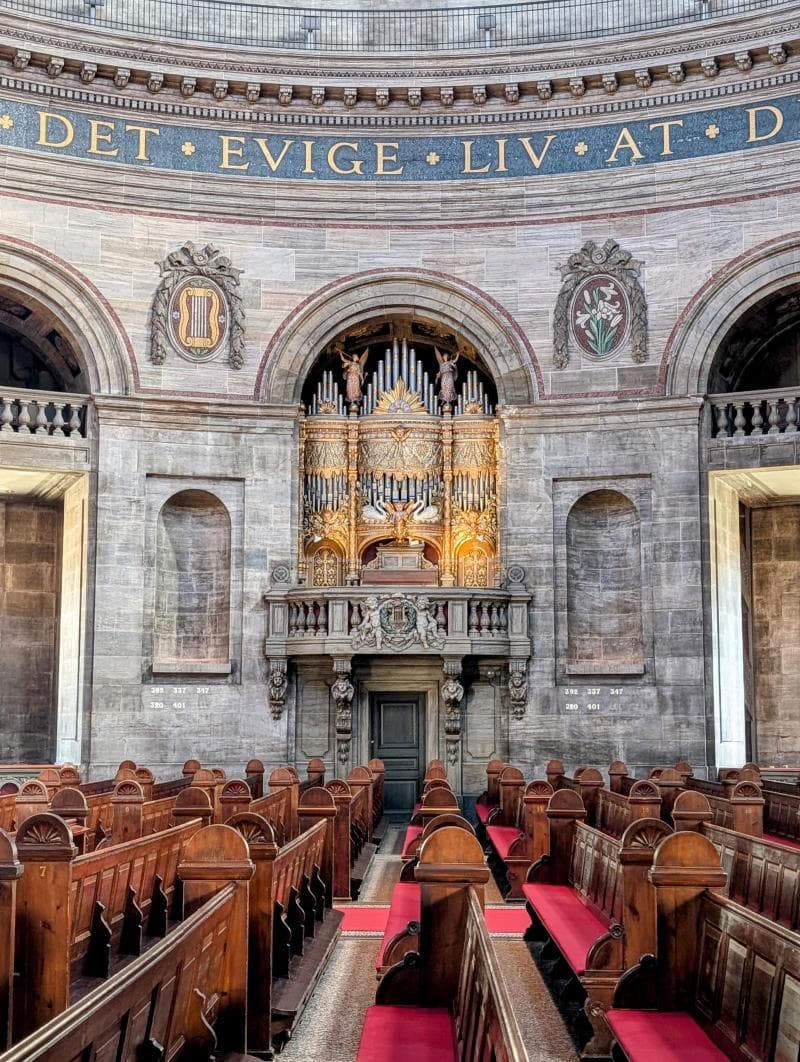
A fun fact: the church has been a popular venue for royal ceremonies, including weddings and baptisms, solidifying its place in Danish heritage. It's also renowned for its excellent acoustics and houses a modern Marcussen organ, alongside an ornate original 'Swan Organ' (no longer in use). For those seeking a deeper connection, the church offers free admission to its main hall, allowing visitors to soak in its serene atmosphere. For a small fee, guided tours allow access to the dome, offering breathtaking panoramic views of Copenhagen, Amalienborg Palace, and even the Øresund strait towards Sweden on clear days.
Visitor Perspective
Visiting the Marble Church offers a profoundly enriching experience. As you approach, the sheer scale of the dome is awe-inspiring, an immediate photo opportunity. Stepping inside, the vast, circular nave beneath the soaring dome creates an intimate yet grand spatial experience, a feeling of calm grandeur. The play of light through the dome's windows beautifully highlights the interior details, inviting contemplation.
Many travelers recommend timing your visit to coincide with the daily changing of the guard at nearby Amalienborg Palace, as the church serves as a perfect complement to a royal district exploration. The church's central location in Frederiksstaden means it's easily walkable from other key Copenhagen attractions like Nyhavn. Whether you are an architecture enthusiast, a history buff, or simply a curious traveler, the Marble Church provides a memorable and meaningful cultural encounter in the heart of Copenhagen.
Coordinates: 12.58958, 55.68498
View on Google Maps💬 How Travelers Describe This Place
Based on community votes
Unique
921Photogenic
831Must See
357Interesting
232Beautiful
147
Traveler Stories
Discover memorable experiences shared by travelers who have visited this place.
No traveler stories yet.
Be the first traveler to share what made this place memorable.

Tour
By
Spot
Discover amazing places around the world. Your journey starts here.
Explore
© 2026 TourBySpot. All rights reserved.