Palace Square
Copenhagen, Denmark
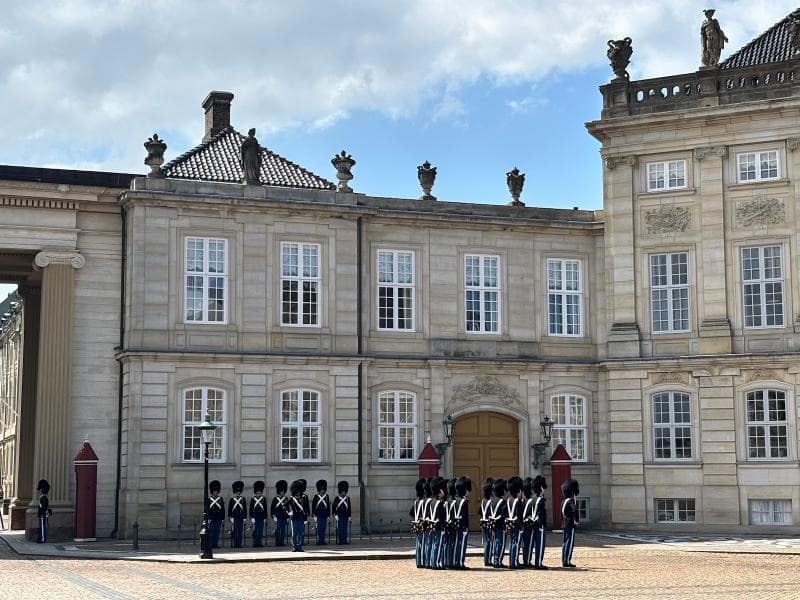
Explore Amalienborg's Palace Square in Copenhagen, Denmark, the living heart of the Danish monarchy. Witness the Changing of the Royal Guard.
Overview
Palace Square, or 'Amalienborg Slotsplads', stands as the vibrant heart of the Amalienborg Palace complex in Copenhagen, Denmark. This magnificent octagonal square is encircled by four identical Rococo palaces, serving as the official winter residence for the Danish royal family. More than just an architectural marvel, it is a living symbol of Denmark's monarchy and a focal point for both daily life and grand royal events. At its center proudly stands a monumental equestrian statue of King Frederik V, the founder of this distinguished area. Visitors flock here daily, drawn by the allure of royal history and the captivating spectacle of the Changing of the Royal Guard, a tradition that animates the square with pomp and precision.
History & Cultural Background
The Amalienborg Palace complex, with its central Palace Square, was conceived in the early 1750s as a grand urban development known as Frederiksstaden. This ambitious project aimed to commemorate the 300th anniversary of the Oldenburg royal house, reflecting the era's ideal of absolutism. Designed by the renowned architect Nicolai Eigtved, the four palaces surrounding the square were initially intended as residences for prominent noble families. However, fate intervened in 1794 when the royal residence, Christiansborg Palace, was consumed by a devastating fire. The royal family, left without a home, acquired the Amalienborg palaces, which were unoccupied at the time, and made them their new official residence. Since then, Amalienborg has remained the primary residence of the Danish monarchy, steeped in centuries of royal heritage.
What Makes It Special
What truly sets Amalienborg's Palace Square apart is its harmonious blend of architectural grandeur, historical significance, and living royal tradition. It is considered one of Europe's finest Rococo ensembles, with Nicolai Eigtved's design providing a balanced and stately aesthetic. The four palaces, Christian VII's, Frederik VIII's, Christian IX's, and Christian VIII's, each bear the names of past royals and still serve various functions for the royal family today. At the heart of the octagonal square, the equestrian statue of King Frederik V is a masterpiece by French sculptor Jacques Saly. This impressive statue, unveiled in 1771, was so elaborate that it reportedly took 14 to 20 years to complete and cost more than the combined construction of the four palaces themselves. The square's enduring charm is also found in its continuous role as a working royal palace, where visitors can witness the monarchy's daily rhythm firsthand.
Stories, Fun Facts & Local Details
Palace Square is a stage for countless stories. The daily Changing of the Royal Guard is a cherished ritual, drawing crowds to witness the Royal Life Guard marching from their barracks at Rosenborg Castle through the city streets to Amalienborg, arriving precisely at noon. The presence of musical accompaniment, such as the Royal Guards music band, depends on whether the monarch is in residence—indicated by a raised flag. When the monarch is not present, the guard still changes, but without the band. This tradition underscores the active role of the Danish royal family. A fascinating historical anecdote recounts how during World War II, a small police force guarding the King at Amalienborg barricaded the square and engaged with German soldiers, resulting in casualties. Furthermore, Christian IX and Queen Louise, who resided here, earned the title 'the in-laws of Europe' because four of their children ascended to various European thrones, linking Amalienborg to royal lineages across the continent.
Visitor Perspective
For any curious traveler, a visit to Amalienborg's Palace Square offers a unique opportunity to immerse oneself in Danish royal life. The square itself is freely accessible 24/7, allowing everyone to admire the Rococo architecture and soak in the atmosphere. The highlight for many is the Changing of the Guard ceremony, which takes place daily at 12:00 PM. It is advisable to arrive a little earlier, around 11:30 AM, to see the guards marching from Rosenborg Castle. When observing the ceremony, visitors are kindly asked to maintain a respectful distance from the guards and the palace buildings, typically 1.5 meters, to ensure safety and decorum. For a deeper dive into royal history, the Amalienborg Museum, located in Christian VIII's Palace, showcases the private interiors and historical artifacts of recent kings and queens, providing a captivating behind-the-scenes look at the Danish monarchy. Nearby, one can explore other cultural gems like Frederik's Church, also known as the Marble Church, and the scenic Amalie Garden, both integral parts of the Frederiksstaden district's grand design.
Coordinates: 12.59302, 55.684059
View on Google Maps💬 How Travelers Describe This Place
Based on community votes
Must See
998Unique
903Beautiful
481Interesting
458Photogenic
197
Traveler Stories
Discover memorable experiences shared by travelers who have visited this place.
No traveler stories yet.
Be the first traveler to share what made this place memorable.

Tour
By
Spot
Discover amazing places around the world. Your journey starts here.
Explore
© 2026 TourBySpot. All rights reserved.