Temple Of Poseidon
Athens, Greece
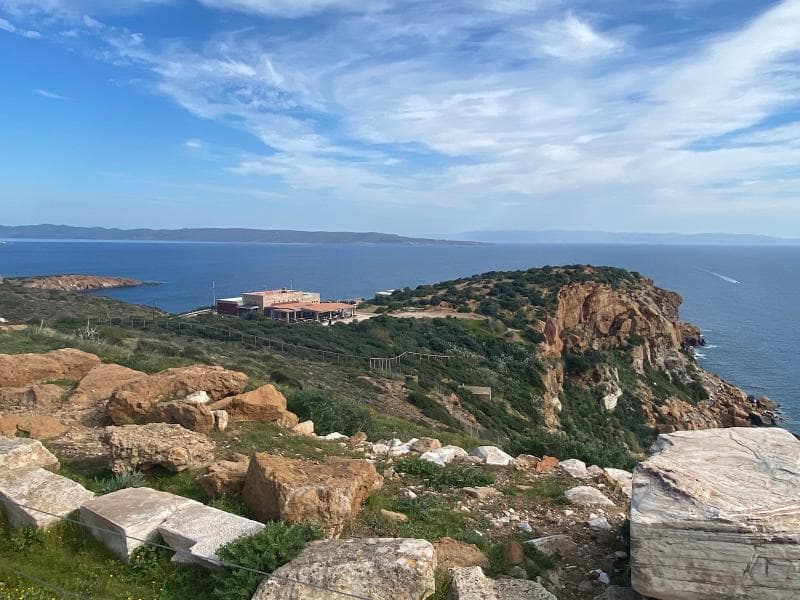
Explore the ancient Temple of Poseidon at Cape Sounion, Athens, Greece. Discover its rich history, stunning Aegean views, and mythological tales.
Overview
Perched dramatically on the southernmost tip of the Attica peninsula, the Temple of Poseidon at Cape Sounion stands as an enduring monument to ancient Greek civilization and its profound connection to the sea. Approximately 69 kilometers southeast of Athens, this ancient sanctuary offers not only a glimpse into classical architecture but also breathtaking panoramic views of the Aegean Sea. Dedicated to Poseidon, the mighty Olympian god of the sea, the temple's white marble columns have served as a navigational beacon for sailors for millennia, signaling both the approach to Attica and the sanctity of the site.
The temple is a prime example of the Doric order, characterized by its elegant simplicity and robust construction. Its strategic location, high above the waves, makes it an unforgettable destination, especially renowned for its spectacular sunsets that paint the sky over the endless blue.
History & Cultural Background
The history of Cape Sounion as a sacred site stretches back to at least the 11th century BC, with archaeological evidence suggesting continuous religious activity. Homer first referred to Sounion as a sacred cape in the Odyssey, testifying to its ancient significance. The present Temple of Poseidon was constructed during Athens' illustrious Golden Age, between 444 and 440 BC, under the ambitious building program initiated by the statesman Pericles. This period also saw the construction of other iconic Athenian structures, such as the Parthenon and the Temple of Hephaestus, with some historians suggesting the same architect may have designed the Temple of Poseidon.
This temple replaced an earlier poros stone temple on the site, which was destroyed by Persian forces in 480 BC during their invasion of Greece. After their victory against the Persians in the naval Battle of Salamis, the Athenians famously placed a captured Persian warship at Sounion as a trophy dedicated to Poseidon, underscoring their reverence for the sea god. Given Athens' reliance on maritime trade and its formidable naval power, the worship of Poseidon, brother of Zeus and god of the seas, was paramount. He was revered as the protector of sailors, and his favor was continuously sought, as his wrath could unleash devastating storms.
Cape Sounion was not merely a place of worship; its elevated position made it a crucial strategic point. It functioned as a border post, a lookout for approaching ships, and a fortress guarding the sea lanes to Piraeus, Athens' central port. The nearby silver mines of Lavrion also contributed significantly to Athenian wealth and naval strength, further highlighting the cape's economic and military importance.
What Makes It Special
The Temple of Poseidon's allure stems from its extraordinary fusion of human artistry and natural grandeur. Its placement atop a 60-meter-high cliff commands unbroken views of the Aegean Sea, creating an awe-inspiring spectacle. Constructed from coarse-grained white marble quarried from the nearby Agrileza Valley, the temple features Doric columns that are notably slenderer than typical Doric pillars and possess 16 flutes instead of the usual 20. This unique design element was likely chosen for its aesthetic and structural resilience against the exposed, harsh coastal weather.
Historically, its tall white marble columns served as a vital navigational landmark, visible from afar and guiding ancient mariners towards safety. Inside the cella, a colossal bronze statue of Poseidon, estimated to be 20 feet tall, once stood facing the temple's entrance, reinforcing the god's majestic presence. Though much of the temple's sculptural decoration has eroded, an Ionic frieze on the architrave once depicted mythological scenes such as the Gigantomachy and the Amazonomachy, with Parian marble reliefs celebrating Poseidon's power and Theseus's deeds.
Stories, Fun Facts & Local Details
Cape Sounion is steeped in captivating myths and historical anecdotes. Perhaps the most poignant is the legend of King Aegeus. Expecting his son Theseus to return from Crete after confronting the Minotaur, Aegeus instructed him to hoist white sails if victorious. Tragically, Theseus forgot, and upon seeing black sails, the despairing king cast himself into the sea from Cape Sounion, giving the Aegean Sea its name.
The site's ancient importance is further cemented by its mention in Homer's Odyssey, identifying it as a sacred place where King Menelaus of Sparta buried his helmsman, Phrontis. A more recent historical touch involves the famous English Romantic poet Lord Byron, who visited in 1810 and carved his name into one of the temple's columns, a testament to its enduring romantic appeal. Beyond its religious role, ancient Greeks also held grand quadriennial festivals at Sounion in honor of Poseidon, with officials arriving in sacred ships.
Visitor Perspective
Visiting the Temple of Poseidon is an immersive journey into ancient history and natural splendor. As you approach, whether by land along the scenic Athenian Riviera or by sea, the sight of the temple's enduring columns rising above the cliffs is truly unforgettable. The site invites contemplation, allowing travelers to walk in the footsteps of ancient Athenians and imagine the rituals and fears of those who depended on Poseidon's favor. The powerful sea breeze, the scent of pine, and the vast expanse of the Aegean Sea create a profound sense of connection to this timeless landscape.
While the temple is a magnificent archaeological ruin, the surrounding environment significantly enhances the experience. The panoramic views are spectacular, encompassing islands like Kea and Kythnos. Many visitors time their visit to witness the famous Sounion sunset, a truly magical transition of colors over the sea, often considered one of Greece's most beautiful. It's advisable to wear comfortable shoes and bring sun protection, as the site is exposed. The adjacent area also contains the remnants of the Sanctuary of Athena, adding another layer to the historical exploration.
Coordinates: 24.0148, 37.65021
View on Google Maps💬 How Travelers Describe This Place
Based on community votes
Photogenic
639Unique
421Interesting
366Must See
298Beautiful
212
Traveler Stories
Discover memorable experiences shared by travelers who have visited this place.
No traveler stories yet.
Be the first traveler to share what made this place memorable.
Things to see at Temple Of Poseidon



Tour
By
Spot
Discover amazing places around the world. Your journey starts here.
Explore
© 2026 TourBySpot. All rights reserved.