Sukhbaatar Square
Ulaanbaatar, Mongolia
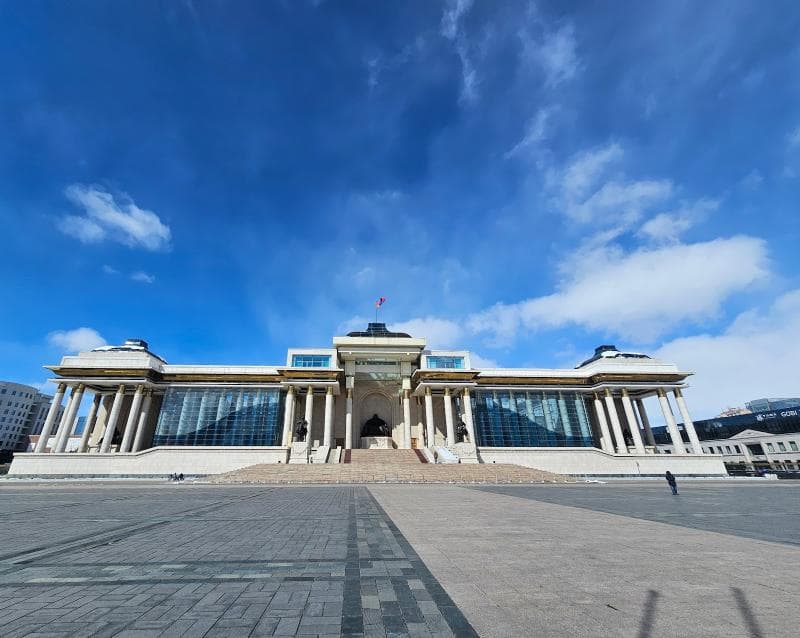
Explore Sukhbaatar Square, the central heart of Ulaanbaatar, Mongolia. Discover its rich history, iconic statues of Sükhbaatar and Genghis Khan, and vibrant cultural significance as the nation's civic hub.
Overview
Sukhbaatar Square, nestled in the vibrant heart of Ulaanbaatar, Mongolia, serves as a grand central plaza and a profound symbol of the nation's independence and rich history. It is more than just an open space; it is the epicenter of civic life, where historical narratives intertwine with modern-day Mongolian identity. Visitors find themselves surrounded by significant landmarks, from the imposing Government Palace to cultural institutions, all contributing to a captivating urban tapestry. The square features an iconic equestrian statue of Damdin Sükhbaatar, the revolutionary hero for whom the square is named, and a majestic monument dedicated to Genghis Khan, creating a powerful tableau of Mongolia's past and present.
This expansive plaza is a focal point for national celebrations, cultural gatherings, and public events, drawing both locals and international travelers alike. It offers a unique vantage point to observe the daily rhythms of Ulaanbaatar and immerse oneself in the country's spirit.
History & Cultural Background
The area now known as Sukhbaatar Square has a long and evolving history. In the early 19th century, it was referred to as 'Indriin Square' or 'Great Universe'. Following the death of Damdin Sükhbaatar in 1923, the square was officially named in his honor. Sükhbaatar is revered as the 'hero of the revolution' for his pivotal role in leading Mongolia to declare its final independence from China in July 1921.
A monumental equestrian statue of Damdin Sükhbaatar, depicting him on a charging horse and pointing skyward, was erected in the center of the square in 1946, commemorating the 25th anniversary of the revolution. This statue stands on the very spot where, according to legend, Sükhbaatar's horse urinated during a celebratory rally in 1921, an event seen as a good omen that was marked and later chosen as the statue's foundation.
The square saw a temporary name change in 2013 to 'Chinggis Square' in homage to Genghis Khan, but its original name, Sukhbaatar Square, was restored in 2016, reflecting the complex layers of Mongolian national identity. The grand Government Palace, situated on the northern side of the square, was constructed between 1946 and 1951. In front of the Government Palace, a large colonnade monument featuring a seated Genghis Khan flanked by his son Ögedei Khan and grandson Kublai Khan was added in 2006, celebrating the 800th anniversary of the Mongol Empire.
Historically, Sukhbaatar Square was also the central stage for significant political events, including military parades during Mongolia's socialist period and the pivotal demonstrations and hunger strikes of the Democratic Revolution in 1990.
What Makes It Special
Sukhbaatar Square holds a unique charm due to its blend of historical reverence and contemporary vitality. It presents a fascinating architectural contrast, with Soviet-era buildings standing alongside modern skyscrapers, framing a space that honors both Mongolia's revolutionary past and its imperial legacy. The dual presence of statues dedicated to Damdin Sükhbaatar and Genghis Khan underscores the nation's profound respect for its founders and liberators.
Beyond its monuments, the square functions as the beating heart of Ulaanbaatar's civic and cultural life. It regularly hosts major state ceremonies, national holidays, rock concerts, and cultural exhibitions. The Government Palace, housing the offices of the president and prime minister, dominates the northern view, while other important institutions like the State Opera and Ballet Theatre, the National Museum of Mongolia, and the Central Post Office are all within the square's vicinity.
Stories, Fun Facts & Local Details
One of the most intriguing stories associated with Sukhbaatar Square is the legend of Damdin Sükhbaatar's horse. It is said that during the celebration of the 1921 revolution, his horse urinated on a specific spot in the square. This event was perceived as an auspicious sign, and a soldier named 'Bonehead' Gavaa marked the location. Years later, in 1946, the spot was found and chosen as the foundation for Sükhbaatar's equestrian statue.
The statue itself is not just a depiction; it carries a powerful message. An inscription at its base features Sükhbaatar's words: 'If we an entire people unite in a common effort and common will, there is nothing in the world that we can not achieve, learn and succeed in.' Surrounding the statue are 14 lion sculptures connected by 208 iron chains, symbolizing the idea that 'Mongolia is inviolable.'
Adding to its historical layers, a mausoleum containing Sükhbaatar's remains once stood on the square until its demolition in 2005. Today, the square is a lively gathering place where Mongolians celebrate milestones like graduations and weddings, often posing for photographs with the iconic statues. During warmer months, a new urban park and musical fountain, featuring light and water shows, draw crowds of all ages, transforming the square into a dynamic hub of activity.
Visitor Perspective
For a curious traveler, Sukhbaatar Square offers an unparalleled opportunity to grasp the essence of Ulaanbaatar and Mongolia. It is an ideal starting point for exploring the city's heritage and observing modern Mongolian life unfold.
Visiting the square allows for a relaxed stroll amidst impressive architecture and significant monuments. It's a pedestrian-friendly area, making it easy to wander and soak in the atmosphere. While there, you might witness the morning flag ceremony in front of the Government Palace, a solemn and impressive display. The Blue Sky Tower, located nearby, offers an observation deck providing panoramic views of the square and the city. Whether you are a history enthusiast, a photographer, or simply seeking to experience the pulse of Mongolia's capital, Sukhbaatar Square promises an enriching and memorable visit.
Coordinates: 106.9175, 47.919
View on Google Maps💬 How Travelers Describe This Place
Based on community votes
Beautiful
873Interesting
477Unique
422Photogenic
157Must See
53
Traveler Stories
Discover memorable experiences shared by travelers who have visited this place.
No traveler stories yet.
Be the first traveler to share what made this place memorable.
Things to see at Sukhbaatar Square





Tour
By
Spot
Discover amazing places around the world. Your journey starts here.
Explore
© 2026 TourBySpot. All rights reserved.