Parliament Building Facade
Ulaanbaatar, Mongolia
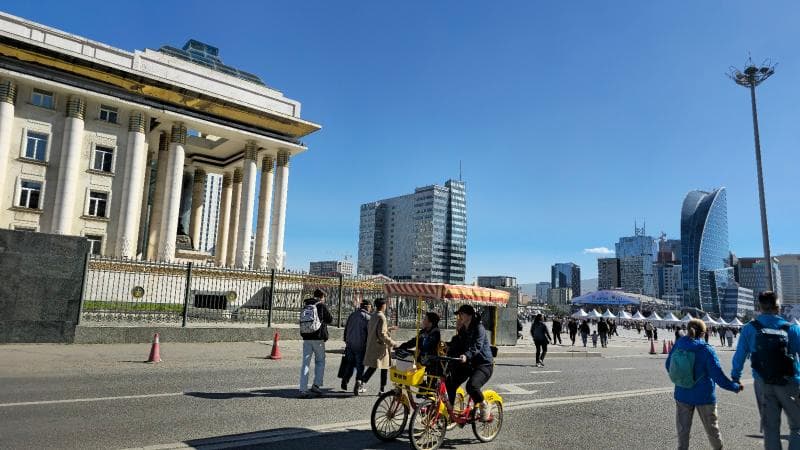
Explore the majestic Parliament Building Facade in Ulaanbaatar, Mongolia, a grand blend of history and modern design. Discover its iconic Chinggis Khaan monument.
Overview
The Parliament Building facade, prominently situated on the northern side of Sukhbaatar Square in Ulaanbaatar, Mongolia, is officially known as the Government Palace or State Palace. This grand edifice serves as the central administrative and ceremonial hub of the nation, housing the State Great Khural (Mongolia's unicameral parliament), along with the offices of the President and Prime Minister. Its striking architectural presence is a testament to Mongolia's rich past and its journey towards modernity, blending historical elements with contemporary design. Once known locally as the 'Saaral Ordon' or 'Gray Palace' due to its original exterior color, it was repainted white in 2007, enhancing its stately appearance. The facade is considered the architectural centerpiece of the Mongolian capital, an imposing and beautiful landmark often admired from the square, especially when illuminated at night.
History & Cultural Background
The Government Palace was constructed between 1946 and 1951, embodying the Soviet Classicism or Stalinist architectural style prevalent during that era. Its design initially reflected a period of significant Soviet influence, aiming to project governmental seriousness and permanence. However, the ground upon which it stands carries a much deeper historical resonance. This location was once home to the Ikh Khüree, also known as the Yellow Palace, a major monastic complex and the spiritual heart of pre-modern Ulaanbaatar. Over centuries, this sacred space underwent profound transformations, evolving from a religious center into a socialist administrative hub, and eventually into the democratic core of the nation.
A pivotal moment in modern Mongolian history, the peaceful Democratic Revolution of 1990, unfolded on the square before this building, marking the end of one-party rule. In a significant post-Soviet reinterpretation, a new facade and ceremonial complex were unveiled in 2006 to commemorate the 800th anniversary of the Great Mongol State. This renovation notably involved the removal of Sükhbaatar's Mausoleum, which had stood on the site until 2005-2006. The current facade thus stands as a symbol of Mongolia's enduring imperial identity intertwined with its modern democratic aspirations.
What Makes It Special
The Parliament Building's facade is most distinguished by its grand portico and monumental sculptural ensemble. At its heart sits a majestic, seated statue of Chinggis Khaan, Mongolia's revered founder, enshrined under a large rectangular glass cupola. This central figure is supported by four white marble columns with opulent gold capitals. Flanking the great Khaan are seated statues of his illustrious descendants: his third son, Ögedei Khaan, and his grandson, Khubilai Khaan, positioned in loggias on either side of the complex. Further enhancing this historical tableau are two mounted warrior statues, representing Chinggis Khaan's loyal generals, Bo'orchu and Muqali, who stand guard on either side of the grand stairway leading up to the monument.
The imposing 140-meter colonnade, composed of massive columns, contributes to the building's formidable presence. The integration of classical Mongolian motifs with contemporary architectural practices symbolizes the nation's continuous evolution and its cherished values. An inscription on Chinggis Khaan's pedestal, carved in classical Mongolian script, proudly declares, 'The founder of the Great Mongol State heavenly ruler Chinggis Khaan,' underscoring his profound significance. Adding another layer of cultural depth, the colonnade galleries feature state-of-the-art glass artworks by artist N. Amgalanbayar, which depict the rich history of Mongolian statehood.
Stories, Fun Facts & Local Details
Sukhbaatar Square, named after Damdin Sükhbaatar, a revolutionary hero who led Mongolia's 1921 revolution, holds numerous captivating tales. An iconic equestrian statue of Sükhbaatar still stands proudly in the center of the square. A popular local anecdote recounts that his statue is placed precisely where his horse allegedly urinated during a triumphant rally in 1921, an event considered a fortuitous omen by many. This spot was carefully marked and later chosen for his monument.
The square itself is a vibrant focal point for Ulaanbaatar's public life. It regularly hosts national events, celebrations, and diverse cultural gatherings, ranging from traditional festivals like Naadam to contemporary rock concerts. It's common to see foreign dignitaries paying their respects by laying flowers at Sükhbaatar's statue during official visits. The square's evolving name—briefly changed to Chinggis Khaan Square in 2013 before reverting to Sukhbaatar Square in 2016—reflects the dynamic interplay of historical figures in Mongolia's national identity. The Parliament Building's former nickname, 'Saaral Ordon' (Gray Palace), also offers a glimpse into local historical perceptions of the structure before its significant renovation.
Visitor Perspective
For any traveler exploring Ulaanbaatar, the Parliament Building facade is an essential sight. While the Government Palace itself is generally not open for public tours, its magnificent exterior and the monumental Chinggis Khaan complex are fully accessible and best admired from Sukhbaatar Square. This area offers unparalleled photo opportunities, capturing the grandeur of the architecture and the historical significance of the statues. As the central hub of Ulaanbaatar, the square provides an ideal starting point for city exploration, with numerous other cultural and historical landmarks within easy walking distance. Visitors can immerse themselves in the atmosphere of Mongolia's political and cultural heart, often bustling with locals and tourists alike, especially during the many national celebrations and public events that take place here.
Coordinates: 106.91722, 47.92083
View on Google Maps💬 How Travelers Describe This Place
Based on community votes
Beautiful
998Interesting
903Unique
481Photogenic
458Must See
92
Traveler Stories
Discover memorable experiences shared by travelers who have visited this place.
No traveler stories yet.
Be the first traveler to share what made this place memorable.

Tour
By
Spot
Discover amazing places around the world. Your journey starts here.
Explore
© 2026 TourBySpot. All rights reserved.