Government Palace
Ulaanbaatar, Mongolia
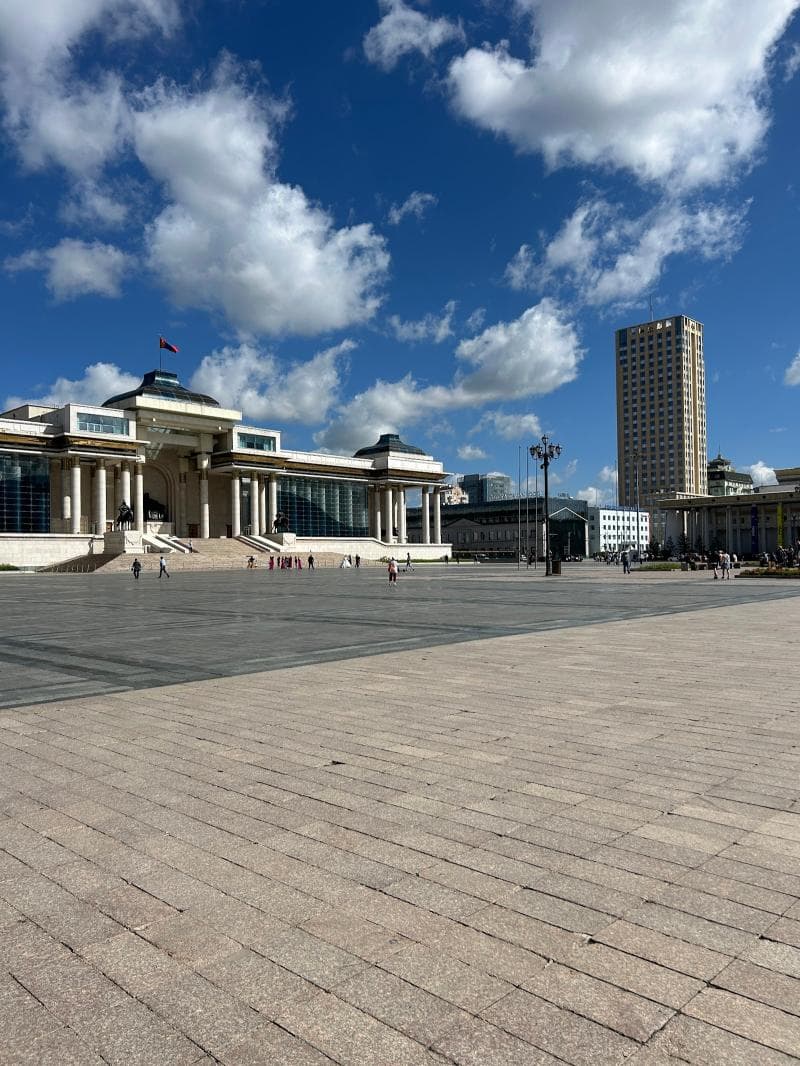
Explore the Government Palace in Ulaanbaatar, Mongolia, a symbolic blend of history and power, featuring colossal statues of Chinggis Khaan and unique architecture.
Overview
The Government Palace, also known as the State Palace, stands as a monumental landmark on the northern side of Sukhbaatar Square in Ulaanbaatar, Mongolia. This grand edifice serves as the heart of Mongolia's political life, housing the State Great Khural (the unicameral parliament), along with the offices of the President and the Prime Minister. Its imposing Stalinist classical facade, characterized by a 140-meter colonnade of massive columns, makes it an undisputed architectural centerpiece of the capital. Originally referred to by locals as 'Saaral Ordon', meaning 'Gray Palace', due to its former exterior color, the building was repainted white in 2007, enhancing its visual prominence.
Sukhbaatar Square itself is more than just a public space; it is a ceremonial hub that has witnessed key historical events and continues to host significant national celebrations, including the opening ceremonies of the annual Naadam festival. The palace's strategic location anchors this central area, reflecting its importance in both governance and public life.
History & Cultural Background
The ground upon which the Government Palace now stands holds centuries of rich history. Before its construction, this area was largely occupied by the Ikh Khüree monastery, also known as Züün Khüree (East Monastery), which served as the central temple-palace complex and spiritual nucleus of pre-modern Ulaanbaatar. Established in 1639, this movable monastery eventually settled in its present location in 1855 and was renowned for its high-level monastic education and vibrant religious festivals.
The early 20th century saw significant transformations. The monastery was eventually destroyed, and a Green Domed Theater was built on the site, which tragically burned down in 1949. The construction of the current Government Palace commenced between 1946 and 1951, officially completed in 1951-1954, during a period of strong Soviet influence over the Mongolian People's Republic. The design embraced Stalinist High Classicism, aiming to project ideological seriousness and permanence through monumental civic architecture. For decades, the square in front of it, then known as Sukhbaatar Square, was the focal point for annual civil, youth, and military parades during Mongolia's socialist era.
A notable shift occurred in 1990 when the square became the epicenter of Mongolia's peaceful democratic revolution, witnessing mass protests that ultimately led to the end of one-party rule. Further changes in symbolism came with the dismantling of the Mausoleum of Sukhbaatar and Choibalsan in 2005-2006, making way for the grand colonnade and statues of Mongolian national heroes.
What Makes It Special
What truly sets the Government Palace apart is its unique blend of architectural styles and symbolic representations. While its core structure embodies Soviet-era classicism, a significant post-Soviet reinterpretation occurred in 2006. To commemorate the 800th anniversary of the Great Mongol Empire, a monumental sculptural ensemble was installed in the central portico.
The centerpiece of this ensemble is a colossal seated statue of Chinggis Khaan, the revered founder of the Mongol Empire. He is flanked by statues of his third son and successor, Ögedei Khaan, and his grandson, Kublai Khaan, creating a powerful dynastic axis. Two equestrian figures of Chinggis Khaan's trusted generals, Muqali and Bo'orchu, stand guard, further emphasizing the nation's imperial heritage. This artistic integration cleverly overlays Soviet architecture with pre-communist Mongolian identity, making the facade a stage for historical narrative and national memory.
Beyond its exterior, the palace functions as a modern governmental hub, housing not only parliamentary and presidential offices but also a Museum of Mongolian Statehood, which opened in 2012, showcasing historical and cultural relics within its walls.
Stories, Fun Facts & Local Details
The Government Palace is steeped in fascinating local lore and details that add to its character. Before its current white appearance, the building's gray exterior led to its affectionate nickname, 'Saaral Ordon' or 'Gray Palace', by the residents of Ulaanbaatar. The site itself, transforming from a prominent monastic complex to a socialist administrative center and finally to a symbol of democratic Mongolia, reflects the nation's tumultuous yet resilient journey.
A charming anecdote linked to the square's earlier history tells of General D. Sukhbaatar, after whom the square was originally named. Legend has it that when the People's Army entered Khuree in 1921, Sukhbaatar's horse urinated on the central square. A soldier then marked this spot, which was later chosen as the foundation for Sukhbaatar's equestrian statue.
Inside the palace complex, a large ceremonial ger – a traditional Mongolian nomadic dwelling – is a unique feature. It is used to receive distinguished guests, offering a tangible connection to Mongolia's nomadic roots amidst the formal setting of a government building. The majestic statue of Chinggis Khaan is elevated by a ceremonial 45-step staircase, symbolizing the age at which he unified the Mongolian nation, adding a layer of profound historical symbolism to the architectural design.
Visitor Perspective
While the Government Palace is a working government building, its external grandeur and historical significance make it a primary attraction for travelers to Ulaanbaatar. Most visitors experience the palace from Sukhbaatar Square, where they can admire its imposing facade, the iconic statues of Chinggis Khaan and his successors, and soak in the vibrant atmosphere of the city's central hub. The square is a popular gathering place, offering ample opportunities for photography and people-watching.
Direct access inside the palace is generally restricted due to its governmental function. However, specific events or pre-arranged appointments might allow entry. Visitors with official business are advised to bring identification, wear business attire or traditional clothing, and adhere to strict security protocols, including prohibitions on large luggage or liquids. While a visit inside may not always be possible, the sheer presence of the Government Palace and its historical context within Sukhbaatar Square provides a deeply enriching experience for anyone seeking to understand Mongolia's past and present.
Coordinates: 106.91731, 47.92075
View on Google Maps💬 How Travelers Describe This Place
Based on community votes
Photogenic
799Beautiful
639Unique
526Must See
366Interesting
181
Traveler Stories
Discover memorable experiences shared by travelers who have visited this place.
No traveler stories yet.
Be the first traveler to share what made this place memorable.

Tour
By
Spot
Discover amazing places around the world. Your journey starts here.
Explore
© 2026 TourBySpot. All rights reserved.