St. Pierre Cathedral
Geneva, Switzerland
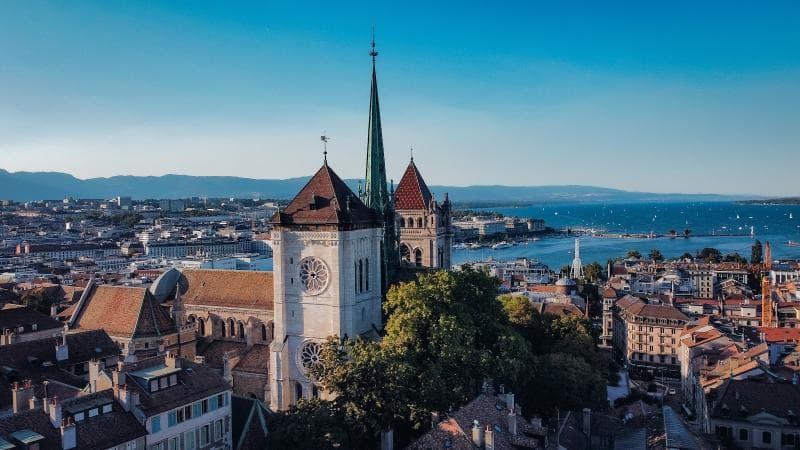
Explore St. Pierre Cathedral in Geneva, Switzerland, a historic landmark and Reformation site with panoramic city views and a fascinating archaeological crypt.
Overview
Perched majestically atop the highest point of Geneva's charming Old Town, St. Pierre Cathedral stands as a timeless sentinel, bearing witness to centuries of history and profound cultural shifts. This over 850-year-old architectural marvel in Geneva, Switzerland, is far more than just a church; it is a vibrant tableau of European heritage. Its commanding presence is a blend of various architectural styles, showcasing Romanesque foundations, Gothic embellishments, and an 18th-century Neoclassical facade. Since 1535, it has served as the principal church of the Protestant Church of Geneva and is inextricably linked with the powerful figure of John Calvin, who famously preached from its pulpit, cementing its role as a central site of the Protestant Reformation. A visit here offers a unique journey through time, from its ancient archaeological roots beneath the building to the breathtaking panoramic views from its towers, overlooking the city, Lake Geneva, and the distant Alps.
History & Cultural Background
The story of St. Pierre Cathedral began long before its current form. Evidence suggests that a place of worship has existed on this sacred hill since the 4th century CE. Intriguingly, archaeological discoveries reveal even deeper roots, uncovering a 1st-century BC tomb of an ancient Allobrogian chieftain, hinting at pre-Christian spiritual practices on this very spot. The first Christian edifice emerged between 350 and 375 AD, built upon the ruins of a Roman sanctuary, signifying Geneva's early importance as an episcopal seat.
The construction of the present-day cathedral commenced around 1160 under Prince-Bishop Arducius de Faucigny, initially in the Romanesque style, evolving with significant Gothic elements added throughout the 13th century, with its main structure largely completed by 1288. Over centuries, the cathedral experienced transformations, including a prominent Neoclassical facade added between 1752 and 1756, giving it a distinctive silhouette. The year 1535 marked a pivotal moment when Geneva embraced the Reformation. Catholic mass was abolished, and the cathedral transitioned into a Protestant place of worship, famously becoming 'St Peter's Temple.' John Calvin's 23 years of preaching within these walls profoundly influenced not only Geneva but the wider Protestant world. This rich tapestry of evolution has earned St. Pierre Cathedral recognition as a Swiss Cultural Property of National Significance and its inclusion in the 'European heritage' roll of honor in 2009.
What Makes It Special
St. Pierre Cathedral's uniqueness lies in its extraordinary layers of history and diverse appeal. Architecturally, it is a magnificent testament to time, showcasing an unusual yet harmonious blend of Romanesque, Gothic, and Neoclassical styles. However, its most compelling feature might be hidden beneath its soaring vaults: one of Switzerland's largest and most significant archaeological sites. Here, you can journey through 2,000 years of human history, exploring Roman mosaics, remnants of early Christian churches, and even the tomb of a Celtic chieftain, all presented with modern museum techniques.
Spiritually and historically, the cathedral is an undeniable symbol of the Protestant Reformation. Visitors can see the pulpit where John Calvin delivered his influential sermons, a stark reminder of Geneva's role as a 'Protestant Rome.' In vivid contrast to the main nave's reformed austerity, the exquisitely redecorated Chapel of the Maccabees, with its polychrome Gothic Revival style, offers a glimpse into earlier artistic expressions. Beyond its historical weight, the cathedral offers an unforgettable sensory experience. Climbing the 157 steps of its North Tower rewards you with unparalleled panoramic views of Geneva, the shimmering Lake Geneva, the iconic Jet d'Eau, and the majestic surrounding mountains. Moreover, the cathedral houses one of Switzerland's largest collections of Romanesque and Gothic capitals, a hidden artistic treasure.
Stories, Fun Facts & Local Details
Imagine standing where pre-Christian rituals once took place, centuries before the first stone of the cathedral was laid. The discovery of an Allobrogian chieftain's tomb beneath the building speaks to the profound continuity of this sacred space. During the Reformation, the cathedral's interior underwent a dramatic transformation. Most Catholic decorations were removed in 1535, reflecting Calvinism's emphasis on the 'Word' over ornate imagery, leaving a vast, plain interior that contrasts sharply with many other European cathedrals.
Legend speaks of the 'Calvin Chair,' an austere seat near the pulpit where the reformer is said to have sat. The cathedral's bells, including 'La Clémence' cast in 1407, are not merely timekeepers but have sometimes participated in unique events. On certain full moon nights, 'The Nocturnes de St-Pierre' offer visitors a chance to experience the towers by moonlight, with the bells occasionally playing unexpected popular tunes, creating a magical atmosphere. Beyond its religious significance, St. Pierre Cathedral remains an integral part of Geneva's civic life, notably hosting the oath-taking ceremony for the Swiss government, underscoring its enduring importance to the community.
Visitor Perspective
Visiting St. Pierre Cathedral is an accessible and enriching experience for any traveler to Geneva. Entry to the main nave of the cathedral is free, allowing everyone to absorb its historic ambiance and architectural grandeur. For those eager to delve deeper, separate tickets are available for the archaeological site beneath the cathedral and for ascending the North Tower. A combined ticket offers access to both, providing excellent value for a comprehensive visit.
The archaeological site, with its separate entrance, is a fascinating subterranean museum, where audio guides are available to narrate the rich history uncovered within. The climb to the North Tower, though involving 157 steps, is well worth the effort for the breathtaking views it provides. Allow approximately one hour for exploring the cathedral and climbing the towers, and another hour if you plan to explore the extensive archaeological site. Situated in the heart of Geneva's Old Town, the cathedral is easily reachable, and while wheelchair access to some areas is limited, there is an accessible entrance at the foot of the North Tower. With flexible opening hours throughout the year, St. Pierre Cathedral offers a profound connection to Geneva's past, present, and the enduring human spirit.
Coordinates: 6.14861, 46.20111
View on Google Maps💬 How Travelers Describe This Place
Based on community votes
Interesting
934Beautiful
879Unique
741Must See
396Photogenic
276
Traveler Stories
Discover memorable experiences shared by travelers who have visited this place.
No traveler stories yet.
Be the first traveler to share what made this place memorable.
Things to see at St. Pierre Cathedral



Tour
By
Spot
Discover amazing places around the world. Your journey starts here.
Explore
© 2026 TourBySpot. All rights reserved.