St. Mark's Square
Venice, Italy
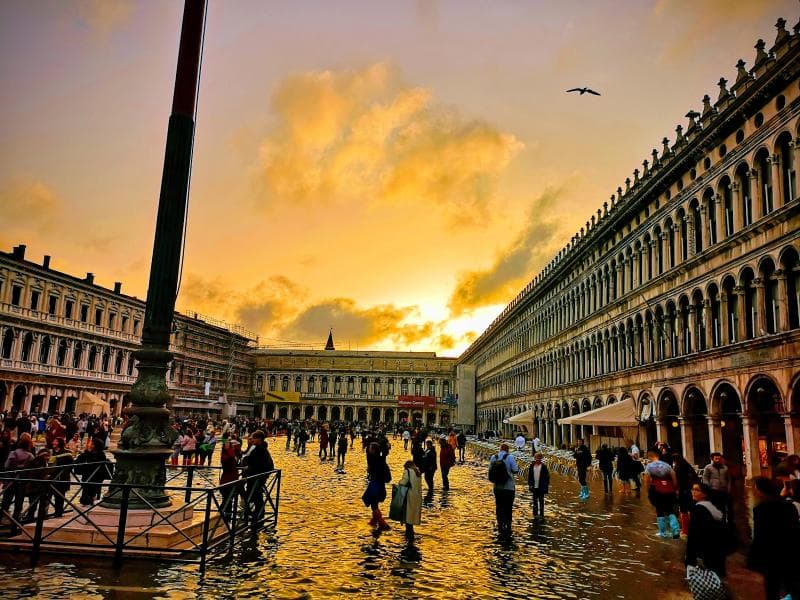
Discover St. Mark's Square in Venice, Italy – the iconic heart of the city, rich in history, breathtaking architecture, and unique Venetian charm.
Overview
St. Mark's Square, known locally as Piazza San Marco, stands as the illustrious heart of Venice, Italy. It is not merely a square but the city's principal public gathering space and the only one in Venice officially designated as a 'Piazza' (all others are called 'Campi'). This magnificent open area is surrounded by some of Venice's most iconic architectural treasures, including St. Mark's Basilica, the Doge's Palace, the Campanile, and the Procuratie buildings. Often described by Napoleon as 'the drawing room of Europe,' its grandeur and historical significance are palpable. The square's unique trapezoidal shape, measuring approximately 175 meters long and 72 meters wide, creates an expansive yet intimate atmosphere, perpetually bustling with life and history.
As the lowest point in Venice, St. Mark's Square is notably susceptible to 'acqua alta,' the seasonal high tides that can temporarily submerge parts of the city, adding another layer to its unique character. Despite this, or perhaps because of it, the square remains a vibrant hub, serving as a social, religious, and political center for centuries.
History & Cultural Background
The origins of St. Mark's Square trace back to the 9th century, when it was a smaller space adjacent to the original St. Mark's Basilica. Significant expansion and transformation occurred in the 12th century under Doge Sebastiano Ziani, who enlarged the area to accommodate the growing power and importance of the Venetian Republic. It was during this period that the square began to take on its present scale and function as the city's political and religious core.
The square has witnessed countless historical events, from ceremonial parades and official processions of the Doge to public festivals and even executions. Its architectural evolution reflects Venice's rich tapestry of cultural influences, particularly Byzantine and Renaissance styles. The current Campanile, though originally built in the 9th century as a watchtower, collapsed in 1902 and was meticulously rebuilt 'as it was, where it was' by 1912. The grand buildings encircling the square, such as the Procuratie, once housed important government offices and now host historic cafes and museums, continuously contributing to the square's living history.
What Makes It Special
St. Mark's Square is distinguished by its unparalleled collection of historical and architectural masterpieces. Dominating one end is St. Mark's Basilica, an extraordinary example of Italo-Byzantine architecture renowned for its opulent facades and over 4,000 square meters of glittering gold mosaics that narrate biblical stories. Adjacent to it stands the Doge's Palace, a stunning Gothic edifice that served as the seat of Venetian power and residence for the Doges.
The towering Campanile offers breathtaking panoramic views of Venice and its lagoon, a vantage point from which to truly appreciate the city's unique urban fabric. The square's elegant arcades, home to cafes like the historic Caffè Florian, invite visitors to pause and soak in the atmosphere, just as they have for centuries. The presence of the Piazzetta dei Leoncini and the two iconic columns marking the entrance from the lagoon, featuring the winged lion of St. Mark and St. Theodore, further cements its unique identity.
Stories, Fun Facts & Local Details
One of the most enduring stories associated with the square involves the relics of St. Mark the Evangelist. Venetian merchants famously 'acquired' these relics from Alexandria in the 9th century, hiding them in barrels of pork to circumvent Muslim guards. This act solidified St. Mark as Venice's patron saint and led to the construction of the magnificent Basilica to house his remains.
A quirky detail is that St. Mark's is the only 'Piazza' in Venice; all other public squares are called 'Campi' (fields), a nod to their less formal origins. Also, the square's persistent struggle with 'acqua alta' means that during high tides, raised walkways are often deployed, transforming the square into a fascinating, temporary waterscape. Locals often joke about it being 'the closest you can get to the water' without being in a canal.
Legend also has it that walking between the two grand granite columns at the entrance to the Piazzetta from the lagoon brings bad luck, as this was historically a site for public executions. Another fascinating aspect is the presence of three flagpoles in front of the Basilica, which historically represented the three kingdoms Venice conquered: Crete, Cyprus, and the Peloponnese.
Visitor Perspective
Visiting St. Mark's Square is an essential Venetian experience. To truly appreciate its beauty and history, consider arriving early in the morning, between 8 and 9 AM, to avoid the peak crowds and capture its serenity. Late afternoons and evenings also offer a magical ambiance as the square lights up.
Allow ample time to explore the key attractions: marvel at the mosaics inside St. Mark's Basilica, delve into the history of the Venetian Republic at the Doge's Palace, and ascend the Campanile for unparalleled views. The Museo Correr, Archaeological Museum, and Marciana Library also provide rich cultural insights into Venice's past. Whether enjoying a coffee at one of the historic cafes or simply observing the ebb and flow of life, St. Mark's Square offers a profound connection to Venice's soul. During 'acqua alta,' waterproof shoes are recommended to fully embrace this unique Venetian phenomenon.
Coordinates: 12.339092, 45.434326
View on Google Maps💬 How Travelers Describe This Place
Based on community votes
Beautiful
953Unique
658Photogenic
585Interesting
69Must See
22
Traveler Stories
Discover memorable experiences shared by travelers who have visited this place.
No traveler stories yet.
Be the first traveler to share what made this place memorable.
Things to see at St. Mark's Square



Tour
By
Spot
Discover amazing places around the world. Your journey starts here.
Explore
© 2026 TourBySpot. All rights reserved.