Campanile
Venice, Italy
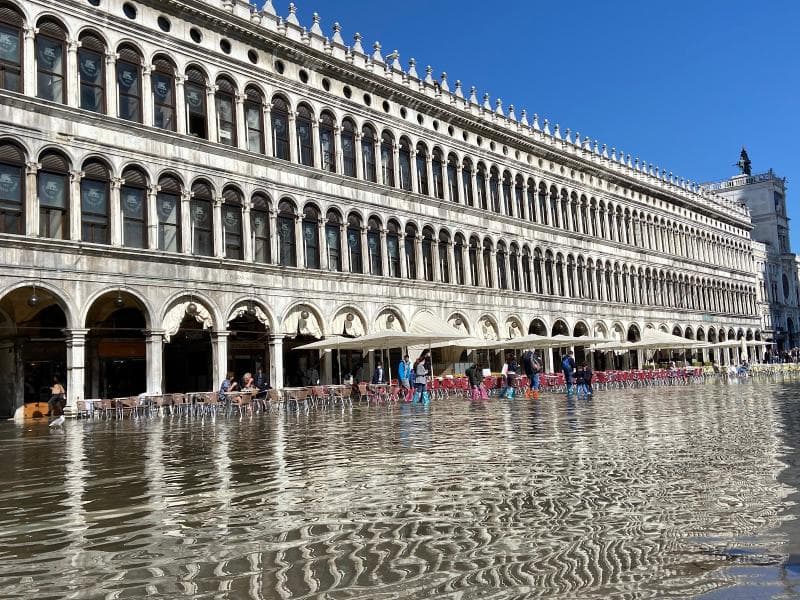
Discover the Campanile di San Marco in Venice, Italy – the iconic bell tower in St. Mark's Square offering breathtaking panoramic views and rich history.
Overview
Standing majestically in the heart of St. Mark's Square, the Campanile di San Marco, often affectionately called 'El Paron de Casa' (the Master of the House) by Venetians, is an undeniable symbol of Venice, Italy. This towering bell tower of St. Mark's Basilica reaches a height of approximately 98.6 meters, making it the tallest structure in the city. From its commanding position, it offers unparalleled panoramic views of Venice, its intricate network of canals, the shimmering lagoon, and even distant islands. While appearing ancient, the Campanile travelers see today is a faithful reconstruction, completed in 1912, after its dramatic collapse a decade earlier. Its enduring presence marks it as a historical sentinel, watching over centuries of Venetian life and providing a focal point for the iconic Piazza San Marco. It is a landmark that has served many purposes, from a defensive watchtower to a scientific observatory, continually adapting to the needs and spirit of the Republic.
History & Cultural Background
The roots of the Campanile di San Marco stretch back to the 9th or 10th century, when it was initially conceived as a simple watchtower and lighthouse to guard the entry to the city and guide ships safely into Venice's harbor. Over centuries, it underwent numerous transformations and additions, with a belfry and spire first appearing in the 12th century. The tower achieved its full height and its iconic Renaissance form in 1514, after significant rebuilding efforts following an earthquake in 1511. However, the tower's long history was punctuated by damage from lightning strikes and other calamities.
A pivotal moment in its story occurred on July 14, 1902, when the Campanile unexpectedly collapsed. Despite being over a thousand years old, the collapse was largely contained, miraculously causing no human fatalities, though it destroyed the Loggetta at its base and a corner of the Biblioteca Marciana. The only recorded casualty was the caretaker's cat. The city of Venice, recognizing its profound importance, famously vowed to rebuild it 'com'era, dov'era' – 'as it was, where it was'. This monumental task took ten years, and the rebuilt Campanile, incorporating many original materials and enhanced with modern structural stability, was inaugurated on April 25, 1912, exactly 1000 years after the alleged laying of the original foundations.
What Makes It Special
Beyond its impressive height and commanding presence, several elements make the Campanile di San Marco truly unique. At its summit, a golden statue of the Archangel Gabriel, crafted in 1882, acts as a weather vane, glinting in the Venetian sun and serving as a beacon for those approaching by sea. The belfry houses five historic bells, each with a distinct voice and purpose in the civic and religious life of the Venetian Republic. The largest, the 'Marangona', signaled the beginning and end of the working day. The 'Malefico' would ring for executions, the 'Nona' for midday, the 'Trottiera' to summon members of the Maggior Consiglio, and the 'Mezza terza' for Senate sessions.
At its base lies the elegant Loggetta del Sansovino, a finely decorated marble structure that once served as a meeting place for nobles and a sentry post. Although destroyed in the 1902 collapse, it was meticulously rebuilt with original fragments and precise replication. The simple yet grand design of the Campanile, a square brick shaft topped by a belfry and pyramidal spire, stands in contrast to the ornate architecture of St. Mark's Basilica and the Doge's Palace, yet harmonizes perfectly within the square. Its isolated position makes it a distinct landmark and a testament to Venetian engineering and artistry.
Stories, Fun Facts & Local Details
The Campanile holds fascinating anecdotes within its ancient brickwork. One of the most celebrated involves the renowned scientist Galileo Galilei. In 1609, he used the Campanile as an observatory to demonstrate his newly improved telescope to the Venetian Doge and other prominent figures, forever linking the tower to advancements in astronomy. Imagine the awe of those present as they witnessed distant ships and celestial bodies through this revolutionary device from atop Venice's tallest point.
Another cherished tradition connected to the tower is the 'Flight of the Angel' (Svolo dell'Angelo), a spectacular event during the Venice Carnival. Historically, an acrobat would descend on a tightrope from the Campanile's belfry to the Doge's Palace, a thrilling performance that marked the start of the festivities. Today, this tradition continues with a 'celebrity' taking on the role of the Angel, symbolizing the city's enduring spirit and its love for spectacle. The story of the Campanile's collapse in 1902 often includes the poignant detail that the only fatality was the bell-ringer's cat, a small mercy that Venetians remember with a sense of humor, emphasizing the 'gentlemanly' way the tower fell.
Visitor Perspective
For any traveler to Venice, a visit to the Campanile di San Marco offers an unforgettable experience, providing a unique aerial perspective of this extraordinary city. The ascent to the observation deck is made comfortable by a modern lift, eliminating the need for hundreds of steps. As you rise, the bustling energy of St. Mark's Square shrinks below, and the city's true geography unfolds before your eyes. From the top, you gain a breathtaking 360-degree panorama. You can clearly trace the serpentine Grand Canal, identify the domes of St. Mark's Basilica, admire the grandeur of the Doge's Palace, and spot the distinct shapes of islands like Giudecca and San Giorgio Maggiore.
On a clear day, the views extend even further, reaching the distant peaks of the Alps. This bird's-eye view profoundly illustrates Venice's unique relationship with water, revealing the city as a delicate mosaic of islands rather than a continuous landmass. It's a moment of quiet contemplation amidst the city's vibrant energy, allowing you to grasp the sheer marvel of Venice's construction and its harmonious integration with the lagoon. The experience offers not just stunning photographs, but a deeper appreciation for the city's layout, history, and its enduring magic.
Coordinates: 12.339, 45.434
View on Google Maps💬 How Travelers Describe This Place
Based on community votes
Photogenic
872Interesting
846Must See
201Beautiful
121Unique
87
Traveler Stories
Discover memorable experiences shared by travelers who have visited this place.
No traveler stories yet.
Be the first traveler to share what made this place memorable.

Tour
By
Spot
Discover amazing places around the world. Your journey starts here.
Explore
© 2026 TourBySpot. All rights reserved.