St. Mark’s Basilica
Venice, Italy
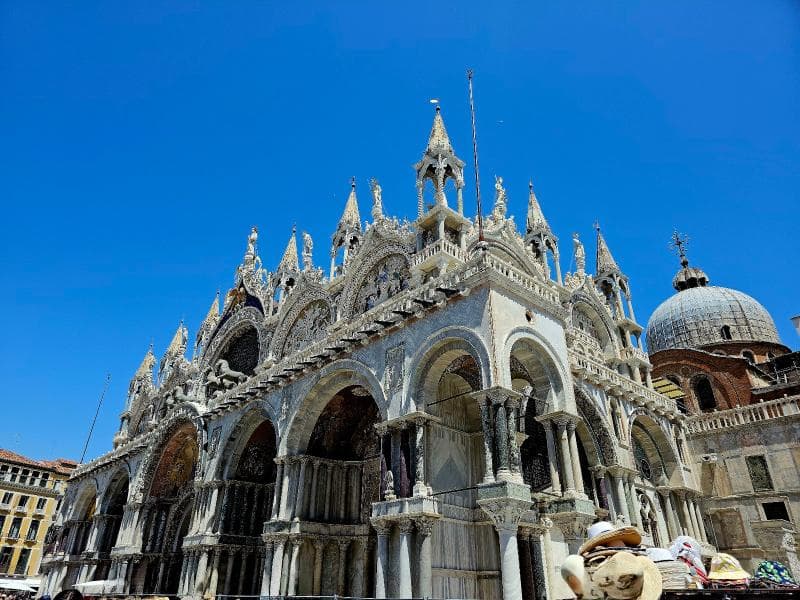
Discover St. Mark's Basilica, Venice, Italy's golden masterpiece. Explore its Byzantine architecture, shimmering mosaics, and rich history in St. Mark's Square.
Overview
Nestled in the heart of Venice, Italy, within the grandeur of St. Mark's Square, stands St. Mark's Basilica (Basilica di San Marco). Often referred to as the 'Chiesa d'Oro' or 'Church of Gold', this magnificent cathedral is an iconic symbol of Venetian history, wealth, and spiritual devotion. Its distinctive architecture, a stunning fusion of Byzantine, Romanesque, and Gothic styles, immediately captures attention, while its shimmering interiors promise an unforgettable journey through art and history.
History & Cultural Background
The story of St. Mark's Basilica is deeply interwoven with the very identity of Venice. Its origins trace back to 828 AD when Venetian merchants famously (and allegedly) smuggled the relics of Saint Mark the Evangelist from Alexandria, Egypt, back to Venice. This bold act transformed St. Mark into the city's patron saint and spurred the construction of a grand basilica to house his remains.
The first basilica was a modest structure, later rebuilt after a fire in 976. The current awe-inspiring edifice, largely inspired by the Church of the Holy Apostles in Constantinople, began construction in 1063. Its Byzantine design reflected Venice's strong cultural and trade connections with the Eastern Roman Empire, a relationship that profoundly shaped the Republic's artistic and political landscape. For nearly a millennium, the Basilica served as the private chapel of the Doge, the elected leader of Venice, a testament to its immense political significance. It hosted coronations, state funerals, and crucial diplomatic events. It wasn't until 1807, with the fall of the Venetian Republic, that it officially became the city's cathedral, replacing the earlier San Pietro di Castello.
What Makes It Special
St. Mark's Basilica is renowned for its unparalleled artistry, particularly its breathtaking mosaics and the opulent Pala d'Oro. Over 8,000 square meters (or 85,000 square feet) of its interior surfaces, including the grand domes and vaults, are adorned with dazzling gold-ground mosaics. These intricate artworks, crafted from tiny pieces of glass, stone, and gold leaf (tesserae), narrate biblical stories, scenes from the lives of saints, and episodes from St. Mark's journey. The gold tesserae reflect light, creating a luminous and ethereal glow that symbolizes divine light and spirituality.
Architecturally, the Basilica embodies a Greek cross plan with five prominent domes, a characteristic feature of Byzantine design. Its façade is adorned with precious marbles, sculptures, and ornate carvings, many brought from various corners of the world as spoils of war and trade. Inside, visitors are met with over 500 columns, some dating back to the 3rd century, further highlighting its ancient roots and accumulated treasures.
A true highlight is the Pala d'Oro, the Byzantine high altar screen located behind the main altar. This astonishing masterpiece is made of gold, cloisonné enamel, and nearly 2,000 precious stones, including pearls, emeralds, sapphires, garnets, rubies, and amethysts. It's an unparalleled display of medieval craftsmanship and Venetian opulence. The Basilica also houses a rich Treasury, containing a vast collection of religious relics, valuable artifacts, and exotic objects, many of which were acquired during the Crusades, particularly from Constantinople during the Fourth Crusade in 1204.
Above the central portal, the famous bronze Quadriga, the Horses of St. Mark, stand as a testament to Venice's imperial past. While replicas now grace the exterior, the original ancient statues, believed to be Roman or Greek, are preserved within the Basilica's museum. They were famously looted from Constantinople and symbolize both Venice's glory and its controversial history.
Stories, Fun Facts & Local Details
The legend of St. Mark's relics being smuggled from Alexandria involved hiding them beneath layers of pork to deter Muslim guards – a tale that adds a dramatic flair to its founding story. The sheer scale of the mosaics is astounding; some estimate they would cover over 1.5 American football fields! It's also interesting to note that the large, decorative outer domes seen from St. Mark's Square are actually 'fake', built over the lower, structural domes to give the basilica an even more imposing silhouette. During periods of 'acqua alta' (high water), a phenomenon common in Venice, the basilica can sometimes be visited via temporary catwalks, offering a unique, albeit damp, experience.
Visitor Perspective
Visiting St. Mark's Basilica is an immersive experience that transports you back in time. To ensure a respectful visit, remember the dress code: shoulders and knees must be covered. Large bags and backpacks are not permitted inside and must be checked at a nearby facility. Due to its immense popularity, lines can be exceptionally long, so purchasing skip-the-line tickets or booking a guided tour in advance is highly recommended. For the most dazzling view of the golden mosaics, try to time your visit between 11:30 AM and 12:30 PM when the basilica's lights are often turned on, illuminating the shimmering gold. Exploring the Loggia level (museum) offers closer views of the mosaics and access to the balcony where you can see the replica horses and enjoy panoramic views of St. Mark's Square. While entry to the main basilica is often free, there are small fees for areas like the Pala d'Oro and the Treasury.
Coordinates: 12.3396, 45.4345
View on Google Maps💬 How Travelers Describe This Place
Based on community votes
Unique
886Interesting
564Must See
443Beautiful
233Photogenic
201
Traveler Stories
Discover memorable experiences shared by travelers who have visited this place.
No traveler stories yet.
Be the first traveler to share what made this place memorable.

Tour
By
Spot
Discover amazing places around the world. Your journey starts here.
Explore
© 2026 TourBySpot. All rights reserved.