Procuratie
Venice, Italy
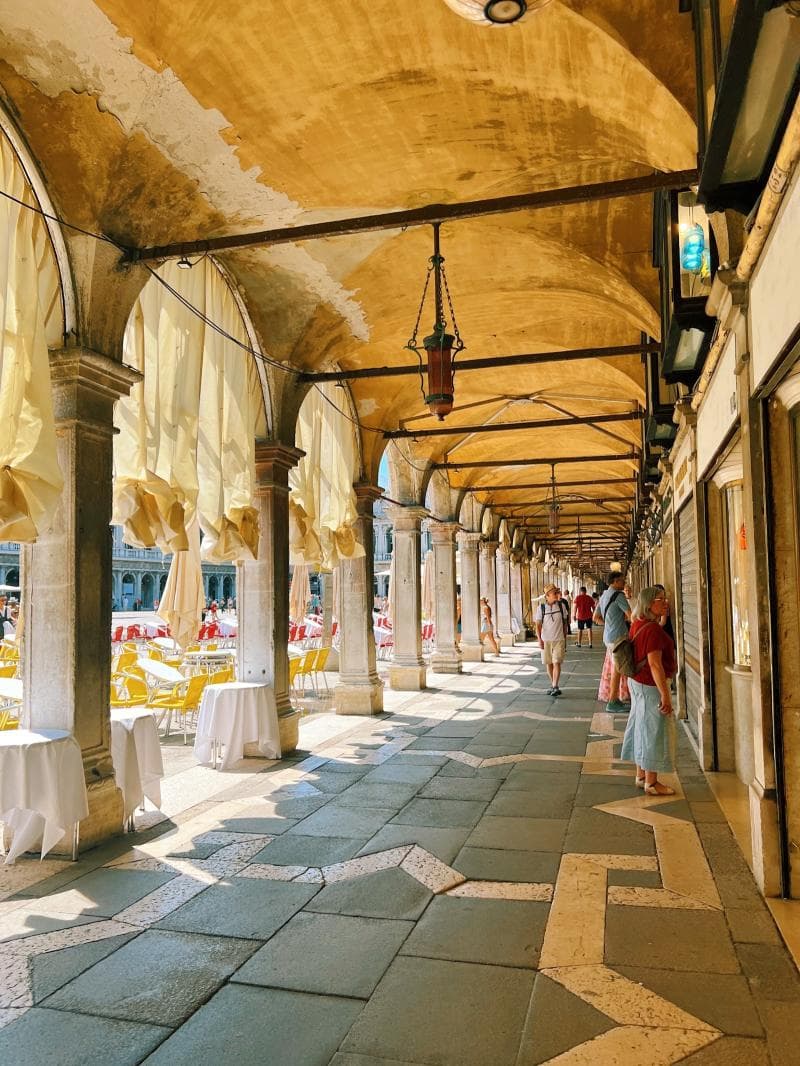
Explore the historic Procuratie in St. Mark's Square, Venice, Italy. Discover its rich history, unique architecture, and current cultural role as a hub for social initiatives.
Overview
The Procuratie are a magnificent ensemble of three interconnected buildings that define the perimeter of the iconic St. Mark's Square in Venice, Italy. These historic structures, comprising the Procuratie Vecchie (Old Procuracies), the Procuratie Nuove (New Procuracies), and the Ala Napoleonica (Napoleonic Wing or Newest Procuracies), were originally constructed to serve as residences and administrative offices for the powerful Procurators of St. Mark. Together, they frame one of the world's most famous public spaces, showcasing centuries of Venetian architectural evolution and civic grandeur.
With their distinctive arcades and classical facades, the Procuratie stand as a testament to Venice's enduring legacy, housing not only historical remnants but also vibrant contemporary life, including famed coffeehouses and cultural institutions.
History & Cultural Background
The history of the Procuratie is intrinsically linked to the Venetian Republic and its unique governance. The Procurators of St. Mark were the second-highest dignitaries in the Republic, holding immense influence. Their responsibilities included managing the treasury of St. Mark's Basilica, overseeing state wards, and handling trust funds for religious and charitable institutions.
The oldest section, the Procuratie Vecchie, on the northern side of the square, was rebuilt between approximately 1514 and 1538, following a fire that damaged an earlier 12th-century structure. Architects like Pietro Bon, Zuan Celestro, Bartolomeo Bon, and Jacopo Sansovino contributed to its design, establishing an Early Renaissance style that would influence later developments in the square. This reconstruction was part of Doge Andrea Gritti's ambitious 'renovatio urbis' (urban renewal) program. The Vecchie initially contained apartments that were rented out, providing significant revenue to fund building projects and repairs across the city.
On the southern side, the Procuratie Nuove were constructed between 1583 and around 1660 by architects such as Vincenzo Scamozzi and Francesco Smeraldi. These buildings replaced dilapidated medieval structures and housed the official residences of the procurators. Their High Renaissance style marked the culmination of a century-long urban renewal program, aiming to give Venice's city center the appearance of a grand classical forum.
The third component, the Ala Napoleonica, also known as the Procuratie Nuovissime, bridges the western end of the square, connecting the Vecchie and Nuove. This neoclassical structure was built between 1807 and 1815 during the second period of French occupation. Its construction involved the demolition of the historic Church of San Geminiano to create a royal residence for the viceroy of the Kingdom of Italy, Eugène de Beauharnais.
Beneath the arcades of both the Vecchie and Nuove, ground-floor spaces were rented out for shops, workshops, and eventually, the celebrated coffeehouses that became integral to Venetian social life, such as Caffè Florian and Caffè Quadri.
What Makes It Special
The Procuratie are special for several compelling reasons, most notably their role in defining the architectural and social heart of Venice. The unified facade, despite being built over centuries in different styles, creates a harmonious and majestic enclosure for St. Mark's Square, symbolizing the enduring power and aesthetic vision of the Venetian Republic.
Recently, the Procuratie Vecchie underwent a significant restoration and, for the first time in 500 years, opened a large portion of its interior to the public in 2022. This transformation has re-established the building's connection to its original social dimensions, becoming a global hub for 'The Human Safety Net' foundation. This initiative fosters social inclusion and empowers vulnerable communities worldwide, breathing new life into a historical landmark.
The architectural continuity achieved across these three structures, despite the distinct eras of their construction, demonstrates a remarkable commitment to urban planning and civic aesthetics that is rarely seen elsewhere. The contrasting yet complementary Early Renaissance and High Renaissance styles, along with the later Neoclassical addition, provide a fascinating timeline of architectural trends.
Stories, Fun Facts & Local Details
The Procurators of St. Mark were so influential that their status was second only to the Doge, reflecting the Republic's emphasis on meticulous administration and charitable works. The rental income generated from the apartments in the Procuratie Vecchie was crucial for funding Venice's extensive building and maintenance projects.
One delightful detail is the continued presence of some of the world's oldest and most famous coffeehouses, such as Caffè Florian (opened in 1720) and Caffè Quadri, operating beneath the arcades of the Procuratie. These establishments have witnessed centuries of Venetian life, hosting countless conversations and historical moments.
The demolition of the 12th-century San Geminiano church to make way for the Ala Napoleonica highlights the dramatic impact of Napoleonic rule on Venice's urban fabric. This change, though controversial, completed the square's enclosure.
Art historical accounts reveal that earlier versions of the Procuratie Vecchie can be seen in Renaissance paintings, such as Giovanni Bellini's 'Procession in St. Mark's Square,' offering a glimpse into the square's past appearance.
Today, within the Procuratie, visitors can also admire the Negozio Olivetti, designed by Carlo Scarpa, a masterpiece of 20th-century architecture that beautifully integrates with the historic surroundings.
Visitor Perspective
For a curious traveler, exploring the Procuratie offers a profound immersion into the heart of Venice. Begin by strolling beneath the cool, elegant arcades, imagining centuries of Venetian citizens and dignitaries passing through the same space. Consider pausing at one of the historic coffeehouses for an espresso, a timeless Venetian experience that allows you to soak in the atmosphere of the square, much as Lord Byron or Marcel Proust once did.
The newly opened sections of the Procuratie Vecchie provide a unique opportunity to step inside a building that was largely inaccessible for half a millennium. Here, you can engage with 'The Human Safety Net' exhibition, which combines social purpose with art and innovation. Additionally, the San Marco Art Centre (SMAC) offers a multidisciplinary artistic experience.
A visit to the Correr Museum, housed partly within the Procuratie Nuove and the Ala Napoleonica, further enriches the experience, offering deep insights into Venetian art, history, and culture, with collections spanning centuries. The Procuratie are not merely buildings; they are a living narrative of Venice, inviting you to connect with its past, present, and future.
Coordinates: 12.339092, 45.434326
View on Google Maps💬 How Travelers Describe This Place
Based on community votes
Photogenic
989Must See
791Interesting
613Beautiful
514Unique
207
Traveler Stories
Discover memorable experiences shared by travelers who have visited this place.
No traveler stories yet.
Be the first traveler to share what made this place memorable.

Tour
By
Spot
Discover amazing places around the world. Your journey starts here.
Explore
© 2026 TourBySpot. All rights reserved.