Scott Monument
Edinburgh, United Kingdom
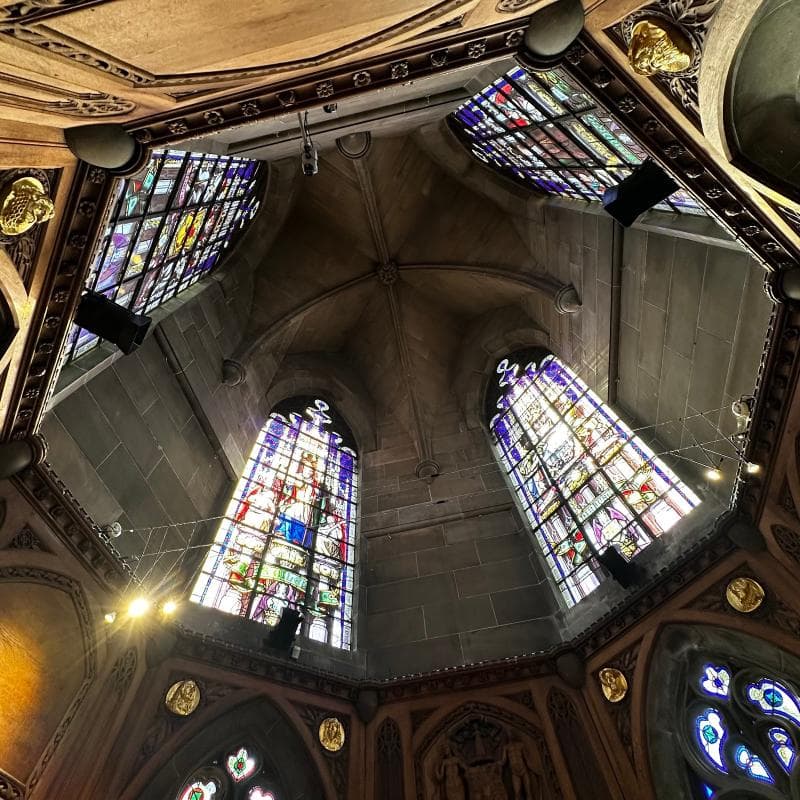
Explore the Scott Monument in Edinburgh, United Kingdom, a stunning Victorian Gothic tribute to Sir Walter Scott, offering panoramic city views.
Overview
Towering majestically over Edinburgh's Princes Street Gardens, the Scott Monument is a striking Victorian Gothic tribute to one of Scotland's most celebrated literary figures, Sir Walter Scott. Standing at an impressive 61.11 meters (200 feet 6 inches) tall, it is recognized as the second-largest monument dedicated to a writer in the world, surpassed only by the José Martí monument in Havana. Its intricate spire and darkened stone facade make it an unmistakable landmark in the heart of the Scottish capital, offering a dramatic visual link between the Old and New Towns. Built from Binny sandstone, the monument's grand design is a testament to the enduring legacy of Scott and his profound influence on Scottish culture and literature.
History & Cultural Background
Following the death of Sir Walter Scott in 1832, a revered poet, novelist, and the founder of the historical novel genre, there was a widespread desire to commemorate his immense contributions. An architectural competition was launched in 1836 to design a fitting memorial. The winning entry came from George Meikle Kemp, a self-taught architect and joiner, who submitted his design under the pseudonym 'John Morvo' – a name inspired by a medieval architect of Melrose Abbey. Kemp's anonymity stemmed from his fear that his lack of formal architectural qualifications might disqualify him. His Gothic vision was chosen in 1838, and the foundation stone was laid on August 15, 1840, Scott's birthday. Construction commenced in 1841 after parliamentary approval and continued for nearly four years, largely funded by public donations. Tragically, Kemp did not live to see its completion; he drowned in the Union Canal in March 1844, just as the monument was nearing its final stages. The monument was officially inaugurated on August 15, 1846, standing as a powerful symbol of national pride and a lasting homage to a literary giant who profoundly shaped perceptions of Scotland.
What Makes It Special
The Scott Monument's unique charm lies in its intricate Victorian Gothic architecture, often likened to a 'gothic rocket.' Its towering height and ornate details immediately capture attention. The monument is constructed from Binny sandstone, quarried from nearby Ecclesmachan in West Lothian. Over the years, this stone has absorbed Edinburgh's historic soot and grime, giving the monument its distinctive dark, almost black appearance, creating a striking contrast with the bright white Carrara marble statue nestled at its base. This central statue, sculpted by Sir John Steell, depicts Sir Walter Scott seated with a book and quill, accompanied by his beloved deerhound, Maida. Surrounding the monument's spire are 68 finely carved figures, with 64 visible from the ground. These statues represent characters from Scott's famous 'Waverley Novels' and other significant Scottish poets and historical figures, effectively transforming the monument into a narrative tapestry of his literary world. Visitors can ascend a series of spiral staircases to three viewing platforms, each offering progressively more breathtaking panoramic views of central Edinburgh, including the iconic Edinburgh Castle, the Old Town, and the surrounding landscape.
Stories, Fun Facts & Local Details
The story behind the monument is filled with intriguing details. George Meikle Kemp's decision to enter the design competition under a pseudonym, 'John Morvo,' highlights his humility and passion for the project despite his lack of formal architectural training. His untimely death before the monument's completion adds a poignant chapter to its history. The grand marble statue of Scott and Maida at the monument's heart also has a tale of its own; carved from a massive 30-ton block of Carrara marble imported from Italy, its journey to Edinburgh was a feat, requiring 25 horses to transport it from Leith docks to the sculptor's studio. It holds the distinction of being the first marble statue ever displayed in Scotland. Adding to Scott's legacy in Edinburgh, the city's main railway station, Edinburgh Waverley, is uniquely named after his popular 'Waverley' novels, making it the only station in the world named after a book.
Visitor Perspective
For those eager to experience the monument beyond its ground-level grandeur, climbing the Scott Monument is a rewarding adventure. The ascent involves navigating 287 steps via a narrow, winding spiral staircase. While the climb can be physically demanding and potentially claustrophobic in its upper sections, the effort is amply rewarded with spectacular 360-degree views of Edinburgh from its various platforms. The first platform also houses a small museum room, offering insights into Scott's life and the monument's construction. Visitors should be aware that due to its historic architecture, there is no elevator, making it inaccessible for wheelchair users or those with significant mobility issues. However, even from the ground, the monument's exterior is a marvel of intricate stonework and sculptural detail, well worth a visit. Its central location in Princes Street Gardens makes it easily accessible and a perfect starting point for exploring other Edinburgh landmarks, with Waverley Station just steps away.
Coordinates: -3.19329, 55.95236
View on Google Maps💬 How Travelers Describe This Place
Based on community votes
Must See
569Unique
476Interesting
465Photogenic
276Beautiful
128
Traveler Stories
Discover memorable experiences shared by travelers who have visited this place.
No traveler stories yet.
Be the first traveler to share what made this place memorable.
Things to see at Scott Monument



Tour
By
Spot
Discover amazing places around the world. Your journey starts here.
Explore
© 2026 TourBySpot. All rights reserved.