Santa Maria delle Grazie
Milan, Italy
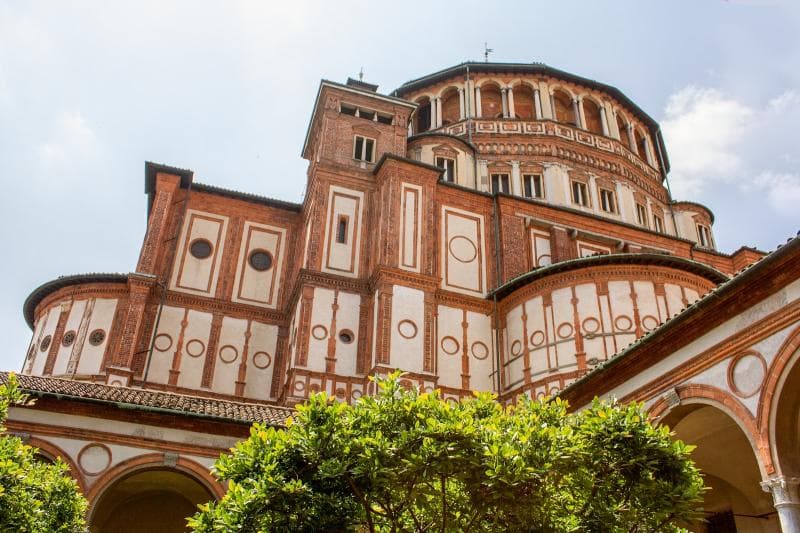
Explore Santa Maria delle Grazie in Milan, Italy, a UNESCO World Heritage site featuring Leonardo da Vinci's 'The Last Supper' and stunning architecture.
Overview
Santa Maria delle Grazie, or 'Holy Mary of Grace,' is an extraordinary church and Dominican convent nestled in the heart of Milan, Italy. This UNESCO World Heritage site is a testament to Italy's rich artistic and architectural legacy, drawing visitors from across the globe. It is most famously known as the home of Leonardo da Vinci's immortal masterpiece, 'The Last Supper,' which graces the refectory wall of the adjacent convent. The complex beautifully marries two distinct architectural styles: the dignified Lombard Gothic of its initial construction and the refined Renaissance additions that came later.
History & Cultural Background
The story of Santa Maria delle Grazie began in 1463 when Francesco I Sforza, Duke of Milan, commissioned the construction of a Dominican convent and church on the site of a pre-existing chapel dedicated to the Madonna delle Grazie. The initial design, primarily in the Gothic style, was undertaken by architect Guiniforte Solari, with the convent largely completed by 1469. However, the church's destiny took a significant turn when Ludovico Sforza, known as Ludovico il Moro, became Duke. He envisioned the church as the burial site for the Sforza family and initiated major renovations. From 1492, Donato Bramante, a renowned Renaissance architect, was brought in to redesign the apse and create the magnificent dome and surrounding structures, transforming parts of the church into a stunning example of Renaissance architecture. It was during this period, between 1495 and 1498, that Ludovico il Moro commissioned Leonardo da Vinci to paint 'The Last Supper' in the convent's refectory, forever linking the site to one of art history's greatest achievements. The complex miraculously survived extensive damage during World War II; during an Allied aerial bombardment in 1943, much of the refectory was destroyed, but the wall holding 'The Last Supper' was protected by sandbags and survived.
What Makes It Special
The profound allure of Santa Maria delle Grazie lies in its dual artistic and architectural significance. The complex was inscribed as a UNESCO World Heritage site in 1980, primarily due to Leonardo da Vinci's 'The Last Supper,' which is recognized as a 'timeless and unique artistic achievement' that heralded a new era in art. Leonardo's masterpiece is not merely a painting; it is a revolutionary work that captures a precise, dramatic moment—Jesus' announcement of betrayal—with unparalleled emotional depth and innovative composition, deeply influencing subsequent Western painting. Beyond the renowned mural, the church itself is an architectural marvel. It showcases a remarkable blend of Solari's Lombard Gothic design in the nave and Bramante's early Renaissance additions, particularly the grandeur of the tribune and its dome. This harmonious fusion of styles makes the building a fascinating study in the evolution of Renaissance architecture in Milan.
Stories, Fun Facts & Local Details
One of the most intriguing aspects of 'The Last Supper' is Leonardo's experimental technique. Instead of using traditional fresco, which requires painting on wet plaster, he employed tempera and oil on a dry plaster surface. This allowed for greater detail and nuanced effects, but unfortunately, it also led to the painting's rapid deterioration shortly after its completion. It has undergone numerous, often challenging, restoration efforts throughout the centuries to preserve what remains. The choice to paint 'The Last Supper' in the refectory, where the Dominican friars would eat, allowed Leonardo to create an illusion that extended the room, making the biblical scene an integral part of their daily life. Adjacent to the church, visitors can discover the serene 'Chiostrino delle Rane,' or 'Cloister of the Frogs.' This small, elegant cloister gets its whimsical name from the four bronze frog sculptures that adorn its central fountain, spouting water. It offers a tranquil escape and a beautiful view of Bramante's dome. The very survival of 'The Last Supper' is a compelling story; it was meticulously protected with sandbags during the 1943 bombings, a testament to the foresight and dedication to preserving this irreplaceable treasure.
Visitor Perspective
For those planning to experience the wonder of Santa Maria delle Grazie, particularly Leonardo's 'The Last Supper,' advanced planning is essential. Tickets for 'The Last Supper' are extremely limited and must be booked well in advance, often months ahead, due to conservation efforts that restrict entry to small groups for only 15 minutes. The church itself, however, can be visited independently and often without charge, offering a chance to admire Solari's Gothic nave and Bramante's Renaissance apse at a more leisurely pace. The site is conveniently located in Milan's city center and is easily accessible via public transport, with metro stations like Cadorna (M1, M2) and Conciliazione (M1), as well as several tram and bus lines, within walking distance. Allowing extra time to reach the ticket office and pass through security is always advisable to ensure a smooth visit.
Coordinates: 9.1707, 45.4659
View on Google Maps💬 How Travelers Describe This Place
Based on community votes
Must See
980Photogenic
944Interesting
396Beautiful
389Unique
340
Traveler Stories
Discover memorable experiences shared by travelers who have visited this place.
No traveler stories yet.
Be the first traveler to share what made this place memorable.
Things to see at Santa Maria delle Grazie



Tour
By
Spot
Discover amazing places around the world. Your journey starts here.
Explore
© 2026 TourBySpot. All rights reserved.