Bramante architecture
Milan, Italy
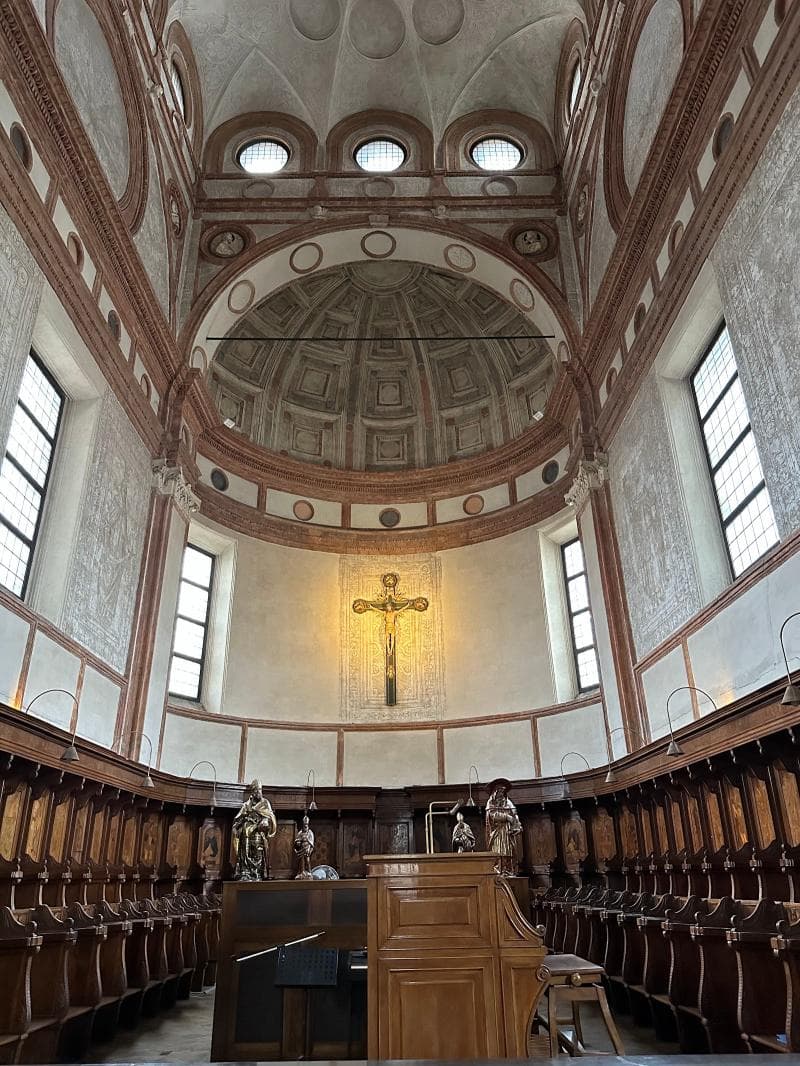
Explore Bramante's Renaissance architecture at Santa Maria delle Grazie in Milan, Italy, a UNESCO site blending Gothic and classical styles.
Overview
Nestled in the vibrant city of Milan, Italy, the Church of Santa Maria delle Grazie stands as a remarkable testament to two distinct architectural eras. While famed globally for housing Leonardo da Vinci's 'Last Supper', the architectural genius of Donato Bramante significantly shaped its eastern end, transforming a Gothic structure into a masterpiece of early Renaissance design. This UNESCO World Heritage site offers a fascinating dialogue between the late Gothic style of Guiniforte Solari and Bramante's innovative Renaissance additions, particularly his tribune, dome, and cloisters, which were pivotal in introducing the new classical aesthetic to Lombardy.
History & Cultural Background
The story of Santa Maria delle Grazie began in 1463 when Duke Francesco I Sforza of Milan commissioned the construction of a Dominican convent and church. The initial design, executed by Guiniforte Solari, followed the prevailing Lombard-Gothic style, characterized by its brick façade and pointed arches. However, the church's destiny took a grander turn in 1492 when Duke Ludovico il Moro, a significant patron of the arts, decided to transform the church into the Sforza family mausoleum. He entrusted this ambitious project to Donato Bramante, an architect who would become a seminal figure in the High Renaissance. Bramante's arrival in Milan marked a crucial moment, as he brought with him the sophisticated principles of Renaissance architecture, characterized by harmony, classical proportion, and geometric precision. He began his work on the tribune in 1492, designing an expanded eastern end for the existing church. This period also saw Leonardo da Vinci at work within the convent, creating his iconic 'Last Supper' in the refectory, further solidifying the site's immense cultural significance.
What Makes It Special
Bramante's contributions to Santa Maria delle Grazie are a profound expression of Renaissance ideals. He conceived the new eastern end, known as the tribune, as a monumental cubic space crowned by a majestic hemispherical dome. This design was revolutionary for Milan, incorporating elements inspired by Filippo Brunelleschi's Old Sacristy in Florence, yet expanded upon by Bramante with additional apses and a sense of volumetric arrangement over planar design. He integrated large semi-circular apses and a drum-shaped dome, creating a harmonious and unified space that contrasts with the earlier Gothic nave while remaining remarkably cohesive. The Chiostrino delle Rane, or 'Cloister of the Frogs', is another serene space attributed to Bramante, featuring Tuscan columns and a charming fountain, providing a tranquil counterpoint to the grandeur of the church's interior. The architectural language here speaks of order, rationality, and a renewed interest in classical forms, utilizing local materials like terracotta bricks and granite to achieve a distinctly Milanese Renaissance aesthetic.
Stories, Fun Facts & Local Details
Duke Ludovico il Moro's personal ambition played a key role in the church's transformation. He envisioned Santa Maria delle Grazie not merely as a place of worship but as the final resting place for his family, though his plans for a grand sepulchre were ultimately incomplete due to political upheaval. A fascinating detail is the subtle inscription of Bramante's name within the church vaults, dating to 1494, which serves as a quiet claim to his significant authorship, despite some historical debates about the extent of his involvement. The 'Cloister of the Frogs' earned its whimsical name from the bronze frog sculptures spouting water in its central fountain, a charming and peaceful spot for contemplation that visitors can still enjoy today. During World War II, the convent suffered severe damage from Allied bombings in 1943. While much of the refectory was devastated, the wall bearing Leonardo's 'Last Supper' miraculously survived, largely due to protective sandbagging. Impressively, Bramante's majestic dome also emerged unscathed, a testament to its robust construction.
Visitor Perspective
For a curious traveler, stepping into Santa Maria delle Grazie is an journey through time, observing the interplay between centuries of architectural thought. The transition from Solari's solemn Gothic nave to Bramante's radiant Renaissance tribune is palpable, a shift from verticality and intricate detail to serene harmony and classical proportion. You will find yourself drawn to the vastness of the dome, an architectural marvel that seems to lift the spirit with its perfect geometry and light. Exploring the peaceful cloisters, especially the 'Chiostrino delle Rane', offers a moment of quiet reflection, away from the bustling Milanese streets, inviting you to appreciate the thoughtful design of these spaces. While many come for Leonardo's masterpiece, taking the time to observe Bramante's work allows for a deeper understanding of the entire complex, appreciating it not just as a canvas for a famous painting, but as a monumental work of architecture that shaped the course of the Renaissance in Italy.
Coordinates: 9.17111, 45.46583
View on Google Maps💬 How Travelers Describe This Place
Based on community votes
Photogenic
726Must See
642Unique
597Beautiful
300Interesting
300
Traveler Stories
Discover memorable experiences shared by travelers who have visited this place.
No traveler stories yet.
Be the first traveler to share what made this place memorable.

Tour
By
Spot
Discover amazing places around the world. Your journey starts here.
Explore
© 2026 TourBySpot. All rights reserved.