POLIN Museum Of The History Of Polish Jews
Warsaw, Poland
Explore a millennium of Jewish history at the POLIN Museum in Warsaw, Poland. Discover vibrant culture, unique architecture, and powerful stories.
Overview
The POLIN Museum of the History of Polish Jews, situated in Warsaw, Poland, stands as a profound institution dedicated to preserving and recalling the thousand-year history of Jews in Poland. Opened in its striking building in April 2013, with its comprehensive Core Exhibition launching in October 2014, the museum is built on the site of the former Warsaw Ghetto, a location imbued with immense historical significance. The name 'Polin' itself holds deep meaning, translating from Hebrew as either 'Poland' or 'rest here,' a term connected to a legend about the arrival of the first Jews to Polish lands. This modern cultural institution was established through a unique public-private partnership, combining the efforts of the Association of the Jewish Historical Institute, the City of Warsaw, and the Ministry of Culture and National Heritage. Its ambitious scope earned it the prestigious European Museum of the Year Award in 2016, recognizing its innovative approach to historical narration.
History & Cultural Background
The journey to establish the POLIN Museum began with the Association of the Jewish Historical Institute in 1993, with the project officially commencing in 1995. Over a decade of dedicated effort culminated in its formal establishment in 2005. The museum's architectural design, by Finnish architects Rainer Mahlamäki and Ilmari Lahdelma, was selected through an international competition, with construction starting in 2009. The building itself became a monument, not merely a structure, deliberately reflecting the simple shape and dynamic relief of the nearby Monument to the Ghetto Heroes, rather than overshadowing it. This placement in the Muranów district, once a thriving Jewish neighborhood and later tragically transformed into the Warsaw Ghetto, ensures a powerful connection to the very history it narrates.
What Makes It Special
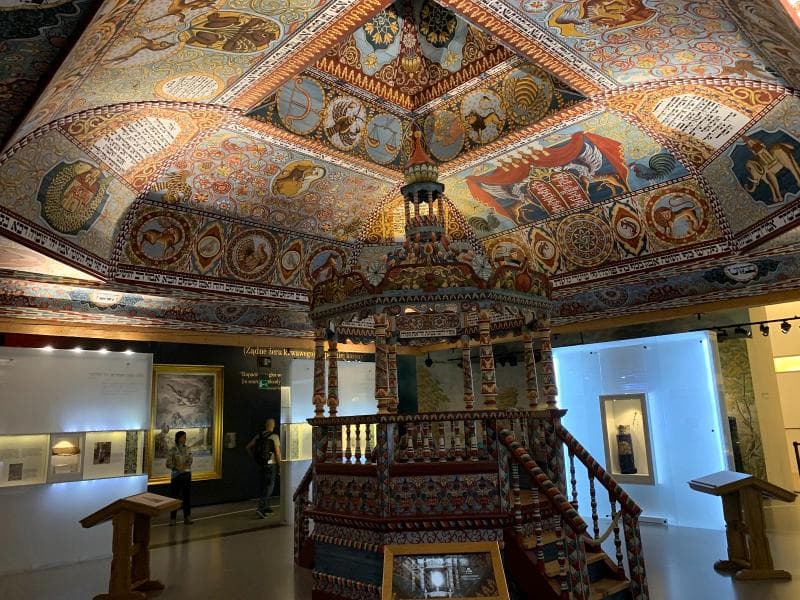
What truly distinguishes the POLIN Museum is its expansive narrative, which courageously ventures beyond the Holocaust to embrace a full millennium of Jewish life, culture, and contributions in Poland. Its Core Exhibition, spanning over 4,000 square meters across eight galleries, offers a captivating multimedia journey. Visitors encounter interactive installations, authentic paintings, oral histories, and detailed reconstructions that breathe life into a 'world that is no more'. A standout feature is the meticulously recreated roof and ceiling of the 17th-century Gwoździec synagogue, a testament to Jewish artistic heritage that was tragically lost. The museum's architecture is equally compelling. From its minimalist exterior of glass and copper mesh, one enters a cavernous main hall characterized by undulating, dynamic walls. This dramatic fissure symbolizes the 'fractured history' of Polish Jews, often interpreted as the parting of the Red Sea or the cracks in Jewish history. The design deliberately guides the visitor through contrasting spaces, moving from the open, curvilinear forms of earlier historical periods to more angular and contemplative spaces reflecting the darker chapters.
Stories, Fun Facts & Local Details
The Hebrew inscription of 'Polin' on the museum's glass facade subtly evokes the ancient legend of Jewish arrival in Poland, a powerful reminder of enduring presence. The institution's mission extends beyond mere exhibition; it actively promotes dialogue, mutual understanding, and respect between Poles and Jews, and confronts contemporary issues like xenophobia and prejudice. The museum's location directly opposite the Monument to the Ghetto Heroes creates a poignant dialogue, where the monument commemorates those who perished, and the museum reminds us 'how they lived'. The building's design carefully integrates with the surrounding Muranów district, ensuring it complements rather than overwhelms the area's historical context and post-war reconstruction. The Core Exhibition itself begins with a 'Forest' gallery, an imaginative space where visitors first encounter the legend of Jewish settlement in Poland. This unique narrative approach ensures that the history is not just presented but felt, allowing visitors to immerse themselves in different historical periods through stories of everyday life, holidays, customs, and significant figures.
Visitor Perspective
A visit to the POLIN Museum is described as an immersive and thought-provoking experience, a journey through a thousand years of history from the Middle Ages to the present day. The museum offers an innovative and interactive approach to history education, engaging visitors through multimedia displays and installations. Many visitors find the experience profound, often describing it as a 'museum-experience' rather than just a collection of objects. For those seeking deeper engagement, audioguides are readily available, and guided tours offer expert insights into the extensive collection. The museum is designed with visitor comfort in mind, offering accessibility for people with disabilities, and conveniences for families and international guests. While the detailed exhibitions can be extensive, the museum encourages multiple visits, suggesting that each exploration can offer a unique perspective. Beyond the core historical narrative, the museum also serves as a vibrant cultural center, hosting temporary exhibitions, concerts, and educational events that explore various facets of Jewish culture and contemporary issues.
Coordinates: 20.9934833, 52.2491839
View on Google Maps💬 How Travelers Describe This Place
Based on community votes
Must See
898Photogenic
853Beautiful
667Interesting
190Unique
32
Traveler Stories
Discover memorable experiences shared by travelers who have visited this place.
No traveler stories yet.
Be the first traveler to share what made this place memorable.
Things to see at POLIN Museum Of The History Of Polish Jews



Tour
By
Spot
Discover amazing places around the world. Your journey starts here.
Explore
© 2026 TourBySpot. All rights reserved.