Marienplatz
Munich, Germany
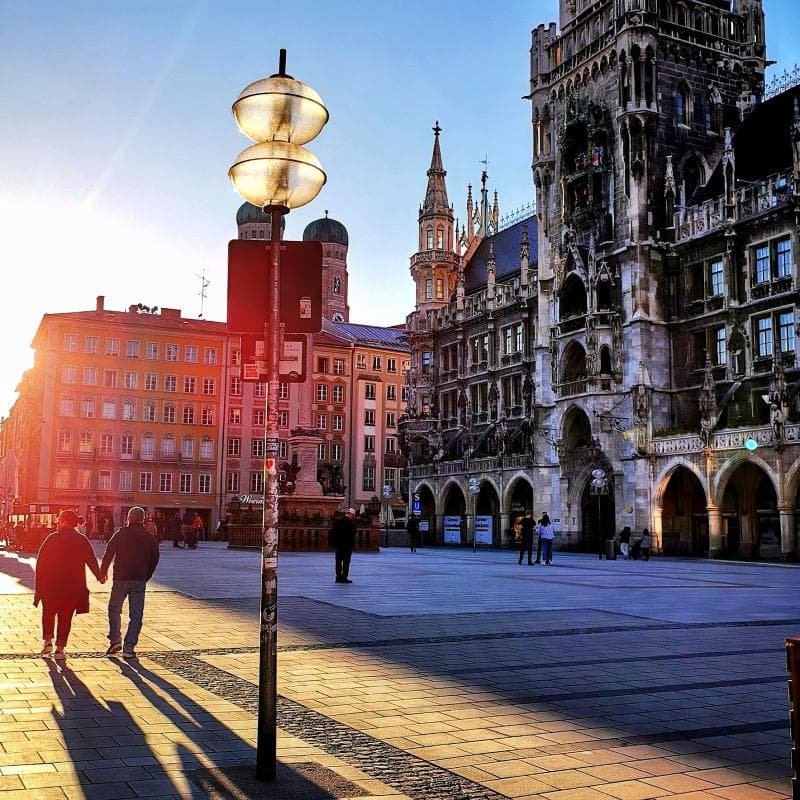
Discover Marienplatz, Munich's historic central square in Germany. Marvel at the Glockenspiel, New Town Hall, and Marian Column. Explore centuries of Bavarian culture.
Overview
Marienplatz, nestled in the vibrant heart of Munich, Germany, has been the city's geographical and cultural epicenter since its very founding in 1158. Today, it stands as a bustling pedestrian zone, a magnificent starting point for any traveler eager to delve into Munich's rich history and lively present. Once known as Schrannenplatz, or 'Grain Market Square', this iconic plaza was renamed Marienplatz in 1854, honoring the revered Mariensäule, the Marian Column, that graces its center.
Flanked by architectural marvels like the Neo-Gothic New Town Hall and the historic Old Town Hall, Marienplatz is more than just a square; it is a living tableau where every stone whispers tales of centuries past. It is the pulsating hub where ancient traditions meet contemporary urban life, making it an indispensable stop on any Munich itinerary.
History & Cultural Background
The story of Marienplatz begins with Henry the Lion, who established Munich in 1158, designating this very spot as the city's central marketplace. For centuries, it served as the bustling commercial heart, a place where goods were traded, proclamations were made, and public events unfolded.
One of its most significant historical markers, the Mariensäule, was erected in 1638. This column was a profound gesture of gratitude and resilience, commemorating Munich's survival and deliverance from Swedish occupation during the tumultuous Thirty Years' War. It was dedicated to the Virgin Mary, reflecting the city's deep Catholic traditions.
Dominating the northern side of the square is the Neues Rathaus, or New Town Hall, an impressive Neo-Gothic structure built between 1867 and 1909. Its intricate facade and towering presence are a testament to Munich's prosperity and architectural ambition. Opposite, on the eastern side, stands the Altes Rathaus, the Old Town Hall, a building with a history spanning over 500 years. Though rebuilt after World War II, it retains its medieval charm, bridging the gap between Munich's ancient origins and its modern identity.
What Makes It Special
Marienplatz's unique charm lies in its harmonious blend of historical grandeur and dynamic urban energy. It is quite literally the heart of Bavaria, as a small bronze plaque near the Mariensäule marks the point from which all distances in the region are traditionally measured.
The square's most celebrated feature is undoubtedly the Glockenspiel, housed within the tower of the New Town Hall. This elaborate mechanical clock captivates audiences daily, with its 43 bells and 32 life-sized figures reenacting historical Bavarian scenes.
Beyond its iconic structures, Marienplatz serves as a beloved gathering place, a vibrant stage for public life. Throughout the year, it transforms to host significant cultural events, from the enchanting Christmas markets to joyous city festivals and even the championship celebrations of FC Bayern Munich. It is a place where every visit offers a new perspective, a fresh memory to cherish.
Stories, Fun Facts & Local Details
The Glockenspiel's performance is not merely a show; it's a journey back in time. Twice, or sometimes thrice, a day, its figures come alive, reenacting Duke Wilhelm V's 1568 wedding, complete with a jousting tournament. Following this, the 'Schäfflertanz', or cooper's dance, is performed. Legend has it that this dance originated in 1517, performed by coopers to cheer up the populace after a devastating plague epidemic, assuring them that life would return to normal.
The Mariensäule itself tells a story of triumph over adversity. Topped by a golden statue of the Virgin Mary, the Patrona Bavariae, she watches over the city. At the base, four cherubs playfully battle against allegorical beasts representing war (a lion), plague (a basilisk), heresy (a snake), and famine (a dragon), symbolizing Munich's victory over these afflictions.
Another quirky detail is the 'Münchner Kindl', the Munich Child, a figure depicted on the New Town Hall tower. Originally a monk, this emblem of the city has evolved over time, often portrayed today as a charming child or a young girl, symbolizing Munich's welcoming spirit.
For a spectacular vantage point, visitors can ascend the New Town Hall tower or the nearby St. Peter's Church (Alter Peter) for breathtaking panoramic views of Marienplatz and the sprawling cityscape, extending to the Alps on a clear day.
Visitor Perspective
Approaching Marienplatz is remarkably easy, thanks to Munich's efficient public transport system, with both U-Bahn and S-Bahn lines converging directly beneath the square. This accessibility makes it an ideal starting point for exploring the historic Old Town and its myriad attractions, such as the Frauenkirche and the bustling Viktualienmarkt, a short walk away.
While the square itself is open 24/7, catching the Glockenspiel performance is a highlight for many. It typically plays at 11 am and 12 pm year-round, with an additional 5 pm show from March to October. Be prepared for crowds, especially during these times, as visitors from around the world gather to witness the charming spectacle.
Beyond the major landmarks, Marienplatz offers a vibrant atmosphere with street performers, numerous shops, inviting cafes, and traditional Bavarian restaurants in the surrounding pedestrian areas. For practical advice, the Tourist Information Office is conveniently located within the New Town Hall, ready to assist with maps, tours, and local insights. Marienplatz is truly an immersive experience, connecting you directly to the pulse of Munich.
Coordinates: 11.5718, 48.1357
View on Google Maps💬 How Travelers Describe This Place
Based on community votes
Beautiful
996Interesting
673Must See
585Unique
143Photogenic
80
Traveler Stories
Discover memorable experiences shared by travelers who have visited this place.
No traveler stories yet.
Be the first traveler to share what made this place memorable.
Things to see at Marienplatz



Tour
By
Spot
Discover amazing places around the world. Your journey starts here.
Explore
© 2026 TourBySpot. All rights reserved.