Glockenspiel
Munich, Germany
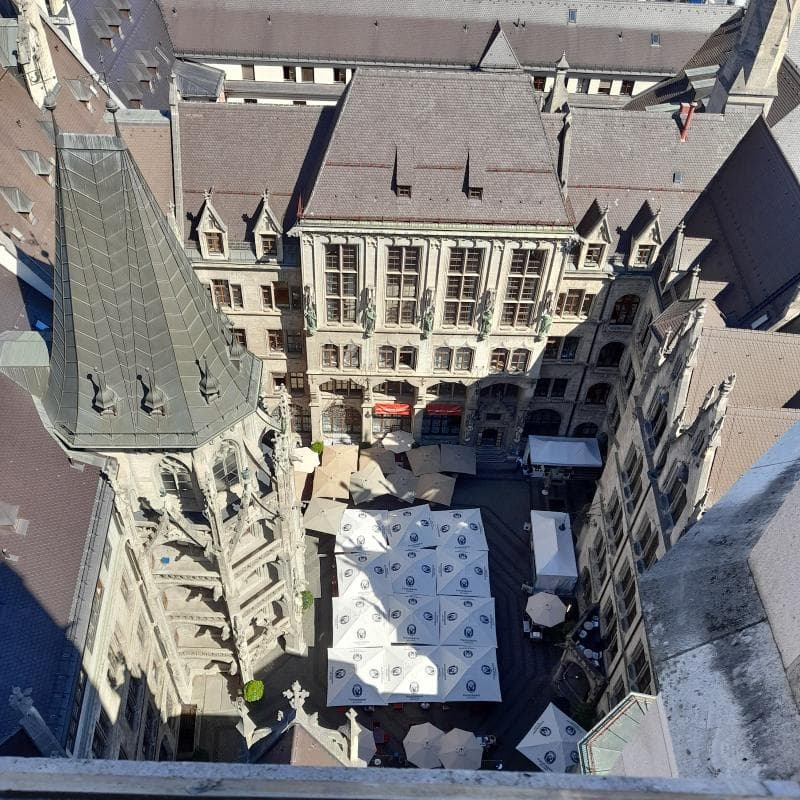
Discover Munich's iconic Glockenspiel in Marienplatz. Watch life-sized figures re-enact Bavarian history and folklore daily. Plan your visit to this enchanting German landmark!
Overview
In the vibrant heart of Munich, Germany, within the historic Marienplatz, stands the majestic New Town Hall (Neues Rathaus), home to one of Europe's most cherished and historically rich attractions: the Glockenspiel. This celebrated mechanical clock, installed in the tower of the New Town Hall, draws crowds daily with its captivating chime and animated figures. It is not merely a clock, but a storyteller, bringing to life centuries of Bavarian history and folklore through its intricate performance. With its 43 bells and 32 life-sized figures, the Glockenspiel is renowned as the largest in Germany and among the largest on the continent, offering a unique blend of visual spectacle and acoustic delight. [4, 6, 9]
Each day, the Glockenspiel performs at 11:00 AM and 12:00 PM. From March to October, an additional show takes place at 5:00 PM. [2, 3, 5] These main performances last approximately 12 to 15 minutes, enthralling onlookers as two distinct scenes from Munich's past unfold. [5, 9, 13] Later in the evening, a quieter, more intimate performance occurs at 9:00 PM, featuring a night watchman, an angel, and the symbolic Münchner Kindl. [2, 7]
History & Cultural Background
The Glockenspiel was an ambitious addition to the New Town Hall, conceived in 1904 and officially debuting on February 18, 1909. [9] Its creation was intended to celebrate Munich's rich heritage, becoming an integral part of the city's architectural and cultural landscape. [9] The mechanism was designed by Christian Reithmann, featuring figures crafted from painted copper sheets and 43 bells, a pioneering electro-mechanical carillon for its era. [9]
The two primary scenes depicted are deeply rooted in 16th-century Munich history. The upper level portrays the lavish 1568 wedding of Duke Wilhelm V of Bavaria to Renata of Lorraine. [3, 5, 6] This grand event, with festivities lasting over two weeks, included a spectacular jousting tournament in Marienplatz, where a Bavarian knight triumphs. [3, 6, 14]
On the lower level, the figures perform the famous Schäfflertanz, or coopers' dance. [3, 5, 6] Legend states this dance originated in 1517, following a severe plague epidemic. [3, 5] Coopers were said to be the first to venture out, dancing to lift spirits and signal it was safe to return to daily life, becoming a symbol of resilience. [2, 5, 6]
What Makes It Special
The Glockenspiel's enduring appeal lies in its ingenious blend of mechanics, history, and musical artistry. It is more than just a clock; it's a meticulously crafted theatrical performance set against the backdrop of one of Germany's most iconic squares. The sheer scale of the mechanism, with its 32 life-sized figures and 43 finely tuned bells, is a marvel of early 20th-century engineering. [9]
The Glockenspiel offers an authentic connection to the past, relying on a system that, while updated with solar power during its 2007 refurbishment, still echoes its original mechanical ingenuity. [9] Each figure moves with charming, almost human-like grace, telling stories that resonate with local pride and universal themes of celebration and resilience. The rotating melodies, changing monthly, add another layer of uniqueness, ensuring each visit offers a slightly different auditory experience. [7, 9]
Stories, Fun Facts & Local Details
A delightful detail is the 'golden bird' that chirps three times at the end of the main show, marking its conclusion. [3, 5] Another unique fact is the evening performance at 9:00 PM, presenting a gentler scene: a night watchman, an angel, and the Münchner Kindl are blessed as a lullaby plays. [2, 5, 6, 7]
The real Schäfflertanz is still performed by live dancers in Munich every seven years, with the next scheduled performance in 2026, offering a living tradition that inspired the Glockenspiel. [2, 4, 6] The extravagant wedding of Duke Wilhelm V and Renata of Lorraine reportedly involved over 1,500 horses and more than 600 oxen for the feasts, highlighting the opulence of the era. [3]
Marienplatz itself has been Munich's central hub since 1158. [9, 16] Ascending the New Town Hall tower, where the Glockenspiel resides, offers panoramic views of Munich, including the Frauenkirche's onion domes and, on clear days, even the distant Alps. [2, 12]
Visitor Perspective
Experiencing the Glockenspiel is a quintessential Munich moment. To truly appreciate the spectacle, arrive at Marienplatz a few minutes before the scheduled performance times to secure a good viewing spot, especially during peak tourist seasons. [14]
The square can become crowded, but the atmosphere is festive. For an elevated view, some nearby buildings, like the Hugendubel bookstore, offer alternative perspectives. [3] The Glockenspiel is free to view. [7] For a more serene experience, the 9:00 PM evening performance is often less crowded and equally enchanting, providing a peaceful end to a day of exploring. [7, 14] It’s a moment of shared wonder, connecting travelers with the enduring stories and spirit of this Bavarian capital.
Coordinates: 11.57555, 48.1375
View on Google Maps💬 How Travelers Describe This Place
Based on community votes
Must See
797Interesting
695Unique
396Beautiful
286Photogenic
22
Traveler Stories
Discover memorable experiences shared by travelers who have visited this place.
No traveler stories yet.
Be the first traveler to share what made this place memorable.

Tour
By
Spot
Discover amazing places around the world. Your journey starts here.
Explore
© 2026 TourBySpot. All rights reserved.