Latin Bridge
Sarajevo, Bosnia and Herzegovina
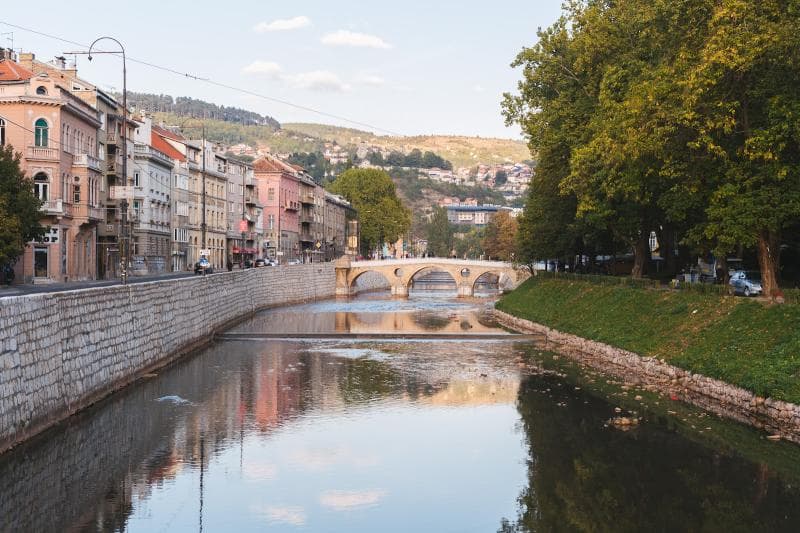
Explore Latin Bridge in Sarajevo, Bosnia and Herzegovina, the Ottoman-era site where Archduke Franz Ferdinand's assassination triggered WWI.
Overview
The Latin Bridge, known locally as Latinska ćuprija, is an Ottoman-era stone bridge gracefully arching over the Miljacka River in Sarajevo, Bosnia and Herzegovina. While seemingly modest in its four-arch design, its significance transcends its architecture, as it stands as the infamous site where the assassination of Archduke Franz Ferdinand occurred on June 28, 1914, an event that directly triggered the outbreak of World War I. Today, the bridge is reserved for pedestrians and cyclists, offering a tranquil crossing and a profound connection to a pivotal moment in global history.
History & Cultural Background
The history of the Latin Bridge dates back to the early 16th century, making it one of Sarajevo's oldest preserved bridges. The earliest record of a crossing at this spot, a wooden bridge, appeared in a 1541 census, attributed to a leather worker named Husein. A stone bridge was later commissioned around 1565 by Ali Ajni-Beg, a prominent citizen of Sarajevo. The bridge acquired its name from the 'Latinluk' or 'Latin Quarter,' a Catholic neighborhood situated on the north bank of the river during the Ottoman period.
On November 15, 1791, a devastating flood severely damaged the structure. Its reconstruction, financed by the Sarajevo merchant Abdulah-aga Briga, was completed between 1798 and 1799, resulting in the four-arched design largely seen today. The bridge's most famous, or infamous, moment arrived on June 28, 1914, when Gavrilo Princip assassinated Archduke Franz Ferdinand and his wife Sophie at its northern end. This act of political violence is widely recognized as the spark that ignited World War I, forever etching the Latin Bridge into the annals of global events.
Following this world-changing event, the bridge's identity became entangled with the region's shifting political tides. During the socialist Yugoslav era, from 1918 to 1993, it was officially renamed 'Principov Most' (Princip's Bridge) in honor of Gavrilo Princip. However, after the Bosnian War, its original, more neutral name, Latin Bridge, was restored, reflecting a desire to depoliticize its historical interpretation.
What Makes It Special
What truly sets the Latin Bridge apart is its disproportionate historical weight relative to its physical appearance. It is not merely an old stone crossing; it is a tangible link to the genesis of World War I, an event that reshaped the 20th century. Beyond its historical narrative, the bridge itself is a testament to Ottoman-era engineering and aesthetic, showcasing the architectural styles prevalent in the region centuries ago. Its characteristic 'eyes' or relieving openings above the pillars, designed to mitigate flood damage from the Miljacka River, are even featured in the official seal of Sarajevo, highlighting its enduring importance to the city's identity.
Adjacent to the bridge, the Sarajevo Museum 1878–1918, housed in the building from which the fateful shots were fired, offers visitors a deeper dive into the assassination and the broader Austro-Hungarian period in Bosnia. The bridge thus serves as a gateway to understanding Sarajevo's complex layers of history, from its Ottoman roots to its role as a flashpoint in modern history, symbolizing the city's enduring ability to carry monumental narratives within its everyday fabric.
Stories, Fun Facts & Local Details
Despite its global fame, the Latin Bridge is an unassuming structure. Standing on its worn cobbles, one might find it hard to reconcile its modest scale with the immensity of the events it witnessed. A small plaque at its northern end neutrally marks the spot where Gavrilo Princip stood. It's worth noting that this plaque, along with other historical markers like bronze footprints that once indicated Princip's exact position, has been subject to change and reinterpretation over the decades, reflecting shifting political narratives and historical perspectives.
Interestingly, the name 'Latin Bridge' refers to the historical 'Latinluk' quarter, a Catholic neighborhood, distinguishing it from an association with ancient Rome and underscoring Sarajevo's rich tapestry of diverse communities. Nobel laureate Ivo Andrić once wrote, 'From everything that man erects and builds in his urge for living, nothing is in my eyes better and more valuable than bridges. They are more important than houses, more sacred than shrines. Belonging to everyone and being equal to everyone.' This sentiment perfectly captures the Latin Bridge's role as a silent, yet powerful, observer of centuries of human history and daily life in Sarajevo.
Visitor Perspective
For many travelers, particularly history enthusiasts, a visit to the Latin Bridge is a compelling experience, offering a palpable connection to the past. Standing at the very spot where a single event altered the course of global history can evoke a profound and sometimes surreal sense of historical immersion. Most visitors find that ten to fifteen minutes spent on the bridge itself is sufficient to take in its atmosphere, often complemented by a longer visit to the nearby Museum of Sarajevo 1878–1918.
The bridge is easily accessible, free to visit, and provides charming views of the Miljacka River and the surrounding old town architecture. To best appreciate its quiet significance and capture photographs in soft light, consider visiting in the early morning or late afternoon, avoiding the busier midday crowds. Even as an international landmark, the Latin Bridge remains an integral part of daily life for Sarajevo's residents, with locals regularly crossing it, children playing nearby, and the river flowing beneath, symbolizing continuity amidst profound historical change.
Coordinates: 18.4289, 43.8576
View on Google Maps💬 How Travelers Describe This Place
Based on community votes
Unique
703Must See
521Photogenic
380Interesting
291Beautiful
28
Traveler Stories
Discover memorable experiences shared by travelers who have visited this place.
No traveler stories yet.
Be the first traveler to share what made this place memorable.
Things to see at Latin Bridge



Tour
By
Spot
Discover amazing places around the world. Your journey starts here.
Explore
© 2026 TourBySpot. All rights reserved.