Miljacka River Promenade
Sarajevo, Bosnia and Herzegovina
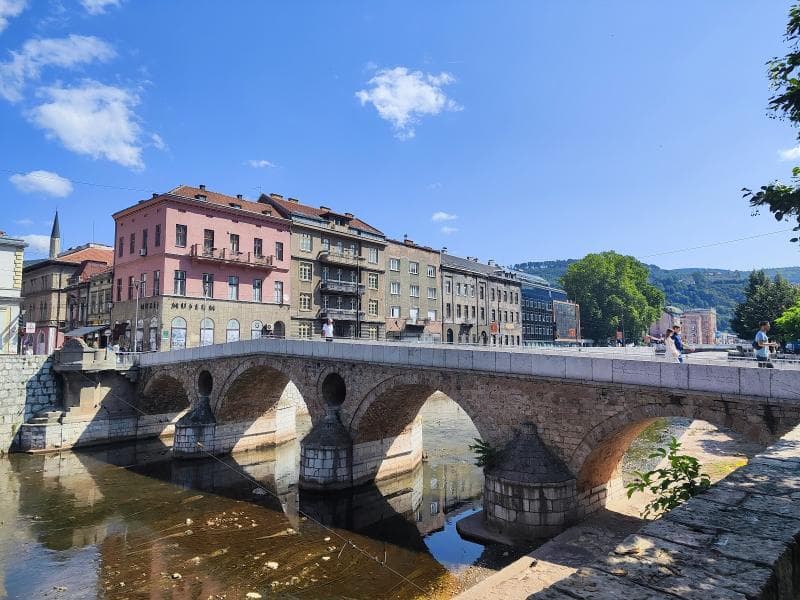
Explore the historic Miljacka River Promenade near the Latin Bridge in Sarajevo, Bosnia and Herzegovina, site of the Archduke's assassination.
Overview
The Miljacka River Promenade, intimately woven into the fabric of Sarajevo, Bosnia and Herzegovina, offers a journey through the city's soul. While not a single, continuous stretch, the promenades along the Miljacka River, particularly in the vicinity of the historic Latin Bridge, serve as vibrant arteries of urban life and historical reflection. The Miljacka itself is often synonymous with Sarajevo, flowing gracefully through the capital and shaping its landscape and history.
These riverside paths provide a serene escape from the city's bustle, connecting significant landmarks and offering picturesque views. The Latin Bridge, a majestic Ottoman-era stone structure, stands as a focal point along this promenade, famously known for its role in a pivotal 20th-century event.
History & Cultural Background
The Miljacka River has silently witnessed centuries of Sarajevo's rich and often turbulent history, from its Ottoman founding to its years under Austro-Hungarian administration, and beyond. The Latin Bridge, or Latinska Ćuprija, is one of the river's most iconic crossings. Its origins trace back to at least 1541 with a wooden bridge, later replaced by a more permanent stone structure around 1565. The current four-arched design largely reflects a reconstruction completed between 1798 and 1799, following a devastating flood.
The bridge earned its name from 'Latinluk,' the Catholic quarter it once connected on the northern bank during the Ottoman period. However, its global fame stems from the fateful morning of June 28, 1914. At the northern end of the bridge, Gavrilo Princip assassinated Archduke Franz Ferdinand of Austria-Hungary and his wife, Sophie, an event widely regarded as the catalyst for World War I. During the Yugoslav era, from 1918 to 1993, the bridge was renamed 'Princip's Bridge' in honour of Gavrilo Princip, before its original name was restored after the Yugoslav Wars.
What Makes It Special
What sets the Miljacka River Promenade apart is its profound historical resonance and the unique blend of architectural styles reflected along its banks. Walking these paths is to traverse a living timeline, where Ottoman-era bridges gracefully intersect with Austro-Hungarian facades. The Latin Bridge, with its distinctive 'eyes'—circular openings above its pillars—even features in the official seal of Sarajevo, underscoring its cultural importance.
Despite its relatively modest size and often shallow, brown waters, the Miljacka is affectionately known as 'Sarajevo's River,' a testament to its integral role in the city's identity. The river's course dictated much of Sarajevo's urban development, creating a naturally channeled layout that played an unexpected role in historical events. The numerous bridges spanning the Miljacka are not merely crossings but 'living monuments' that narrate the diverse chapters of Sarajevo's heritage.
Stories, Fun Facts & Local Details
The river itself holds a charming local nickname: 'Milja,' which roughly translates to 'the dear one,' reflecting the deep affection Sarajevans hold for their waterway. A peculiar detail regarding the 1914 assassination is that it occurred at the street corner just off the northern end of the Latin Bridge, not directly on the bridge itself, a nuance often clarified for curious visitors. The Archduke's car reportedly stalled at this precise spot, a 'geography of fate' that sealed the moment.
Beyond the Latin Bridge, the promenades boast other fascinating elements. The nearby Atmejdan Park, located between the Latin Bridge and Ćumurija Bridge, once served as a horse trading ground and now hosts a cafe in a rebuilt music pavilion, offering a peaceful spot for reflection. Further along, the grand pseudo-Moorish City Hall (Vijećnica) dominates the riverside, a magnificent example of Austro-Hungarian architectural influence. Modern additions like the Festina Lente Bridge, with its unique looping design, also contribute to the river's evolving narrative, embodying the local spirit of 'Hasten slowly.'
Visitor Perspective
For a curious traveler, the Miljacka River Promenade offers an unparalleled opportunity to immerse oneself in Sarajevo's layered history and vibrant present. It's a natural, unforced way to experience the city, guiding visitors through its Ottoman old town and Austro-Hungarian quarter. Whether it's the popular Wilson's Promenade (Vilsonovo šetalište), often closed to traffic on weekends for pedestrians and cyclists, or the paths around the Latin Bridge, these walkways are ideal for unhurried exploration.
Strolling along the Miljacka allows you to trace the city's story, observing the harmonious coexistence of different eras and cultures reflected in its architecture and daily life. It is a place where locals often gather to relax, cycle, or simply enjoy the tranquility that the river brings to the urban environment. This engaging walk connects many of Sarajevo's significant sites, offering both historical depth and a refreshing outdoor experience.
Coordinates: 18.429, 43.8577
View on Google Maps💬 How Travelers Describe This Place
Based on community votes
Interesting
539Beautiful
424Photogenic
251Unique
234Must See
30
Traveler Stories
Discover memorable experiences shared by travelers who have visited this place.
No traveler stories yet.
Be the first traveler to share what made this place memorable.

Tour
By
Spot
Discover amazing places around the world. Your journey starts here.
Explore
© 2026 TourBySpot. All rights reserved.