Franz Ferdinand Memorial Area
Sarajevo, Bosnia and Herzegovina
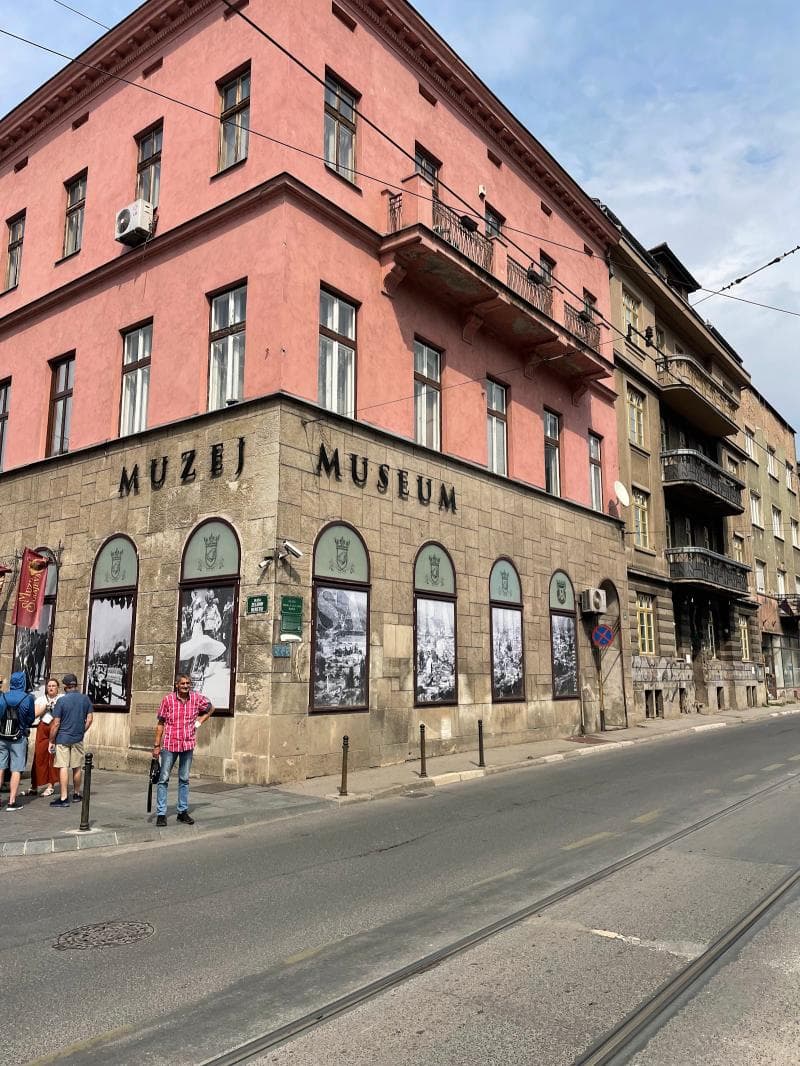
Explore Sarajevo's Franz Ferdinand Memorial Area at the Latin Bridge, the precise spot where Archduke Franz Ferdinand's assassination ignited WWI. Delve into history in Bosnia and Herzegovina.
Overview
Nestled in the heart of Sarajevo, Bosnia and Herzegovina, the Latin Bridge stands as a seemingly modest Ottoman-era structure spanning the serene Miljacka River. However, its understated beauty belies its monumental historical significance. Adjacent to its northern end lies what is informally known as the 'Franz Ferdinand Memorial Area,' specifically the Sarajevo Museum 1878–1918. This pivotal location marks the very spot where, on June 28, 1914, Archduke Franz Ferdinand, heir to the Austro-Hungarian throne, and his wife Sophie were tragically assassinated. This single event set in motion a chain reaction that would irrevocably alter the course of the 20th century, culminating in the outbreak of World War I. Visiting this site offers a profound encounter with a moment that shifted global history, encapsulated by the bridge itself and the interpretive museum nearby.
History & Cultural Background
The Latin Bridge, or 'Latinska ćuprija' as it's known locally, boasts a rich history predating its infamous connection to Franz Ferdinand. Its foundations suggest it is the oldest preserved bridge in Sarajevo, with records mentioning a wooden bridge here as early as 1541. A stone bridge was later built around 1565 by Ali Ajni-Beg. After a devastating flood in 1791, the current stone bridge was constructed in 1798, financed by the merchant Abdulah-aga Briga. Its original name derived from the 'Latinluk' or Catholic quarter it connected on the right bank of the Miljacka River.
For a significant period during the Yugoslav era, from 1918 to 1993, the bridge was officially renamed 'Principov Most' or 'Princip's Bridge,' honoring Gavrilo Princip, the young Bosnian Serb nationalist responsible for the assassination. This renaming reflected the prevailing political narrative of Princip as a national hero who fought against Austro-Hungarian occupation. The museum directly across from the bridge's northern end, now known as the Museum of Sarajevo 1878–1918, was also established in 1953 as the 'Museum of Young Bosnia and Gavrilo Princip,' commemorating the event from a particular ideological viewpoint. After the Bosnian War in the 1990s, the bridge reverted to its original name, Latin Bridge, and the museum's focus broadened to cover the entire Austro-Hungarian period in Sarajevo.
What Makes It Special
What makes the Franz Ferdinand Memorial Area truly special is its unparalleled role as the geographical epicenter of World War I's genesis. It is a place where a seemingly localized act of political violence erupted into a global catastrophe. The bridge itself, a beautiful example of Ottoman engineering with its four arches and distinctive 'eyes' (relieving openings) in its pillars, stands as a silent witness to centuries of Sarajevo's history.
The corner where Princip stood is more than just a street intersection; it represents a nexus of geopolitical tension, nationalistic fervor, and sheer happenstance. The 'fatal wrong turn' taken by Archduke Franz Ferdinand's driver after an initial assassination attempt makes the site even more poignant, highlighting how a small deviation can lead to monumental consequences. This area offers a tangible link to a moment that redefined world order, making it an incredibly powerful and thought-provoking destination.
Stories, Fun Facts & Local Details
One of the most compelling stories surrounding the Franz Ferdinand Memorial Area is the dramatic sequence of events on June 28, 1914. After an initial bomb attempt on the Archduke's motorcade failed, Ferdinand decided to visit the injured in the hospital. However, his driver took a wrong turn onto Franz Joseph Street (now Obala Kulina bana), directly past where Gavrilo Princip was coincidentally standing. Realizing the error, the car stopped to reverse, placing Ferdinand and Sophie mere feet from Princip, who seized the moment to fire the fatal shots. This incredible stroke of ill-fortune for the Archduke, and conversely, opportunity for Princip, underscores the fragility of fate.
Throughout history, the perception of Gavrilo Princip and the event itself has fluctuated dramatically. Once celebrated as a liberator in socialist Yugoslavia, he was later re-evaluated, particularly after the Bosnian War. The original monument erected by the Austro-Hungarians in 1917 to commemorate Ferdinand and Sophie was dismantled in 1919. Later, plaques and even footprints marking Princip's exact position were installed and subsequently removed or destroyed, reflecting the complex and often conflicting interpretations of this historical moment within the region. Today, a plaque on the museum wall soberly recounts the assassination, allowing visitors to form their own perspectives.
Visitor Perspective
For visitors approaching the Latin Bridge today, the experience is one of quiet contemplation and immense historical weight. Standing on the bridge, one can admire its graceful Ottoman architecture and the flow of the Miljacka River, much as people have for centuries. Yet, it's impossible to ignore the corner adjacent to the bridge, which draws the eye with its commemorative plaque. The Museum of Sarajevo 1878–1918, housed in what was once Moritz Schiller's delicatessen – the building Princip stood near – offers a comprehensive and balanced perspective on the Austro-Hungarian period and the assassination.
Inside the museum, you'll find exhibits detailing the political and cultural climate of the era, the assassination plot, and its immediate aftermath. While the original pistol used by Princip and Ferdinand's blood-stained uniform are displayed in Vienna, the museum in Sarajevo often features replicas and extensive historical documentation, photographs, and artifacts that immerse visitors in the period. The Franz Ferdinand Memorial Area is not merely a historical marker; it's an opportunity to connect with a defining chapter of world history and reflect on the enduring legacy of a single event in a vibrant, multicultural city.
Coordinates: 18.42901, 43.85762
View on Google Maps💬 How Travelers Describe This Place
Based on community votes
Beautiful
517Unique
422Interesting
394Photogenic
269Must See
251
Traveler Stories
Discover memorable experiences shared by travelers who have visited this place.
No traveler stories yet.
Be the first traveler to share what made this place memorable.

Tour
By
Spot
Discover amazing places around the world. Your journey starts here.
Explore
© 2026 TourBySpot. All rights reserved.