Sarajevo Museum 1878–1918
Sarajevo, Bosnia and Herzegovina
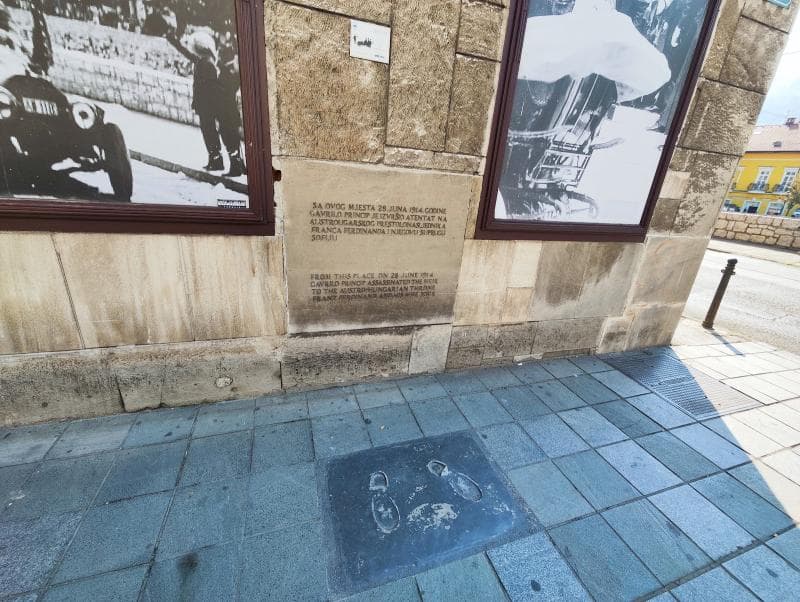
Explore the Sarajevo Museum 1878–1918, located at the Latin Bridge in Sarajevo, Bosnia and Herzegovina, marking the spot where WWI began. Discover the Austro-Hungarian era and the assassination that changed the world.
Overview
Nestled at the northern end of the historic Latin Bridge in Sarajevo, Bosnia and Herzegovina, the Sarajevo Museum 1878–1918 offers a profound journey into a pivotal era that reshaped global history. This small, yet immensely significant museum occupies the very building from which Gavrilo Princip fired the shots that assassinated Archduke Franz Ferdinand and his wife Sophie in 1914, an event that ignited World War I. Dedicated to the Austro-Hungarian period in Sarajevo, the museum chronicles the city's transformation from 1878 to 1918, covering political shifts, cultural developments, and the dramatic incident at its doorstep.
It serves as a poignant reminder of Sarajevo's intricate past, inviting visitors to reflect on the legacy of empires and the profound consequences of a single moment. The museum's strategic location, immediately adjacent to the iconic Latin Bridge, ensures its place as an essential stop for anyone seeking to understand the deep historical layers of this fascinating city.
History & Cultural Background
The period between 1878 and 1918 marked a significant chapter in Sarajevo's history, characterized by the Austro-Hungarian administration following the Congress of Berlin. This era brought considerable modernization and Western influence to the Ottoman-era city, impacting its architecture, urban planning, industry, and cultural life. Sarajevo saw the introduction of innovations like the first horse-drawn tram in 1885 and electric street lighting by 1895, transforming it into a vibrant European center. However, this period also fostered political tensions, particularly with the annexation of Bosnia and Herzegovina by Austria-Hungary in 1908, fueling nationalist sentiments among certain groups.
The museum itself was established in 1953, originally as the 'Sarajevo Assassination Museum,' commemorating the 39th anniversary of the Archduke's killing. Over time, its focus broadened to encompass the entire Austro-Hungarian period, aiming to provide a comprehensive understanding of the forces at play before, during, and after the fateful day of June 28, 1914.
What Makes It Special
What truly sets the Sarajevo Museum 1878–1918 apart is its direct connection to one of the most transformative events of the 20th century. Standing inside the museum, or just outside its doors on the corner, places you precisely at the spot where Gavrilo Princip altered the course of history. The museum's exhibits meticulously detail the events of that day, alongside broader themes of the Austro-Hungarian impact on the city.
Visitors can explore authentic documents, photographs, and artifacts, including a pistol linked to Princip, and a collection of items showcasing Sarajevo's rapid urbanization during this era. Life-size models of Archduke Franz Ferdinand and his wife Sophie offer a vivid representation of the historical figures. The museum's location, combined with its focused narrative, provides a powerful and immersive historical experience that is hard to replicate elsewhere.
Stories, Fun Facts & Local Details
The Latin Bridge itself, a beautiful Ottoman-era structure dating back to at least the 16th century, holds many stories. It was known as 'Principov most' (Princip's Bridge) during the Yugoslav era, honoring Gavrilo Princip as a national hero. After the Bosnian War, its original name, Latin Bridge, was reinstated to depoliticize the site. The very pavement outside the museum, where Princip stood, has seen multiple commemorative plaques over the decades, reflecting changing political narratives.
- One early plaque framed Princip as a criminal, while later Yugoslav-era plaques celebrated him as a freedom fighter.
- The current plaque, installed in the late 1990s, maintains a deliberately neutral tone, acknowledging the historical significance without judgment.
- Sarajevo was a city of 'firsts' during the Austro-Hungarian period: it saw the first brickyard in 1879, an omnibus service in 1880, and even issued the first driving licenses to women in 1904.
These details add layers to the narrative, reminding us that history is constantly reinterpreted and that the past continues to shape the present.
Visitor Perspective
For the curious traveler, the Sarajevo Museum 1878–1918 offers a compact yet incredibly rich educational experience. The museum, typically housed in two ground-floor rooms, presents its collections thematically, guiding you through the intricate tapestry of Sarajevo's Austro-Hungarian years. You'll find exhibits on the city's urban development, cultural life, and the various resistance movements that emerged. The clear displays, featuring photographs, documents, and even reconstructed interiors, allow for a deep dive into the daily life and political atmosphere of the period.
While relatively small, many visitors find it a profoundly impactful stop, especially when coupled with a visit to the Latin Bridge itself. It offers a unique opportunity to connect with a moment that reverberated across continents, providing crucial context for understanding the 20th century. Allow 30-45 minutes for a thorough visit to absorb the details and contemplate the weight of history at this extraordinary location.
Coordinates: 18.428865, 43.857616
View on Google Maps💬 How Travelers Describe This Place
Based on community votes
Photogenic
964Unique
926Beautiful
646Interesting
482Must See
380
Traveler Stories
Discover memorable experiences shared by travelers who have visited this place.
No traveler stories yet.
Be the first traveler to share what made this place memorable.

Tour
By
Spot
Discover amazing places around the world. Your journey starts here.
Explore
© 2026 TourBySpot. All rights reserved.