Independence Square
Minsk, Belarus
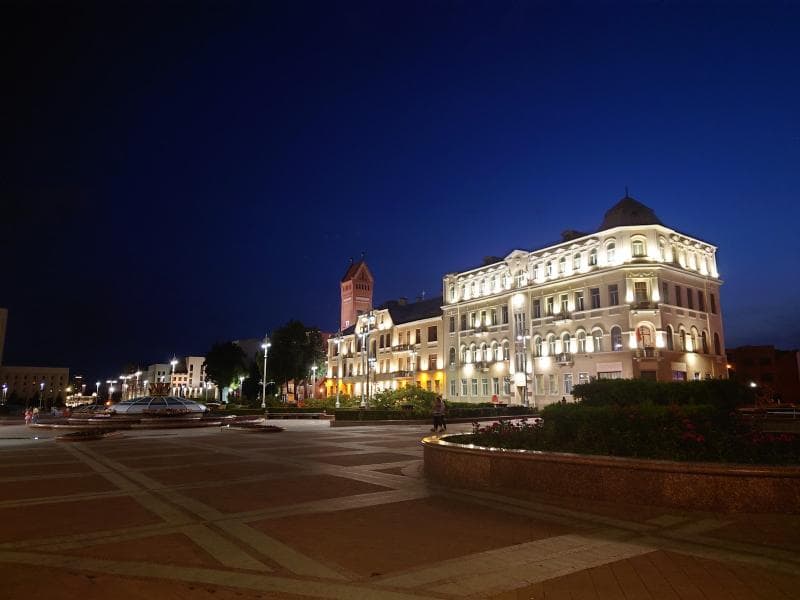
Discover Independence Square in Minsk, Belarus – one of Europe's largest squares, blending Soviet-era architecture with modern vibrancy and rich history.
Overview
Independence Square, or Ploshcha Nezalezhnosti, stands as the vibrant heart of Minsk, the capital city of Belarus. Renowned as one of Europe's largest public squares, it sprawls across an impressive seven hectares, offering a grand blend of historical significance, monumental architecture, and modern urban life. More than just a public space, it serves as the political and administrative core of the nation, flanked by key government buildings and cultural institutions. Visitors are often struck by its sheer scale and the harmonious, yet contrasting, architectural styles that define its perimeter.
Situated strategically at the beginning of Independence Avenue, the square is a natural focal point for both locals and travelers. Beneath its vast expanse lies a bustling underground complex, seamlessly integrating commerce and transit. Whether arriving by metro or simply strolling through, Independence Square provides a profound insight into Minsk's past and present.
History & Cultural Background
The genesis of Independence Square traces back to the 1930s, conceived by the visionary architect Iosif Langbard. It was initially named Lenin Square and designed to be the principal ceremonial venue for the Byelorussian Soviet Socialist Republic, hosting rallies and parades. The monumental Government House, a prime example of Constructivist architecture, was completed in 1934 and became the square's central edifice.
Tragically, World War II inflicted heavy damage upon Minsk, and most of the square's original buildings were destroyed. However, the Government House and the striking Church of Saints Simon and Helena, affectionately known as the Red Church, remarkably survived the devastation. The iconic Lenin monument, initially erected before the war, was re-cast and re-installed in 1945 after its destruction during the German occupation.
Following the war, as Minsk underwent extensive reconstruction, the square temporarily ceded its central status to October Square. However, with the development of the Minsk Metro in the 1980s, Lenin Square re-emerged as a vital hub. In 1991, with Belarus achieving independence, the square was fittingly renamed Independence Square, symbolizing the dawn of a new national era. A significant reconstruction effort in the 2000s further transformed the area, introducing an extensive underground shopping and entertainment center while revitalizing the surface into a pedestrian-friendly zone.
What Makes It Special
Independence Square's unique character stems from its compelling blend of Soviet-era grandeur and contemporary vibrancy. It is one of the few places where monumental Stalinist architecture, like the Government House and the Belarusian State University buildings, coexists with the intricate Neo-Romanesque style of the Red Church. This architectural juxtaposition tells a powerful story of Belarus's layered history, from its Soviet past to its independent present.
The square's thoughtful design integrates green spaces, fountains, and sculptures, transforming a vast open area into an inviting urban park. The underground 'Stolitsa' shopping mall is a marvel of modern urban planning, providing a subterranean world of shops and cafes that belies the historical gravitas above ground. This intelligent use of space ensures the square remains a dynamic public venue for both official events and daily leisure.
Stories, Fun Facts & Local Details
Before its current name, the square was universally known as Lenin Square, a name that still persists for the metro station located directly beneath it. The bronze statue of Vladimir Lenin in front of the Government House is not the original; it's a meticulously crafted copy, installed in 1945 after the first was destroyed during wartime. It remains a rare example of a Lenin statue still prominently displayed in a public space, rather than in a museum.
The Church of Saints Simon and Helena, the 'Red Church,' is renowned for its distinctive red-brick facade, sourced from Częstochowa. Its survival during World War II, amidst the widespread destruction of Minsk, is often regarded as a testament to its enduring cultural and spiritual significance. During the Soviet era, the church faced a curious transformation, serving for a period as a cinema, before being returned to religious use.
Beyond the grand buildings, visitors can discover smaller, meaningful details. The square features a beautiful light and music fountain that often becomes a gathering point, especially in the evenings. There are also sculptures like 'Archangel Michael' and 'The Bell of Nagasaki,' each adding a layer of narrative and artistic expression to the public space. The square's generous dimensions, 450 meters long and 160 meters wide, make it ideal for leisurely strolls and provide ample space for reflection.
Visitor Perspective
For the curious traveler, Independence Square is more than just a sightseeing spot; it's an immersive experience into the heart of Minsk. Its central location, directly accessible via the Ploshcha Lyenina metro station and close to the railway station, makes it an unavoidable and convenient stop on any itinerary.
Walking across the square, one can feel the layers of history underfoot, from Soviet parades to modern-day demonstrations. The underground 'Stolitsa' mall provides a comfortable retreat for shopping, dining, or simply observing local life, especially during colder months. At night, the square transforms under elegant illumination, highlighting its architectural forms and offering a captivating atmosphere for an evening stroll. Independence Square invites visitors to pause, explore, and connect with the unique spirit of Minsk.
Coordinates: 27.547778, 53.895556
View on Google Maps💬 How Travelers Describe This Place
Based on community votes
Interesting
912Must See
875Unique
820Beautiful
718Photogenic
479
Traveler Stories
Discover memorable experiences shared by travelers who have visited this place.
No traveler stories yet.
Be the first traveler to share what made this place memorable.
Things to see at Independence Square



Tour
By
Spot
Discover amazing places around the world. Your journey starts here.
Explore
© 2026 TourBySpot. All rights reserved.