Independence Monument
Minsk, Belarus
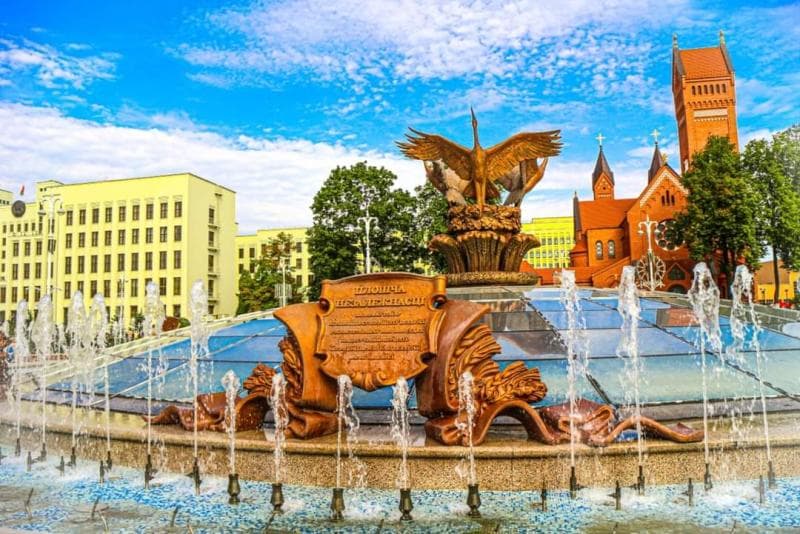
Explore Independence Square in Minsk, Belarus, home to the iconic Lenin Monument, historic Government House, and the vibrant Red Church. Discover its rich Soviet-era history and modern Belarusian identity.
Overview
Independence Square, or Ploshcha Nezalezhnosti, stands as the central artery of Minsk, Belarus. It is not merely a vast urban expanse but a living canvas reflecting the nation's layered history and aspirations. Encompassing approximately seven hectares, it ranks among Europe's largest public squares, an impressive testament to grand urban planning. While the square itself proudly bears the name 'Independence,' symbolizing Belarus's sovereignty, its most prominent sculptural feature is the monumental statue of Vladimir Lenin. This striking bronze figure, often colloquially considered the 'Independence Monument' in the context of the square's name and its pivotal location, anchors the square's historical narrative and serves as a focal point for visitors and locals alike.
The square is an architectural ensemble, a harmonious blend of Stalinist-era buildings, vibrant green spaces, and modern amenities. It hosts the Government House, the Belarusian State University, and the distinctive red-brick Church of Saints Simon and Helena, affectionately known as the Red Church. Beneath its surface lies the sprawling 'Stolitsa' underground shopping and entertainment complex, seamlessly integrating historical grandeur with contemporary city life.
History & Cultural Background
The genesis of Independence Square traces back to the 1930s when it was conceived as Lenin Square, designed by the renowned architect Iosif Langbard. His vision aimed to create Minsk's primary ceremonial venue, a grand space for rallies and military parades during the Soviet era. The square's focal point, the Monument to V.I. Lenin, was initially installed on November 7, 1933, placed strategically in front of the then-under-construction Government House. This early monument depicted Lenin addressing Red Army soldiers. Tragically, during the Nazi occupation of Minsk in July 1941, the original statue was destroyed. However, its significance was such that immediately after Minsk's liberation on July 3, 1944, a decision was made to restore it. Using surviving models from sculptor M. G. Manizer's workshop, a new monument was cast in Leningrad and triumphantly reinstalled on May 1, 1945.
Following Belarus's attainment of independence in the 1990s, the square was aptly renamed Independence Square, reflecting the nation's new era and aspirations. Despite the name change, the Lenin Monument remained, a powerful symbol of the city's continuous historical evolution and a tangible link to its Soviet past.
What Makes It Special
What truly distinguishes Independence Square is its compelling juxtaposition of historical layers. It's a place where the monumental architecture of the Soviet era coexists with symbols of modern Belarusian identity. The presence of the Lenin Monument in a square named 'Independence' creates a powerful dialogue between past and present, challenging visitors to reflect on history and national identity. The Government House, an imposing constructivist edifice, stands as a symbol of state power, while the nearby Red Church, with its distinct Neo-Gothic style and vibrant red brick, offers a stunning architectural contrast, providing a glimpse into the city's early 20th-century heritage.
The square's thoughtful design by Langbard integrated not just buildings but also green spaces and functional areas. Its transformation in the 2000s, including the addition of an underground shopping center and pedestrian zones, further enhanced its role as a dynamic urban hub. This blend ensures that Independence Square is not just a historical site, but a vibrant part of everyday Minsk life.
Stories, Fun Facts & Local Details
- The Lenin Monument, created by sculptor M. G. Manizer, was a significant artistic achievement of its time. At seven meters high, it was one of the largest Lenin statues in the USSR upon its unveiling.
- The pedestal of the Lenin Monument is adorned with four bas-reliefs, each narrating a pivotal chapter of Soviet history: 'The October Revolution,' 'Defending the Motherland,' 'Industrialization of the Country,' and 'Collectivization of Agriculture.' These intricate carvings offer a visual history lesson embedded within the monument itself.
- Beneath the grand open space of Independence Square lies 'Stolitsa,' a multi-level underground shopping and entertainment complex. This subterranean world, complete with shops, cafes, and metro access, was part of a major reconstruction project completed in 2002.
- The Red Church, formally known as the Church of Saints Simon and Helena, gets its popular name from its striking red brick facade. It was built in the early 20th century, a testament to enduring faith amidst changing historical currents, and offers a stark visual contrast to the surrounding Soviet architecture.
- For decades, Independence Square served as the backdrop for major military parades and official ceremonies, making it a witness to countless moments that shaped the nation's past.
Visitor Perspective
A visit to Independence Square offers a unique opportunity to immerse oneself in Minsk's complex identity. As you stroll across its immense expanse, you can almost feel the echoes of history while observing the rhythm of contemporary life. The sheer scale of the square and its surrounding architecture, particularly the Government House and the imposing Lenin Monument, evoke a sense of solemnity and historical weight. The contrasting presence of the Red Church provides a moment of visual and historical respite, inviting reflection on the diverse cultural threads woven into Minsk's fabric.
Beyond its historical monuments, the square is a functional and accessible public space. The 'Ploshcha Lyenina' metro station directly opens onto the square, making it easy to reach. The underground 'Stolitsa' mall offers a practical refuge, especially during colder months, where you can experience modern Belarusian commerce. Whether you're seeking to understand Belarus's past, admire its unique architecture, or simply observe daily life unfold, Independence Square provides a rich and thought-provoking experience, a true heart of the Belarusian capital.
Coordinates: 27.54544, 53.89558
View on Google Maps💬 How Travelers Describe This Place
Based on community votes
Photogenic
712Interesting
542Unique
516Beautiful
326Must See
171
Traveler Stories
Discover memorable experiences shared by travelers who have visited this place.
No traveler stories yet.
Be the first traveler to share what made this place memorable.

Tour
By
Spot
Discover amazing places around the world. Your journey starts here.
Explore
© 2026 TourBySpot. All rights reserved.