Government House
Minsk, Belarus
Explore Government House in Minsk, Belarus, a monumental Constructivist building on Independence Square, housing the National Assembly. Discover its history and architecture.
Overview
Nestled in the heart of Minsk, Belarus, the imposing Government House stands as a monumental testament to Soviet-era architecture and Belarusian statehood. Located prominently on Independence Square, this grand edifice is more than just a building; it is the administrative and political nerve center of the nation, housing the National Assembly of Belarus, which includes both the Council of the Republic and the House of Representatives, as well as the Council of Ministers and other crucial state institutions. Its sheer scale and distinctive architectural style immediately capture attention, making it an undeniable focal point of the city's main square. Originally known as Lenin Square, Independence Square itself was conceived and designed in part by the very architect responsible for Government House, Iosif Langbard. The square and its dominant structure form a cohesive architectural ensemble, steeped in history and symbolic importance for the Belarusian capital.
History & Cultural Background
The story of Government House begins in the early 1930s, a period of ambitious urban planning in the Belarusian Soviet Socialist Republic. Constructed between 1930 and 1934, it emerged from an architectural competition won by the esteemed Belarusian architect Iosif Langbard. Langbard's vision for this pivotal building and the surrounding square was not merely functional; it aimed to create a grand civic center for Minsk. The architectural style chosen was Constructivism, characterized by its strict lines, monumental scale, and geometric forms. This style was revolutionary for its time and Government House remains a prime example, proudly standing as the largest public building of pre-war Belarusian SSR, with an impressive volume of 240,000 cubic meters. Its construction was a challenging feat, often carried out by hand due to the scarcity of machinery, cement, and metal during that era.
Remarkably, Government House is one of the very few structures in Minsk that withstood the devastation of World War II, a period during which it ironically housed the local Gestapo during German occupation. Its survival is a poignant symbol of resilience in a city largely rebuilt from ruins. In front of the building stands a bronze monument to Vladimir Lenin, a central figure in Soviet history. This statue, created by sculptor Matvey Manizer in collaboration with Langbard and installed in 1933 or 1934, was destroyed by the Nazis during the war but was meticulously restored in 1945 using its original casting. The pedestal of the statue even features bas-reliefs with inscriptions in the pre-reform Belarusian language, offering a glimpse into the region's linguistic heritage.
What Makes It Special
What sets Government House apart is its dual role as both a functioning seat of power and a historical monument. Its Constructivist architecture, with its ascending volumes and monumental stepped appearance, was a groundbreaking design for its era and continues to dominate Independence Square with its imposing presence. The building's strategic placement and design by Iosif Langbard integrated it seamlessly with the square, which he also planned, creating a powerful urban ensemble. It represents a key period in Belarusian history and urban development, showcasing a deliberate attempt to craft a modern capital during the Soviet period.
Furthermore, its survival through World War II, while much of Minsk was razed, underscores its enduring significance. The continuity of its function, from a Soviet administrative center to the present-day seat of the Belarusian National Assembly, highlights its unwavering importance in the country's political landscape. The statue of Lenin, which has stood guard for nearly a century, further cements its historical narrative, reminding visitors of the layered past that shaped contemporary Belarus.
Stories, Fun Facts & Local Details
One interesting detail about Government House is that for a time, the Lenin statue positioned before it was the tallest of its kind in the entire USSR. This speaks to the ambition and symbolic weight placed upon this specific location and monument. The construction process itself, primarily manual labor, is a testament to the dedication and hardship involved in bringing such a colossal project to fruition in the early 20th century. Imagine the meticulous work of building such a massive structure with limited technology, shaping the very heart of a burgeoning capital. The square around Government House, originally named Lenin Square, was explicitly designed to host civil and military parades, a tradition that continued for decades. It served as the primary ceremonial venue, where party leaders would observe from a central grandstand, making it a stage for significant historical events and public life. Today, the modern Independence Square, though retaining its historical core, also features an underground complex with shopping areas and cafes, illustrating how history and modernity intertwine in Minsk.
Visitor Perspective
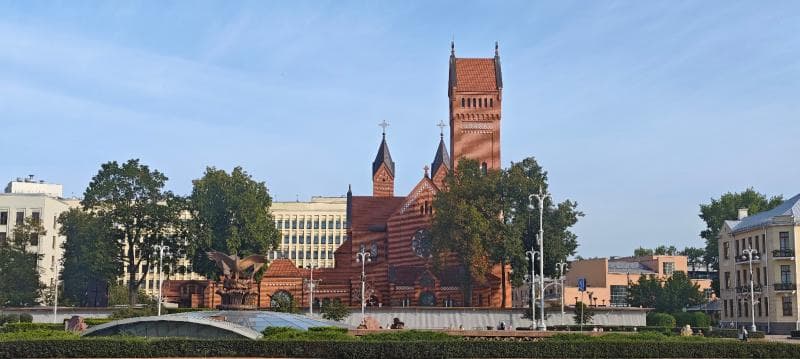
While the interior of Government House is typically not open to the general public for casual visits, often requiring prior arrangements for guided tours, its exterior and the surrounding Independence Square offer an enriching experience for any traveler. Visitors can stroll across the vast expanse of Independence Square, taking in the panoramic views of the Constructivist masterpiece from multiple angles. The best time to appreciate its architectural details is during the day, when the natural light highlights its strict lines and monumental forms. The scale of the building is truly impressive when observed from the square, evoking a sense of history and gravitas. Standing in front of the iconic Lenin statue provides a direct connection to a pivotal era. The square's central location and proximity to other attractions like the Red Church (Church of Saints Simon and Helena), with its contrasting Neo-Gothic style, and the underground shopping center, make it a natural starting point for exploring Minsk's diverse urban landscape. A visit to Independence Square to witness Government House is essential for understanding the historical, political, and architectural fabric of Minsk and Belarus.
Coordinates: 27.54478, 53.89612
View on Google Maps💬 How Travelers Describe This Place
Based on community votes
Beautiful
982Interesting
876Photogenic
648Unique
235Must See
197
Traveler Stories
Discover memorable experiences shared by travelers who have visited this place.
No traveler stories yet.
Be the first traveler to share what made this place memorable.

Tour
By
Spot
Discover amazing places around the world. Your journey starts here.
Explore
© 2026 TourBySpot. All rights reserved.