Church Of Saints Simon And Helena
Minsk, Belarus
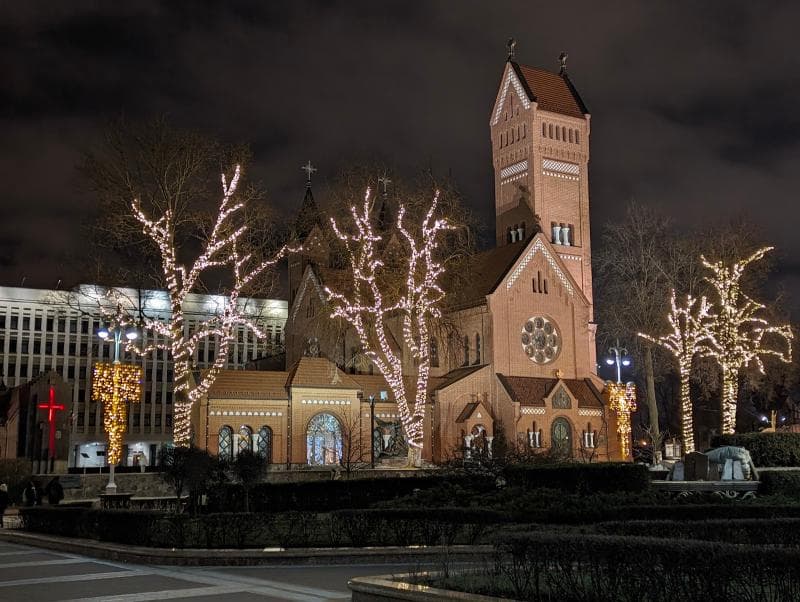
Discover the iconic Church of Saints Simon and Helena, or the Red Church, a Neo-Romanesque gem on Independence Square in Minsk, Belarus.
Overview
In the bustling heart of Minsk, Belarus, stands a truly distinctive architectural landmark: the Church of Saints Simon and Helena. More commonly known as the Red Church due to its striking brick facade, this Roman Catholic place of worship is an unmissable sight on Independence Square. Its unique Neo-Romanesque style, with elements of Neo-Gothic and Art Nouveau, immediately captures the eye, offering a stark yet beautiful contrast to the surrounding Soviet-era architecture. Beyond its visual appeal, the Red Church is a profound symbol of faith, resilience, and memory, embodying a rich tapestry of Belarusian history and culture.
History & Cultural Background
The story of the Church of Saints Simon and Helena began with a heartfelt personal tragedy. Its construction, initiated in 1905 and completed in 1910, was financed by Edward Woyniłłowicz, a prominent Belarusian-Polish landowner and civic activist. He dedicated the church to the memory of his two young children, Szymon and Helena, who had passed away prematurely. This poignant origin story infuses the church with a deep emotional resonance, transcending its architectural grandeur.
Designed by Polish architects Tomasz Pajzderski and Władysław Marconi, the church was built using red bricks sourced from Częstochowa, Poland, which gave it its enduring nickname. Its history, however, was far from peaceful. Following the Bolshevik Revolution, the church faced severe trials. In 1923, it was reportedly robbed by the Red Army. In 1932, Soviet authorities closed it down, secularizing the building and converting it into a Polish theatre, and later a film studio. During the German occupation in 1941, it briefly returned to its original religious purpose, only to be re-purposed as a cinema after World War II. It was not until 1990, spurred by public activism and two hunger strikes, that the building was finally returned to the Roman Catholic Church, marking a significant moment in Belarus's national awakening and religious freedom.
What Makes It Special
The Red Church stands out not only for its color but also for its architectural details. It is a five-nave, three-tower basilica with a voluminous and spatial asymmetrical composition. Its twin towers, rising dramatically, reach a height of 80 meters, making them visible from various points in the city center. Unusually, two smaller hipped towers are positioned not on the main facade but on the altar sides, said to represent Woyniłłowicz's children, while a taller, central tower is believed to symbolize the parents' sorrow.
The interior, meticulously restored since its return to the Catholic Church, features beautiful stained-glass windows and symbolic murals that create a serene and awe-inspiring atmosphere. The main altar, carved from pure white Italian marble, is a striking and unexpected feature for a church in this region.
Stories, Fun Facts & Local Details
The personal story of Edward Woyniłłowicz and his children, Simon and Helena, is central to the church's identity. This dedication is further reflected in the three bells originally installed in the church: one named 'Edward' for the donor, one for his son 'Simon', and a third in honor of Archbishop Michael. In 2006, Woyniłłowicz's remains, along with his wife's, were reburied within the church, cementing its role as a personal memorial as well as a public spiritual center.
Outside the church, visitors encounter two significant monuments. A bronze sculpture of Archangel Michael, erected in 1996, depicts him slaying a serpent, symbolizing the triumph of heavenly power over darkness. Nearby is the 'Bell of Nagasaki,' a poignant memorial to victims of nuclear disasters, including Hiroshima, Nagasaki, and Chernobyl. Since its dedication in 2000, the bell rings every Sunday at noon, serving as a powerful reminder of peace and remembrance.
Visitor Perspective
Visiting the Church of Saints Simon and Helena offers a contemplative experience, contrasting sharply with the bustling Independence Square outside. The church remains an active place of worship, and visitors are encouraged to dress modestly and remove headphones upon entry as a sign of respect. While photography is generally allowed, flash photography should be avoided, especially during services.
The play of light through its stained-glass windows is particularly enchanting around midday. Exploring the side chapels can reveal smaller, often overlooked artworks. The church also occasionally hosts free classical music concerts, details of which can often be found on notice boards near the entrance. This blend of spiritual sanctity, historical depth, and cultural activity makes the Red Church a compelling stop for any traveler seeking to understand the soul of Minsk.
Coordinates: 27.5475, 53.8965
View on Google Maps💬 How Travelers Describe This Place
Based on community votes
Beautiful
980Must See
288Interesting
247Photogenic
171Unique
130
Traveler Stories
Discover memorable experiences shared by travelers who have visited this place.
No traveler stories yet.
Be the first traveler to share what made this place memorable.

Tour
By
Spot
Discover amazing places around the world. Your journey starts here.
Explore
© 2026 TourBySpot. All rights reserved.