Grossmünster
Zurich, Switzerland
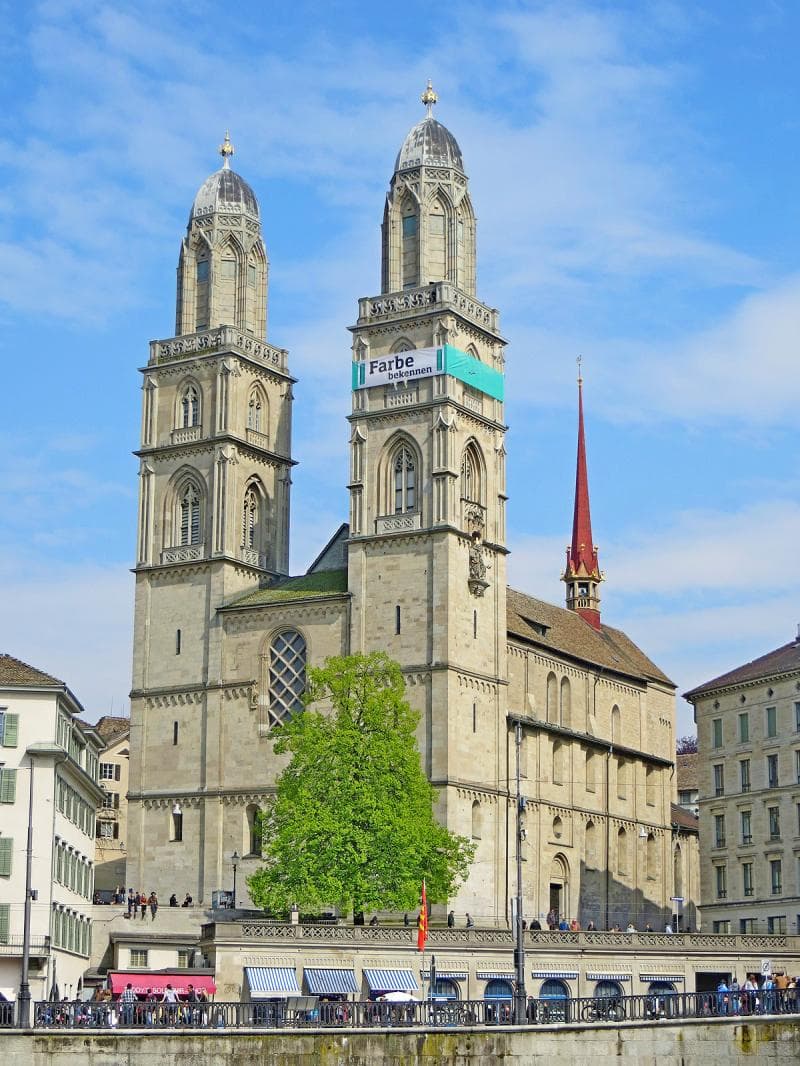
Discover Grossmünster in Zurich, Switzerland, a Romanesque church and the birthplace of the Swiss Reformation, renowned for its twin towers and panoramic views.
Overview
Perched majestically above the Limmat River in Zurich's historic Old Town, the Grossmünster stands as an iconic landmark, instantly recognizable by its distinctive twin towers. More than just a striking architectural marvel, this Romanesque-style Swiss Reformed Church is a profound symbol of Zurich's rich history and cultural identity. It holds a central place among the city's four major churches and played an unparalleled role as the birthplace of the Swiss-German Reformation.
Today, the Grossmünster remains an active place of worship and a vibrant cultural hub, hosting services and events that continue to engage the community. Its imposing yet elegant structure draws visitors from around the globe, eager to explore its storied past and admire its unique features.
History & Cultural Background
The origins of the Grossmünster are steeped in legend, dating back to the time of Charlemagne. According to a popular tale, the Holy Roman Emperor's horse knelt reverently over the burial site of Zurich's patron saints – Felix, Regula, and Exuperantius – prompting him to found a church on this sacred ground in the early 9th century. Archaeological evidence supports the site's ancient significance, revealing a Roman burial ground beneath the current structure.
Construction of the present Romanesque basilica began around 1100 and was largely completed by 1220. Throughout the Middle Ages, the Grossmünster functioned as a monastery church, often vying for prominence with the Fraumünster, located across the Limmat. However, its most transformative period arrived in the 16th century with the dawn of the Protestant Reformation.
In 1519, Huldrych Zwingli, a pivotal figure in European religious history, began preaching from the Grossmünster's pulpit. His sermons advocated for radical reforms, leading Zurich to break with the Roman Catholic Church and become the first Protestant city-state. This movement, continued by his successor Heinrich Bullinger, profoundly reshaped the church's interior, stripping away elaborate ornamentation to reflect the austere ideals of Protestantism, emphasizing simplicity and the spoken word.
What Makes It Special
Beyond its historical significance, the Grossmünster captivates with several distinctive features. Its twin towers, often affectionately nicknamed the 'salt and pepper shakers' by locals, are an unmistakable part of Zurich's skyline. While their original wooden spires were destroyed by fire in 1763, they were replaced in the 18th century with the neo-Gothic domed tops seen today.
Inside, despite the Reformation's emphasis on austerity, the church showcases remarkable artistry. The choir is adorned with stunning stained glass windows created by Augusto Giacometti in 1932. Later, in 2009, German artist Sigmar Polke added mesmerizing windows made from thin slices of agate rock, depicting biblical figures in vibrant hues. The Romanesque crypt, dating from the 11th to 13th centuries, is the largest in Switzerland and houses a 15th-century statue of Charlemagne, a copy of which crowns the south tower, known as the Karlsturm. The church also features ornate bronze doors by Otto Münch and a Reformation Museum within its cloister.
Stories, Fun Facts & Local Details
The legend of Charlemagne's horse kneeling, pinpointing the graves of Felix and Regula, offers a charming, if unverified, origin story for the Grossmünster. Even more dramatically, the patron saints Felix, Regula, and Exuperantius are said to have been beheaded for their Christian faith, only to miraculously pick up their own heads and walk to the hill where the Grossmünster now stands, burying themselves there. This powerful narrative played a crucial role in shaping medieval Zurich's religious identity.
Huldrych Zwingli's reforms were remarkably impactful, even leading to the initial removal of the church organ and the prohibition of church music, reflecting a strict adherence to simplicity. The Grossmünster also boasts a continuous musical tradition, and its excellent acoustics make it a popular venue for organ and choral concerts today.
Visitors should be aware of scheduled renovation work on the Grossmünster from January 2025 to 2029, which may affect access to certain areas.
Visitor Perspective
A visit to the Grossmünster offers both historical immersion and breathtaking views. Entry to the main church is free, allowing you to explore its serene interior, the Romanesque crypt, and admire the famous stained-glass windows. For a truly unforgettable experience, embark on the climb up the Karlsturm, the south tower. Its 187 steep, narrow steps lead to a viewing platform offering panoramic vistas of Zurich's Old Town, the winding Limmat River, Lake Zurich, and, on clear days, the majestic Alps in the distance.
The tower climb typically involves a small fee, though it is often free for holders of the Zürich Card. Comfortable shoes are highly recommended for the ascent. The Grossmünster is easily accessible by Zurich's efficient public transportation system, being just a short walk or tram ride from the main station. To avoid crowds and enjoy a more personal exploration, consider visiting during the early morning or late afternoon, or during the spring and autumn seasons when the weather is mild and tourist numbers are lower.
Coordinates: 8.5439, 47.3701
View on Google Maps💬 How Travelers Describe This Place
Based on community votes
Photogenic
995Beautiful
989Must See
613Interesting
603Unique
581
Traveler Stories
Discover memorable experiences shared by travelers who have visited this place.
No traveler stories yet.
Be the first traveler to share what made this place memorable.
Things to see at Grossmünster



Tour
By
Spot
Discover amazing places around the world. Your journey starts here.
Explore
© 2026 TourBySpot. All rights reserved.