Twin Towers Climb
Zurich, Switzerland
Climb the iconic Twin Towers (Karlsturm) of Grossmünster in Zurich, Switzerland, for breathtaking panoramic views and discover its Reformation history.
Overview
Dominating the skyline of Zurich's Old Town, the Grossmünster is a magnificent Romanesque-style church, instantly recognizable by its iconic twin towers. It stands proudly along the Limmat River, serving not only as a vibrant place of worship but also as a powerful symbol of the city's rich history and cultural identity. For many, the highlight of a visit is the 'Twin Towers Climb', more specifically, ascending the Karlsturm (Charlemagne Tower), the south tower. This climb offers a rewarding experience, leading visitors up 187 or 189 narrow, winding steps to a viewing platform. From this vantage point, sweeping panoramic vistas unfold, encompassing Zurich's charming Old Town, the glistening Limmat River, the expanse of Lake Zurich, and on clear days, the majestic peaks of the Alps in the distance. The Grossmünster, with its robust architecture and significant past, is a cornerstone of any exploration of Zurich.
History & Cultural Background
The Grossmünster's narrative is deeply woven into the fabric of Zurich's earliest legends and pivotal historical moments. According to tradition, the church's origins date back to Charlemagne himself, who, it is said, founded a monastery on the spot where his horse knelt over the tombs of Zurich's patron saints: Felix, Regula, and Exuperantius. Archaeological evidence supports the presence of a Roman burial ground at this ancient site. Construction of the current Romanesque structure commenced around 1100 CE, with its inauguration occurring approximately in 1220 CE.
However, the Grossmünster's most profound historical role began in the 16th century when it became the cradle of the Swiss-German Reformation. From his pastoral office within these very walls, Huldrych Zwingli initiated this transformative movement in 1520. His reforms radically reshaped the religious landscape, emphasizing simplicity in worship and leading to the removal of much of the church's opulent ornamentation. The twin towers themselves, first erected between 1487 and 1492 with wooden steeples, suffered a devastating fire in 1763. They were subsequently rebuilt with the distinctive neo-Gothic tops visible today, completed by 1787.
What Makes It Special
The Grossmünster holds a special place in the hearts of both locals and visitors, primarily due to its enduring symbolism and historical significance. Its twin towers are arguably the most recognizable landmark in Zurich, often affectionately dubbed 'salt and pepper shakers' by residents. The church's unique architectural blend, showcasing sturdy Romanesque elements alongside medieval carvings and later additions, tells a story of centuries of evolution.
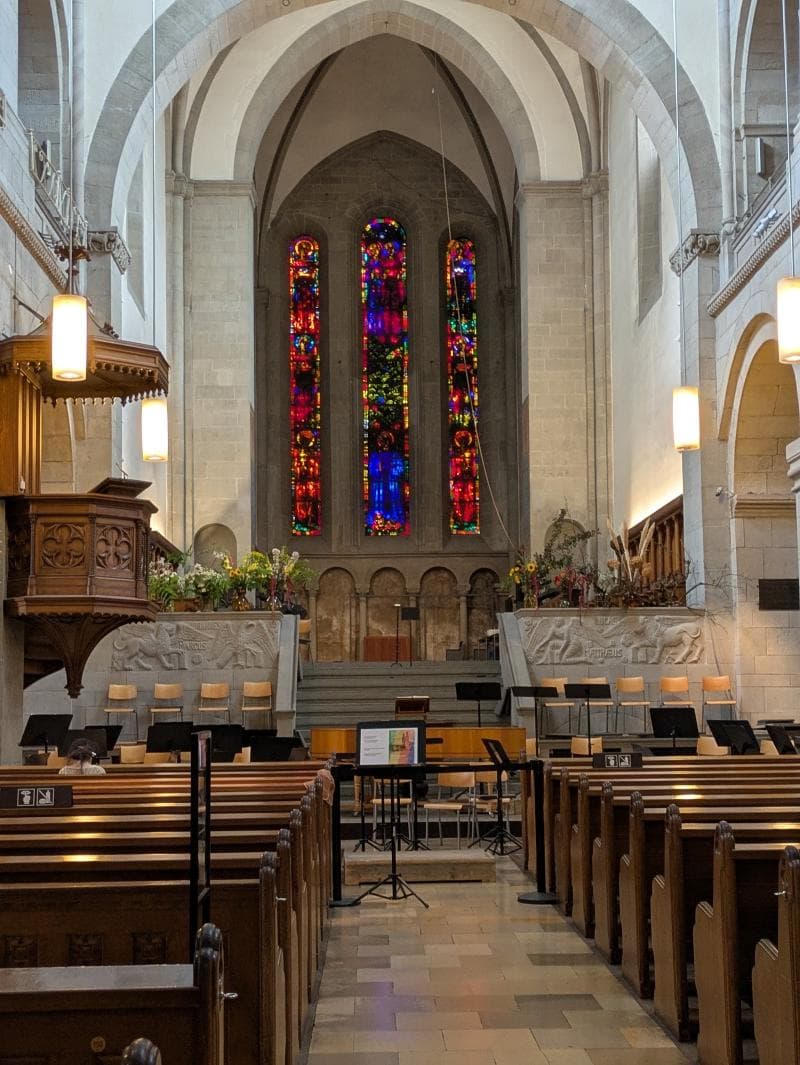
Beyond its visual appeal, the Grossmünster's identity is inextricably linked to the Swiss Reformation. It was here that a religious revolution took root, impacting not just Switzerland but the broader European spiritual landscape. Inside, visitors can admire striking modern stained-glass windows, including works by Augusto Giacometti from 1932 and Sigmar Polke, which beautifully contrast with the ancient stone. The powerful bronze doors, crafted by Otto Münch, further add to its artistic richness. Below ground, the church boasts the largest triple-aisled crypt in Switzerland, an atmospheric space that predates the main church and offers a glimpse into its deep past.
Stories, Fun Facts & Local Details
The Grossmünster is a treasure trove of stories and intriguing details. The legend of Charlemagne's horse kneeling to reveal the saints' burial site is a captivating tale, adding a mythical layer to the church's foundation. It highlights the deep roots of Christian heritage in Zurich and the importance of its patron saints. Another amusing anecdote often shared is that composer Richard Wagner, upon seeing the towers, supposedly remarked that they resembled 'two pepper dispensers' – a humorous observation that likely inspired the popular local nickname for the twin towers.
A notable feature found atop the south tower, the Karlsturm, is a statue of Charlemagne himself, standing as a silent guardian over the city. The church's deliberately austere interior is not by chance; it is a direct and visible consequence of the iconoclastic reforms led by Zwingli, a stark reminder of the Protestant emphasis on simplicity over elaborate decoration. Within the cloister, a dedicated Reformation Museum delves deeper into this pivotal period, offering insights into the individuals and ideas that shaped the church and the nation.
Visitor Perspective
Embarking on the Twin Towers Climb at Grossmünster offers a truly immersive experience, providing both a physical challenge and an unparalleled reward. The ascent involves navigating 187 or 189 steep and often narrow steps within the Karlsturm, making comfortable footwear a must. While challenging, the climb is generally considered moderate and well worth the effort for the breathtaking views.
Upon reaching the top, large panoramic windows provide unobstructed vistas, though for safety reasons, direct access to external terraces is restricted. A nominal fee is charged for the tower climb, and it is always advisable to check the Grossmünster's official website for the most current opening hours, as these can vary seasonally and be affected by services or special events. Typically, a visit encompassing both the church interior and the tower climb requires between one to two hours, making it a perfectly manageable and enriching addition to any Zurich itinerary. Situated centrally within the Old Town, the Grossmünster is easily accessible, allowing visitors to seamlessly combine their visit with exploration of the surrounding historic streets.
Coordinates: 8.543611, 47.370278
View on Google Maps💬 How Travelers Describe This Place
Based on community votes
Must See
995Unique
839Beautiful
388Interesting
289Photogenic
141
Traveler Stories
Discover memorable experiences shared by travelers who have visited this place.
No traveler stories yet.
Be the first traveler to share what made this place memorable.

Tour
By
Spot
Discover amazing places around the world. Your journey starts here.
Explore
© 2026 TourBySpot. All rights reserved.