Fort Saint-Jean
Marseille, France
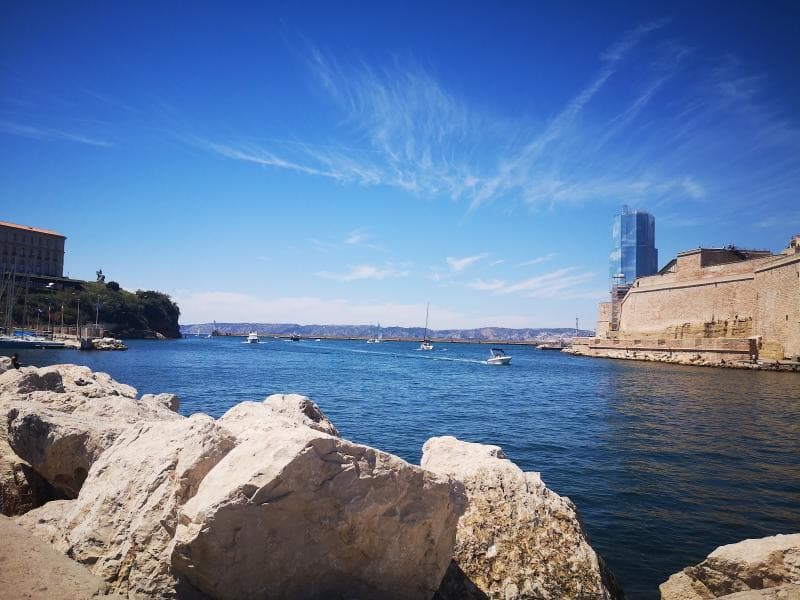
Explore Fort Saint-Jean in Marseille, France, an iconic fortress guarding the Old Port. Discover centuries of history, panoramic views, and its connection to MuCEM.
Overview
Fort Saint-Jean stands majestically at the entrance to Marseille's Old Port, a true emblem of the city's rich past and vibrant present. This iconic landmark, overlooking the Mediterranean Sea, offers visitors a unique blend of ancient history, breathtaking panoramas, and contemporary cultural experiences. Since 2013, it has been seamlessly integrated with the Museum of European and Mediterranean Civilisations (MuCEM) through elegant footbridges, inviting travelers to explore its storied ramparts and gardens. Entry to the outdoor areas of Fort Saint-Jean, including its ramparts and gardens, is free, allowing for accessible exploration of its historic grounds.
History & Cultural Background
The history of Fort Saint-Jean is deeply intertwined with that of Marseille, stretching back over millennia. Archaeological excavations on the site have even unearthed remains from the first Greek settlement in Marseille, dating back to the 6th century BC, testifying to the area's exceptional antiquity. Long before the current fortification, the strategic promontory was home to a commandery of the Knights Hospitaller of Saint John of Jerusalem, established from the 12th century onwards. This complex served as a crucial staging post for Crusaders en route to the Holy Land and included a church, a chapel, a hospital, and a commander's palace, completed in 1365. One of the oldest surviving structures on the site, the King René Tower, was added between 1447 and 1453 by King René, further fortifying the port's defenses.
The fort as it largely appears today began construction in 1660 under the orders of King Louis XIV. However, the primary motivation for its construction was not solely to protect Marseille from external threats. Following a period of unrest and rebellion against royal authority, Louis XIV ordered the building of Fort Saint-Jean and its counterpart, Fort Saint-Nicolas, to assert control over the city, with their cannons famously pointed inwards towards Marseille itself. This act underscored the king's determination to subdue the 'rebellious city'. Throughout its military life, the fort served various purposes, including as a prison during the tumultuous French Revolution, holding notable figures like Louis Philippe II, Duke of Orléans.
During World War II, Fort Saint-Jean suffered significant damage. Occupied by the German army, it was used as an ammunition depot. In August 1944, an accidental explosion destroyed a large portion of its historic buildings and ramparts. After decades of neglect, the fort was classified as a historic monument in 1964 and subsequently underwent extensive restoration between 1967 and 1971. Its grand transformation culminated in 2013 with its integration into the MuCEM, marking a new chapter as a cultural and public space.
What Makes It Special
Fort Saint-Jean's unique appeal lies in its remarkable blend of historical depth and modern accessibility. Its strategic location at the mouth of the Old Port offers unparalleled panoramic views of the bustling harbor, the azure Mediterranean Sea, the iconic Notre-Dame de la Garde Basilica, and the majestic Cathedral of La Major. The architectural juxtaposition of the ancient stone fortifications with the contemporary design of the MuCEM and the elegant footbridges connecting them creates a visually striking experience. These footbridges not only link the fort to the modern museum and the historic Le Panier district but also symbolize a bridge between Marseille's past and its present. Today, it functions as a vibrant cultural hub, hosting exhibitions, various cultural events, and featuring a serene Mediterranean garden known as the 'Garden of Migrations'.
Stories, Fun Facts & Local Details
The very name 'Fort Saint-Jean' honors its origins, deriving from the Knights Hospitaller of Saint John of Jerusalem who occupied the site for centuries before the fort's construction. A compelling detail from its past is Louis XIV's true intention behind its creation; his statement about the people of Marseille being 'extremely fond of nice fortresses' was a veiled jab, as the fort's cannons were pointed towards the city to quell any potential uprisings, rather than solely for external defense. For many years, during the French Army's presence, Fort Saint-Jean also served as a barracks and a clearing station for recruits destined for the French Foreign Legion in Algeria, making it a significant departure point for countless soldiers. Its contemporary role as a publicly accessible space, with free entry to many areas, allows everyone to reclaim and appreciate this historic monument, transforming a former military stronghold into a place of leisure and cultural exchange.
Visitor Perspective
Visiting Fort Saint-Jean offers a captivating journey through time and culture. Travelers can easily reach the fort on foot from the Vieux-Port, or by taking public transport like the metro to Joliette station, followed by a short walk. Once there, the experience is largely about exploration and immersion. Walking along the ancient ramparts provides an 'aerial tour' with magnificent views of Marseille and its surroundings, echoing the watchmen who once guarded these very walls. The integration with the MuCEM allows for a seamless transition between historical contemplation and modern exhibitions, offering a comprehensive understanding of Mediterranean civilisations. Beyond the permanent features, the fort frequently hosts guided tours, temporary exhibitions, and vibrant cultural events, ensuring there is always something new to discover for the curious traveler.
Coordinates: 5.362433, 43.295387
View on Google Maps💬 How Travelers Describe This Place
Based on community votes
Beautiful
963Unique
723Photogenic
482Must See
463Interesting
274
Traveler Stories
Discover memorable experiences shared by travelers who have visited this place.
No traveler stories yet.
Be the first traveler to share what made this place memorable.
Things to see at Fort Saint-Jean



Tour
By
Spot
Discover amazing places around the world. Your journey starts here.
Explore
© 2026 TourBySpot. All rights reserved.