Harbor Overlooks
Marseille, France
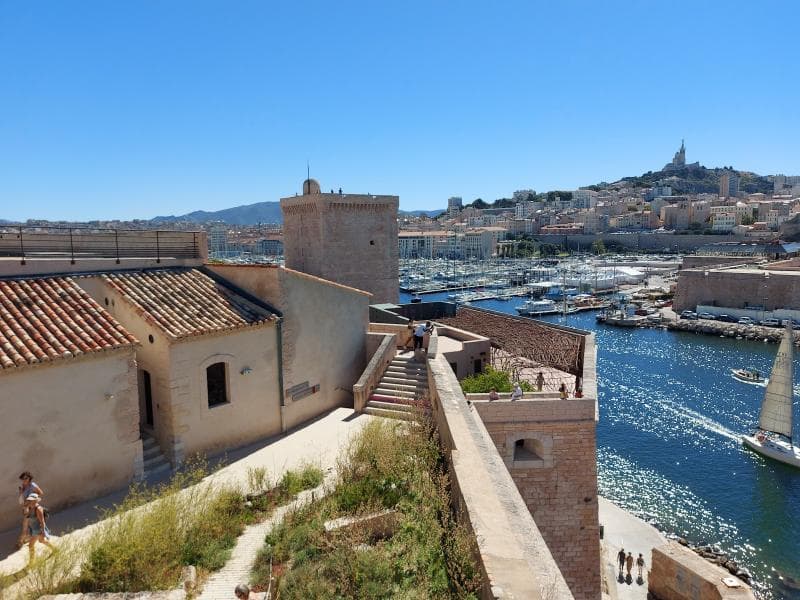
Discover the stunning Harbor Overlooks at Fort Saint-Jean in Marseille, France. Explore centuries of history and enjoy panoramic views of the Old Port and Mediterranean Sea.
Overview
Perched majestically at the entrance of Marseille's historic Old Port, the Harbor Overlooks of Fort Saint-Jean offer visitors an unparalleled vantage point to soak in the vibrant maritime life and stunning Mediterranean vistas. This ancient fortress, a pivotal landmark in the city's 2,600-year history, has been beautifully integrated with the Museum of European and Mediterranean Civilisations (MuCEM), making it a unique cultural and historical destination. The overlooks provide sweeping panoramic views of the bustling Vieux-Port, the iconic Notre-Dame de la Garde basilica standing guard on the horizon, the intricate cityscape, and the boundless azure of the Mediterranean Sea.
Today, the outdoor areas, ramparts, and gardens of Fort Saint-Jean are freely accessible, inviting curious travelers to explore its ancient stones and discover the stories etched into its walls. It serves as a bridge, both literally and metaphorically, connecting Marseille's rich past with its dynamic present.
History & Cultural Background
The origins of Fort Saint-Jean trace back to the 12th century, long before its current formidable structure, when it was a commandery for the Knights Hospitaller of Saint John of Jerusalem. This strategic location served as a crucial staging post for Crusaders en route to the Holy Land.
Over centuries, its defenses evolved. King René of Provence ordered the construction of the imposing square tower, known today as King René's Tower, between 1447 and 1453 to bolster port protection after Marseille was taken by the Spanish. Later, in the mid-17th century, the distinctive round Tour du Fanal (Lantern Tower) was added by shipowners to serve as a watchtower, guiding ships up to 20 kilometers into the harbor.
The fort as we largely see it today was built between 1668 and 1671 under the command of Louis XIV, following a period of unrest in Marseille. Its purpose was dual: to protect the city from external threats and, importantly, to assert royal authority over the often rebellious city, with cannons capable of being turned inwards. After the French Revolution, it transitioned from a military post to a state prison. Tragically, during World War II, while serving as an ammunition depot for German forces, an accidental explosion severely damaged parts of the fort in 1944. Following extensive restoration, Fort Saint-Jean was integrated into MuCEM in 2013, reopening its doors to the public and transforming into a vibrant cultural hub.
What Makes It Special
What truly sets the Harbor Overlooks of Fort Saint-Jean apart is the seamless fusion of centuries of history with breathtaking natural beauty. As part of MuCEM, the fort is connected by elegant footbridges – one leading to the modern J4 building of the museum, and another extending into the historic Le Panier district. This architectural integration allows visitors to effortlessly traverse through time and space. From the fort's ramparts and towers, the vistas are simply mesmerizing. You can gaze upon the colorful boats bobbing in the Old Port, watch the ferries crisscrossing the harbor, and trace the outlines of Marseille's oldest neighborhoods.
The elevated position provides a unique perspective on the city's iconic landmarks, including the distant, shimmering Château d'If and the imposing presence of Notre-Dame de la Garde. The sheer expanse of the Mediterranean from this point is a constant reminder of Marseille's deep connection to the sea and its role as a historic gateway to Europe and the Mediterranean.
Stories, Fun Facts & Local Details
The very name Fort Saint-Jean echoes the ancient presence of the Knights Hospitaller, who established their commandery here. A fascinating detail from the fort's past involves King René's Tower. Built after the Spanish invaded Marseille in 1453 and even made off with the chain that once barred the Old Port entrance, this tower originally housed a dozen cannons on its terrace, poised to defend the city.
Another intriguing aspect is King Louis XIV's strategic decision to build Fort Saint-Jean and its counterpart, Fort Saint-Nicolas, on opposite sides of the harbor entrance. His declaration, 'We noticed that the inhabitants of Marseille were extremely fond of nice fortresses. We wanted to have our own at the entrance to this great port,' was a thinly veiled warning, signifying his intent to control, rather than merely protect, the city. Today, exploring the fort means taking an 'aerial tour' along the *Chemin de ronde*, the patrol path atop the ramparts, just as soldiers once did, offering an immersive historical experience alongside the views.
Visitor Perspective
Visiting the Harbor Overlooks of Fort Saint-Jean is an enriching experience that satisfies both the history enthusiast and the seeker of scenic beauty. As you wander through the fort's restored grounds, you're walking through centuries of military and maritime history, yet simultaneously experiencing a vibrant modern cultural space. The free access to the outdoor areas means you can spend as much time as you like simply taking in the breathtaking views, identifying landmarks, or watching the rhythm of the port below.
It's a perfect spot for capturing memorable photographs, enjoying a moment of tranquility amidst the city's hustle, or simply reflecting on the layers of history that have shaped Marseille. The connection to MuCEM also provides an opportunity to easily combine your exploration of the fort with a deeper dive into Mediterranean cultures. It's truly an unmissable stop for anyone wanting to feel the pulse of Marseille and appreciate its enduring relationship with the sea.
Coordinates: 5.3619, 43.2953
View on Google Maps💬 How Travelers Describe This Place
Based on community votes
Beautiful
540Must See
410Interesting
147Unique
114Photogenic
19
Traveler Stories
Discover memorable experiences shared by travelers who have visited this place.
No traveler stories yet.
Be the first traveler to share what made this place memorable.

Tour
By
Spot
Discover amazing places around the world. Your journey starts here.
Explore
© 2026 TourBySpot. All rights reserved.