English Garden
Munich, Germany
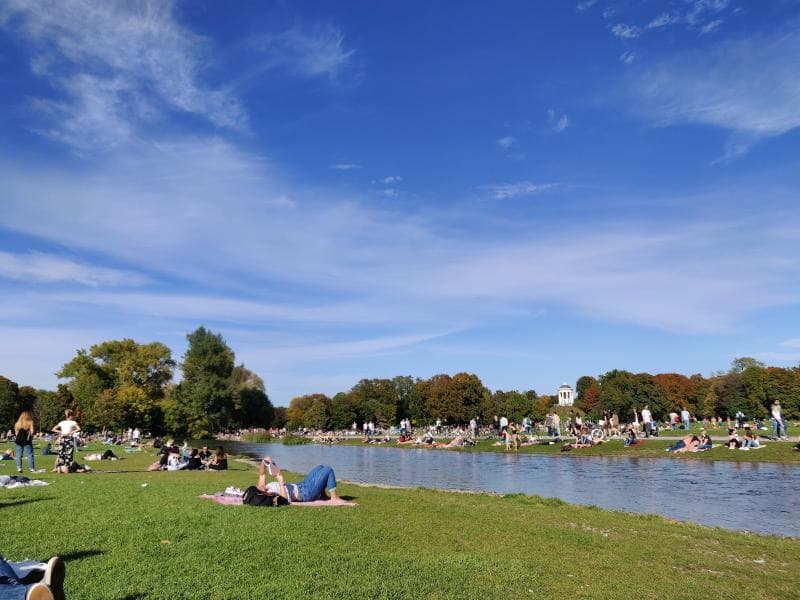
Explore Munich's English Garden (Englischer Garten), one of the world's largest urban parks. Discover history, surfing, beer gardens, and scenic beauty.
Overview
The English Garden, known locally as the Englischer Garten, is a vast urban oasis nestled in the heart of Munich, Germany. Stretching over 5.5 kilometers from the city center to its northeastern limits, it is one of the world's largest urban public parks, significantly larger than New York's Central Park. Covering an impressive area of approximately 370 to 376 hectares, this expansive green space offers residents and visitors a diverse landscape of meadows, forests, and waterways. The park is freely accessible year-round, inviting exploration of its extensive network of paths, which spans around 78 kilometers, including 12 kilometers dedicated to horseback riding. The Englischer Garten is thoughtfully divided into two main sections by the busy Isarring: a more vibrant, attraction-rich southern part and a tranquil, less-frequented northern area, known as the Hirschau.
History & Cultural Background
The creation of the English Garden began in 1789, under the patronage of Prince Charles Theodore, the Elector of Bavaria. The initial vision was overseen by Sir Benjamin Thompson, an American physicist and inventor who later became Count Rumford and Bavaria's war minister. Initially conceived as a military garden to provide soldiers with agricultural training, the concept quickly evolved into a public park. The timing, coinciding with the French Revolution, was strategic; some historians suggest it was also an effort by the Elector, who was not particularly popular, to appease the citizens of Munich. By 1792, the park was officially opened to the city's inhabitants.
The park earned its name, 'English Garden,' because its design emulated the informal, naturalistic style of English landscape gardens, a stark contrast to the geometrically rigid French Baroque gardens prevalent at the time. Royal gardener Friedrich Ludwig von Sckell, who had studied landscape architecture in England, played a crucial role in developing and refining the park's characteristic appearance, emphasizing rolling hills, natural-looking bodies of water, and picturesque plantings that give it a deliberately 'untamed' feel, much loved by locals.
What Makes It Special
The English Garden is renowned for its unique blend of natural beauty and distinctive landmarks. Perhaps its most iconic feature is the Eisbachwelle, a standing river wave at the park's southern edge where surfers, often drawing large crowds, ride the perpetual wave year-round—a remarkable sight in the middle of a major city. Perched atop a small hill, the elegant Monopteros, a Greek-style circular temple, offers breathtaking panoramic views of the park's sprawling greenery and Munich's skyline.
Another prominent landmark is the 25-meter-high Chinese Tower, a wooden pagoda surrounded by one of Munich's largest and most famous beer gardens. The original tower, destroyed during World War II, was faithfully reconstructed in 1952. On a tranquil island at the southern end of the park, the Japanese Teahouse, built for the 1972 Summer Olympics, hosts traditional tea ceremonies, offering a serene cultural experience. Visitors can also enjoy the scenic Kleinhesseloher See, a charming lake where rowing boats can be rented, and the lakeside Seehaus beer garden provides a picturesque spot for relaxation.
Stories, Fun Facts & Local Details
The sheer scale of the English Garden is often a point of pride, with its size frequently compared to, and exceeding, that of New York's Central Park. The Eisbach surfers embody a quintessential Munich eccentricity, turning an urban river into a unique sports arena. Cultural events like the traditional Kocherlball and a festive Christmas market are held annually at the Chinese Tower, reflecting local traditions. Near the Chinese Tower, a historic children's carousel in Biedermeier style continues to delight younger visitors. In the quieter northern reaches of the park, particularly in the Hirschau area, it's not uncommon to spot flocks of sheep grazing, maintaining the natural meadows. This blend of planned naturalism and spontaneous charm contributes to the park's beloved character among Münchners. Famously, the Schönfeldwiese meadow has been a designated area for nude sunbathing since the 1960s, adding to the park's liberal and open atmosphere.
Visitor Perspective
For any traveler exploring Munich, the English Garden offers an unparalleled opportunity for relaxation, recreation, and cultural immersion. It's a vibrant space where one can spend hours jogging, cycling along the extensive paths, horseback riding, or even sledding down hills in winter. Picnics on the vast lawns are a popular pastime, and boat rentals on the Kleinhesseloher See provide a serene escape. The park serves as a vital green lung for the city, providing a peaceful retreat from urban life without ever truly leaving it. Navigating the English Garden is convenient, with several U-Bahn, tram, and bus stops located nearby, making it easily accessible from all parts of Munich. While the southern part bustles with its iconic attractions and lively beer gardens, the northern section offers a more tranquil experience, perfect for those seeking solitude and a deeper connection with nature. Whether you seek activity or repose, the English Garden provides a rich and authentic Munich experience.
Coordinates: 11.5912, 48.1563
View on Google Maps💬 How Travelers Describe This Place
Based on community votes
Interesting
989Unique
613Photogenic
581Must See
514Beautiful
207
Traveler Stories
Discover memorable experiences shared by travelers who have visited this place.
No traveler stories yet.
Be the first traveler to share what made this place memorable.
Things to see at English Garden



Tour
By
Spot
Discover amazing places around the world. Your journey starts here.
Explore
© 2026 TourBySpot. All rights reserved.