Chora Church
Istanbul, Turkey
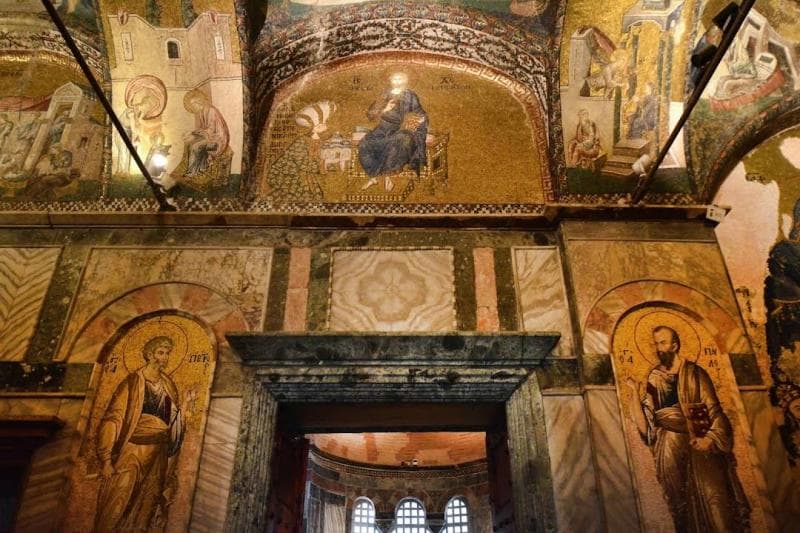
Explore Chora Church (Kariye Mosque) in Istanbul, Turkey, home to the best-preserved 14th-century Byzantine mosaics and frescoes. Discover its rich history and stunning art.
Overview
Nestled within the historic Fatih district of Istanbul, Turkey, the Chora Church, now known as the Kariye Mosque (Kariye Camii), stands as a breathtaking testament to Byzantine art and architecture. Once a prominent Byzantine monastery church, this sacred site has journeyed through various roles, from an imperial church to an Ottoman mosque, a secular museum, and most recently, re-established as a mosque. It is universally celebrated for its incredibly well-preserved 14th-century mosaics and frescoes, considered among the finest examples of Late Byzantine art in existence, offering a vivid narrative of Christian theology and history.
History & Cultural Background
The origins of the Chora Church trace back to the early 4th century, when it was initially constructed as part of a monastery complex situated 'in the country' (Chora in Greek), outside the city walls of Constantinople. Despite the expansion of the city walls in the 5th century, which brought the church within Constantinople's defenses, it retained its evocative name.
Over centuries, the structure underwent multiple rebuilds and restorations. A significant phase occurred in the 11th century, led by Maria Doukaina, mother-in-law of Emperor Alexios I Komnenos, and later by her grandson Isaac Komnenos. However, the church as we largely see it today dates primarily from its extensive reconstruction and artistic embellishment between 1316 and 1321. This monumental undertaking was commissioned by Theodore Metochites, a wealthy scholar, statesman, and the Grand Logothete (chief minister) of Emperor Andronikos II Palaiologos.
Following the Ottoman conquest of Constantinople in 1453, the Chora Church continued to function as a church for a period. In the early 16th century, around 1511, it was converted into a mosque by Grand Vizier Atik Ali Paşa under Sultan Bayezid II, becoming the Kariye Camii. In keeping with Islamic practice, its revered mosaics and frescoes were carefully covered with plaster rather than destroyed, a fortunate act that inadvertently preserved them for centuries. After the establishment of the Turkish Republic, the building was secularized and reopened as the Kariye Museum in 1958, following a meticulous restoration project begun in 1948 by the Byzantine Institute of America and Dumbarton Oaks, which uncovered its stunning artwork. In a more recent development, in 2020, the Chora Church was officially re-designated as a mosque and, after a four-year restoration, reopened for worship and visitors in May 2024.
What Makes It Special
What truly sets the Chora Church apart is its extraordinary collection of mosaics and frescoes, hailed as the finest and most comprehensive examples of Late Byzantine art. These artworks, often referred to as a 'Masterpiece of the Palaiologan Renaissance,' depict intricate narrative cycles from the lives of Christ and the Virgin Mary, along with portraits of saints and theological scenes.
The interior is divided into three main sections: the Naos (main church), the Inner and Outer Narthexes (entrance halls), and the Parekklesion (a side funerary chapel). Each area contributes to the grand visual narrative. In the Outer Narthex, mosaics illustrate the Cycle of the Infancy of Christ and His miracles. The Inner Narthex focuses on the life of the Virgin Mary and the genealogy of Christ. Perhaps the most emotionally resonant artworks are found in the Parekklesion, adorned with frescoes depicting themes of death, resurrection, and judgment, including the monumental Anastasis (Resurrection) fresco, where Christ is shown raising Adam and Eve from their tombs. The depth, vibrant colors, and expressive figures of these artworks were remarkably advanced for their time, foreshadowing the realism of the Renaissance. The Chora Church is also recognized as a UNESCO World Heritage site, underscoring its immense cultural value.
Stories, Fun Facts & Local Details
The name 'Chora' carries a fascinating dual meaning. While literally signifying 'in the country' or 'land,' referencing its original location outside the city walls, it also holds a mystical interpretation. Mosaics within the church depict Christ as the 'Land of the Living' and the Virgin Mary as the 'Container of the Uncontainable,' a profound theological play on the church's name, symbolizing the paradox of Mary holding the divine within her womb.
An interesting historical detail is that the covering of the mosaics with plaster during its time as a mosque was crucial for their survival, protecting them from degradation and the elements. This 'hidden' period allowed for their near-perfect preservation, a historical irony that visitors can appreciate today. Theodore Metochites, the patron behind the 14th-century renovations, was not only a powerful statesman but also a renowned scholar. His dedication to the monastery was so strong that he intended to be buried within its walls, and his portrait offering a model of the church to Christ is prominently displayed above the entrance to the nave. The Chora Church is often fondly nicknamed the 'Sistine Chapel of the East' due to the overwhelming beauty and narrative scope of its interior decorations, providing a unique cultural experience that bridges Byzantine and Islamic heritage.
Visitor Perspective
As of May 2024, the Chora Church (Kariye Camii) has reopened its doors as a working mosque, welcoming visitors to admire its artistic treasures. For foreign visitors, an entrance fee of 20€ applies. While the mosaics in the main prayer hall (Naos) may be covered by retractable curtains during the five daily prayer times, the most famous narrative mosaics in the outer and inner narthexes, as well as the breathtaking Anastasis fresco in the Parekklesion, remain uncovered and fully accessible.
It is advisable to visit early in the morning, between 9:00 AM and 10:00 AM, to avoid crowds and potential prayer intervals. Visitors are encouraged to dress modestly, showing respect for the sacred nature of the site. Photography is generally permitted without flash, but discretion should be exercised, particularly during prayer times, to maintain a respectful atmosphere.
Coordinates: 28.9391, 41.0312
View on Google Maps💬 How Travelers Describe This Place
Based on community votes
Interesting
910Unique
755Photogenic
374Must See
183Beautiful
28
Traveler Stories
Discover memorable experiences shared by travelers who have visited this place.
No traveler stories yet.
Be the first traveler to share what made this place memorable.
Things to see at Chora Church



Tour
By
Spot
Discover amazing places around the world. Your journey starts here.
Explore
© 2026 TourBySpot. All rights reserved.