Chain Bridge
Budapest, Hungary
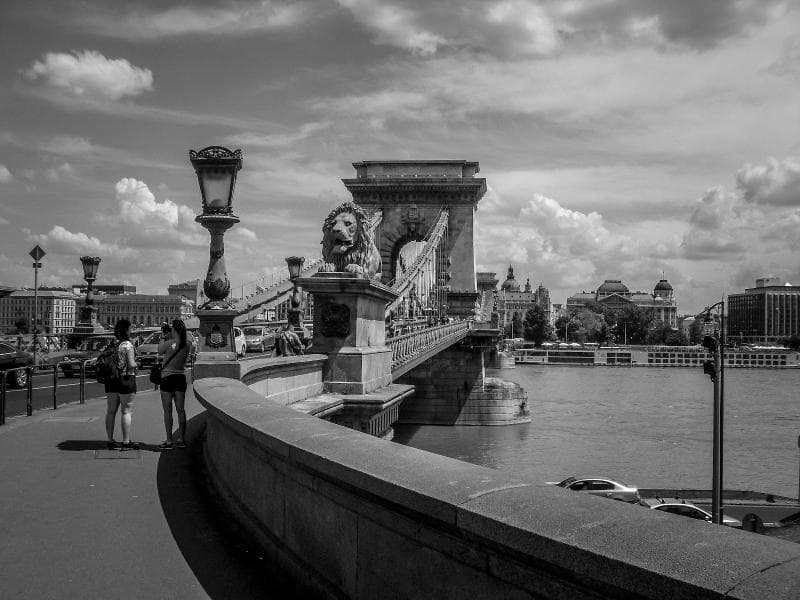
Explore Budapest's iconic Chain Bridge, Hungary's first permanent Danube crossing. Discover its rich history, lion legends, and stunning views connecting Buda and Pest. An essential Hungarian landmark.
Overview
The Széchenyi Chain Bridge, affectionately known as the Chain Bridge or 'Lánchíd' in Hungarian, stands as an enduring symbol of Budapest, Hungary. This magnificent suspension bridge gracefully spans the Danube River, serving as a vital link between the historic cities of Buda on the west bank and Pest on the east. Inaugurated in 1849, it was not only the first permanent bridge to cross the Danube in Hungary but also a monumental engineering achievement of its era. Stretching approximately 375 to 380 meters long with a central span of 202 meters, it was considered one of the largest bridges in the world at the time of its completion. Its strategic location connects key areas of the city, from Széchenyi Square on the Pest side, adjacent to the Hungarian Academy of Sciences, to Adam Clark Square in Buda, leading directly to the Castle Hill Funicular and Buda Castle. After extensive renovations, the Chain Bridge proudly reopened to pedestrians in 2023, once again inviting visitors to traverse its historic span and take in the breathtaking panoramic views of Budapest's UNESCO World Heritage skyline.
History & Cultural Background
The genesis of the Chain Bridge dates back to a personal hardship faced by Count István Széchenyi, often hailed as 'the greatest Hungarian'. In 1820, Széchenyi was prevented from attending his father's funeral in Vienna because the winter ice made crossing the Danube impossible by ferry. This frustration ignited his resolve to fund and advocate for a permanent bridge connecting Buda and Pest. His vision was not merely about practical transport but also about fostering national unity and progress in a fragmented society.
The bridge's design was entrusted to English engineer William Tierney Clark in 1839, known for his work on the Marlow Bridge over the River Thames. Construction commenced around 1839-1840, with Scottish engineer Adam Clark (no relation to William Tierney Clark) overseeing the challenging on-site build. The project was financed by several individuals, including the Greek merchant Georgios Sinas. Despite the turbulent backdrop of the Hungarian Revolution of 1848, the bridge was completed and officially opened on November 20, 1849. Initially, it symbolized a radical social change, as tolls were levied on all who crossed, including the nobility, a stark departure from their traditional exemptions and a step towards 'burden sharing'.
The bridge faced a tragic fate during World War II when retreating German troops blew it up on January 18, 1945, leaving only its stone towers intact. However, embodying the resilience of Budapest, the Chain Bridge was meticulously rebuilt to its original design and dramatically reopened in 1949, precisely 100 years after its first inauguration. This reconstruction reinforced its status as a symbol of survival and rebirth for the city.
What Makes It Special
Beyond its historical significance as Hungary's first permanent Danube crossing, the Chain Bridge is a masterpiece of 19th-century engineering and a powerful cultural icon. Its unique chain suspension design, characterized by two grand classical-style stone towers, was a marvel of the modern world. The bridge's architectural details, including the impressive lion statues guarding each end, add to its majestic presence. These lions, carved by sculptor János Marschalkó in 1852, have become instantly recognizable emblems of Budapest.
The Chain Bridge serves as a crucial artery, connecting Budapest's most celebrated landmarks. On the Pest side, it leads to Széchenyi Square, home to the opulent Gresham Palace and the Hungarian Academy of Sciences. On the Buda side, it terminates at Adam Clark Square, a gateway to the Buda Castle district via the funicular and the Zero Kilometre Stone. The bridge's role in linking these disparate urban halves has made it a focal point for the city's economic, social, and cultural development, contributing immensely to Budapest's transformation into a vibrant metropolis. Its illuminated form at night, alongside the lit-up Parliament and Buda Castle, creates one of the most iconic and breathtaking nightscapes in Europe.
Stories, Fun Facts & Local Details
The Chain Bridge is steeped in local lore and fascinating anecdotes. Perhaps the most famous is the legend surrounding the majestic lion statues. A popular myth suggests that their sculptor, János Marschalkó, was so shamed by ridicule for forgetting to carve their tongues that he jumped into the Danube. However, this is merely an urban legend; the lions do indeed possess tongues, though they are not visible from ground level, and Marschalkó lived for many decades after the bridge's completion.
Another whimsical local joke playfully suggests that if it rains, the Chain Bridge can be pushed into the Castle Hill Tunnel, as the two structures are almost perfectly aligned and similar in length. On the Pest side, a plaque serves as a tribute to William Tierney Clark, commemorating the only two of his bridges to survive World War II: the Chain Bridge itself and the Marlow Bridge in England. The bridge's official name, Széchenyi Lánchíd, honors its initial proponent, Count István Széchenyi, yet it is most commonly known by its descriptive title, the Chain Bridge, or 'Lánchíd'.
Visitor Perspective
Today, the Chain Bridge offers an unparalleled experience for any visitor to Budapest. Following its significant renovation, which concluded in 2023, the bridge is fully accessible to pedestrians 24/7 and completely free to cross. While the walk across its 375-meter length can take just 5 to 10 minutes, most travelers choose to linger, absorbing the spectacular 360-degree views. From its midpoint, one can admire the majestic Hungarian Parliament Building on the Pest side and the historic Buda Castle perched atop its hill.
The Chain Bridge is a photographer's dream, especially during the golden hours of sunrise or sunset, and particularly captivating at night when its intricate structure is bathed in warm, golden light. It serves as an ideal starting point for exploring many of Budapest's central attractions due to its central location and excellent connectivity via public transport. Walking across this iconic landmark not only provides stunning visuals but also a tangible connection to the city's rich past, making it an essential and deeply rewarding part of any Budapest itinerary.
Coordinates: 19.04361, 47.49889
View on Google Maps💬 How Travelers Describe This Place
Based on community votes
Must See
717Photogenic
618Interesting
449Beautiful
335Unique
22
Traveler Stories
Discover memorable experiences shared by travelers who have visited this place.
No traveler stories yet.
Be the first traveler to share what made this place memorable.
Things to see at Chain Bridge



Tour
By
Spot
Discover amazing places around the world. Your journey starts here.
Explore
© 2026 TourBySpot. All rights reserved.